
Table of Contents >> Show >> Hide
- What Was the REX PC Companion?
- Why “Digital Rolodex” Is the Better Description
- The 1990s PDA World: Bigger, Smarter, and More Complicated
- What REX Did Well
- What REX Got Wrong
- REX, Starfish, Franklin, and the Sync Revolution
- Why REX Still Feels Smart Today
- Experiences and Reflections: Living With a Digital Rolodex Mindset
- Conclusion: The Tiny Organizer That Understood the Assignment
Before smartphones swallowed our calendars, contacts, alarms, notes, maps, cameras, wallets, and possibly our attention spans, there was a strange little slab called the REX PC Companion. It was thin enough to disappear into a shirt pocket, shaped like a PC Card, and marketed in the late 1990s as a tiny personal organizer. People often called it a PDA, but that label never quite fit. The REX was not trying to be a pocket computer in the same way the PalmPilot, Apple Newton, or Windows CE handhelds were. It was something more focused, more modest, and in some ways more elegant: the first great digital Rolodex.
That distinction matters. A PDA wanted to replace paper planners, calculators, notepads, and sometimes even tiny laptops. The REX wanted to do something simpler: carry the important information already stored on your computer and make it available anywhere. It was not a miniature office. It was your address book, appointment list, memo pad, and reminder system flattened into a credit-card-sized companion. In today’s language, it was less “mobile productivity platform” and more “offline synced personal database.” That sounds less glamorous, but in practice it made the REX one of the smartest ideas of its era.
What Was the REX PC Companion?
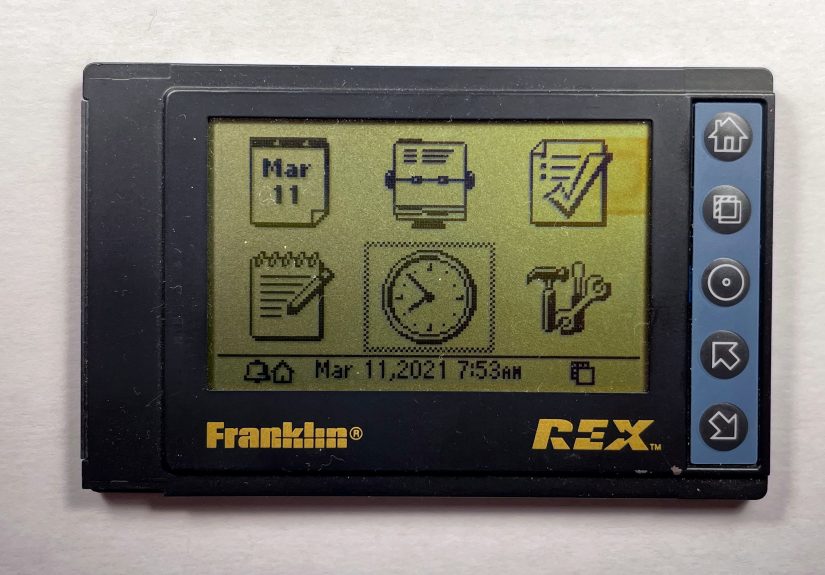
The REX PC Companion was a tiny electronic organizer sold under the Rolodex and Franklin Electronic Publishers family of products in the late 1990s. Its most famous versions, including the REX-1 and REX-3, looked like a Type II PC Card with a small LCD screen and a column of physical buttons. You could slide it into a laptop’s PC Card slot, synchronize it with desktop organizer software, then pull it out and carry it like a business card from the future.
At roughly 3.375 inches by 2.125 inches and about one-eighth of an inch thick, the REX felt almost absurdly small compared with the chunky handheld devices of the time. It weighed about 1.4 ounces, ran on button-cell batteries, and displayed information on a black-and-white LCD screen. The screen was not luxurious, and nobody was watching movie trailers on it unless they had an unusually exciting relationship with text. But it did the job: contacts, calendar entries, to-do lists, memos, clocks, and alarms.
Not a Pocket Computer, a Pocket Reference
The original REX models had little to no practical on-device data entry. That single design choice is the reason it should not be remembered primarily as a PDA. A classic PDA invited you to tap, write, scribble, search, edit, and manage your life directly on the device. The REX expected your computer to do the heavy lifting. You entered names, addresses, appointments, and notes on a PC, synchronized them through Starfish Software’s TrueSync system, and used the REX mostly as a read-only reference once you left your desk.
That may sound limiting, but it was also the genius of the product. Typing long notes on tiny handhelds in the 1990s was rarely enjoyable. Handwriting recognition could be clever, but it also required patience and a willingness to relearn the alphabet like a cybernetic kindergartner. The REX skipped the drama. It admitted the obvious: your full-size keyboard was better for data entry, and your pocket device was better for quick lookup.
Why “Digital Rolodex” Is the Better Description
The Rolodex brand was already associated with rotating desktop card files, the old-school business tool that stored names, phone numbers, addresses, and professional connections. The REX translated that concept into electronic form. Instead of flipping through cards, you scrolled through contacts. Instead of carrying a paper address book, you carried a synced slice of your personal information manager. It was not about computing power; it was about information access.
That is why calling REX a digital Rolodex is not an insult. It is the most accurate compliment. It captured the best part of the Rolodex idea: fast access to trusted personal data. But it made that data portable, searchable, updateable, and synchronized with the machine where most business users were already organizing their lives.
The Power Was in Synchronization
The heart of REX was not the screen, processor, or buttons. The real magic was synchronization. Starfish Software’s TrueSync technology allowed information from popular personal information managers to move onto the device. In the late 1990s, that was a big deal. People used Microsoft Outlook, Schedule+, Lotus Organizer, ACT!, Sidekick, and other desktop tools. The REX positioned itself as a companion to that ecosystem rather than a rival to it.
This is where REX quietly anticipated the future. Modern smartphones are valuable partly because they synchronize constantly with cloud accounts, calendars, contacts, reminders, and email. REX did not have wireless data, app stores, or cloud backup, but its core idea was familiar: your information should follow you. It was not enough for data to live on one computer. It needed to travel, stay organized, and remain consistent across devices.
The 1990s PDA World: Bigger, Smarter, and More Complicated
To understand why REX felt so fresh, remember the handheld market around it. The Apple Newton MessagePad had already introduced many people to the dream of pen-based personal computing, though it also became famous for the difficulty of making handwriting recognition feel truly effortless. Palm devices, especially the PalmPilot line, succeeded by being smaller, faster, and more practical. Windows CE devices tried to shrink the PC experience into handheld form, complete with tiny keyboards and miniature operating-system ambition.
Compared with those devices, the REX seemed almost stubbornly minimal. It did not pretend to be a notebook computer. It did not want to run a universe of applications. It did not ask users to learn a new writing system. It focused on one thing: carrying useful personal data in the smallest practical form. If the PalmPilot was a brilliant pocket notebook, the REX was a brilliant pocket index card file.
Smallness Was the Feature
Today, every product claims to be “ultra portable,” even if it still requires a backpack, a charger, two dongles, and emotional support. The REX was genuinely portable. Its credit-card-like shape meant it could ride in a wallet, shirt pocket, briefcase sleeve, or laptop bag without making itself known. Reviewers at the time described it as an “unconscious carry,” which is still one of the best phrases for a device that becomes useful precisely because you do not have to think about carrying it.
That smallness changed the emotional relationship users had with the device. A larger PDA was something you decided to bring. The REX was something you simply had. That difference is not trivial. The best organizer is not the one with the most features; it is the one that is with you when you need the phone number, meeting time, hotel address, or note you forgot you were supposed to remember.
What REX Did Well
The REX excelled at fast reference. It was ideal for business travelers, salespeople, consultants, managers, students, and anyone who lived inside a desktop calendar but needed that information away from the desk. You could carry hundreds or thousands of entries depending on the model, including contacts, appointments, to-dos, notes, and small text files. For a person who mostly needed to look things up, that was enough.
Its battery life was another advantage. Because it had no color screen, no wireless radio, no demanding processor, and no power-hungry operating system, it could run for months on small batteries. There is something charming about a gadget that did not need to be fed electricity every night like a digital house pet.
It Respected the PC Instead of Fighting It
Many handheld products of the 1990s tried to convince users that the future would happen entirely on the device. REX took a more realistic approach. It understood that the desktop computer was still the central hub for serious data entry and organization. Rather than forcing users to duplicate work, it connected to the software they already used. That made it especially attractive to people who had no interest in managing two separate address books or typing appointment notes on a microscopic interface.
In this way, REX was closer to a peripheral than a computer. But that was not a weakness. Printers, scanners, external drives, and modems were all valuable because they extended the PC. REX extended the PC into your pocket. It was a personal information satellite orbiting the desktop mothership.
What REX Got Wrong
Of course, the REX was not perfect. Its limited input was both a feature and a frustration. If you met someone at a conference and wanted to add a new contact immediately, the original REX was not the friendliest tool. Later models improved on-device entry, but the basic experience still favored synchronization over spontaneous editing.
The screen, while clear for its size, was small and not backlit on early units. That made it less pleasant in dim restaurants, airplane cabins, or hotel rooms where the lighting seemed designed by someone with a personal grudge against business travelers. The physical buttons required patience, and navigating through longer lists could feel slow compared with a touchscreen device.
The Market Moved Faster Than the Idea
REX also faced a brutal reality: the PDA market was evolving quickly. Palm devices became more capable and more popular. Mobile phones began absorbing organizer features. Synchronization became less of a specialty and more of an expectation. By the time later REX models added more input options or touchscreen features, the market was already racing toward integrated smartphones and wireless communication.
Still, the REX deserves credit for understanding something many bigger devices missed. Users did not always want a tiny computer. Sometimes they wanted their information in the least annoying form possible. That remains a surprisingly modern product insight.
REX, Starfish, Franklin, and the Sync Revolution
The story of REX is also a story about companies trying to solve personal information chaos. Franklin Electronic Publishers had deep experience with handheld electronic reference products, including dictionaries and organizers. Rolodex brought a familiar productivity brand. Citizen contributed manufacturing expertise. Starfish Software, led by Philippe Kahn, provided the synchronization brain that made the whole concept useful.
TrueSync was more than a utility bundled in a box. It represented a major shift in thinking. Instead of treating each device as an island, it treated personal data as something that should move across platforms. Motorola’s later acquisition of Starfish showed how important that idea had become. The industry was waking up to the fact that mobile devices were only as useful as their ability to stay connected to the rest of a user’s digital life.
The Forgotten Ancestor of Modern Contact Sync
When you add a contact on your phone today and see it appear on your laptop, tablet, and webmail account, you are living in the world that products like REX helped imagine. REX did not make synchronization invisible, and it certainly did not make it wireless in the modern sense, but it made the value obvious. Your calendar should not be trapped. Your address book should not be stuck. Your reminders should not live in one plastic box on one desk.
That is why the REX feels more important in hindsight than its sales numbers alone might suggest. It was part of the long road from desktop-bound information to always-available personal data. It was a bridge device, and bridge devices often look strange after the world has crossed them. But without bridges, everyone just stands on one side of the river pretending swimming is easy.
Why REX Still Feels Smart Today
The REX PC Companion looks primitive beside a smartphone, but its design philosophy still feels refreshing. It did not chase every feature. It did not confuse complexity with capability. It knew its job and performed it with impressive discipline. In an era when gadgets often tried to become everything, REX became one very useful thing.
Modern technology could learn from that. Many people now crave simpler digital tools: focused e-ink notebooks, distraction-free writing devices, minimalist phones, and single-purpose productivity apps. REX fits naturally into that conversation. It was a minimalist information appliance before minimalism became a premium lifestyle category with tasteful beige packaging.
A Device Built Around Real Behavior
The smartest part of REX was that it matched how many people actually worked. They planned on a desktop computer. They typed on a real keyboard. They needed to check information while moving through airports, offices, meetings, and hotel lobbies. They did not necessarily want to compose essays, run spreadsheets, or play games on a tiny screen. They wanted to know who to call, where to go, what time to arrive, and what note they had made earlier.
That is a humble use case, but humility can be powerful in design. Products fail when they ask users to change too much too quickly. REX asked for a smaller change: keep organizing your life on the PC, then carry a synced copy in your pocket. For many users, that was exactly enough.
Experiences and Reflections: Living With a Digital Rolodex Mindset
Using a device like the REX, or even imagining daily life with one, highlights a different rhythm of technology. Today we expect every device to be alive, connected, buzzing, updating, and occasionally yelling at us about terms of service. The REX belonged to a quieter world. You synchronized it, carried it, and consulted it when necessary. It did not compete for attention. It waited.
That waiting quality is easy to underestimate. A digital Rolodex is not meant to entertain you. It is meant to rescue you from small professional disasters. Imagine walking into a client meeting in 1998. Your laptop is in your bag, your paper notes are somewhere between “probably in the folder” and “oops,” and someone asks for the phone number of a supplier. Pulling out a REX and finding the entry quickly would feel like a magic trick. Not flashy magic with smoke and doves, but practical magicthe kind that saves face.
There is also something psychologically satisfying about carrying only the information you need. The REX did not bring the entire internet. It brought your internet, before the internet became the default container for everything. Your contacts, your appointments, your memos, your tasks: a curated pocket copy of your working life. That limitation created confidence. You were not searching an endless feed; you were checking a trusted list.
The experience also encouraged better organization at the source. Because REX depended on PC synchronization, the quality of the pocket device reflected the quality of your desktop data. If your contacts were messy, your REX was messy. If your calendar was disciplined, your REX became a dependable guide. In that sense, it rewarded good information hygiene. It was a tiny mirror held up to your personal database, and sometimes the mirror politely said, “You have three people named Bob with no last names. Good luck, champion.”
Compared with a paper Rolodex, the REX offered portability and updating. Compared with a full PDA, it offered simplicity and size. Compared with a modern smartphone, it offered calm. That may be its most interesting legacy. It reminds us that progress is not always about adding more. Sometimes progress means removing friction from one important task. The REX made personal information easier to carry, and it did so without pretending to replace every tool on your desk.
For collectors and retro-computing fans, the REX remains fascinating because it sits at a crossroads. It belongs to the age of PCMCIA cards, Windows 95 productivity software, button-cell batteries, and desktop PIMs. Yet its central promise feels contemporary: your information should be portable and synchronized. The materials are vintage, but the idea is alive every time a phone contact syncs across devices or a calendar alert follows you from laptop to watch.
The best way to appreciate REX is not to judge it as a failed smartphone ancestor. That would be unfair, like criticizing a bicycle for not being a helicopter. The better question is whether it solved the problem it chose. As a PDA, it was limited. As a digital Rolodex, it was brilliant. It carried the right information, in a tiny format, with a synchronization model that pointed toward the future. That is more than enough to earn it a fond place in the history of mobile computing.
Conclusion: The Tiny Organizer That Understood the Assignment
Rex wasn’t really a PDA, and that is exactly why it deserves to be remembered. The REX PC Companion did not try to become a pocket-sized desktop computer. It did not overload users with features or force them into awkward data entry. Instead, it transformed the familiar Rolodex concept into a portable, synchronized, digital reference tool. It carried contacts, appointments, notes, and tasks in a form so small it felt almost impossible in the late 1990s.
Its legacy is not about raw computing power. It is about product focus. REX showed that mobile information did not have to mean mobile complexity. It anticipated the importance of synchronization, respected the role of the desktop PC, and made personal data genuinely portable. In a world now overflowing with multifunction devices, the REX still offers a sharp lesson: the best gadget is not always the one that does the most. Sometimes it is the one that does exactly what you need, then quietly slips back into your pocket.







 Close
Close