
Table of Contents >> Show >> Hide
- Meet John Dory Oyster Bar at the Ace Hotel
- First Impressions: Aquarium Chic on Broadway
- The Design Story: Roman and Williams at Their Playful Best
- On the Plate: Oysters, Pan Roasts, and Deep-Water Comfort Food
- The Vibe: High-Energy Oyster Bar With Ace Hotel Edge
- Why Remodelista Loved It: A Design Playbook in Oyster-Bar Form
- After Closing: What Remains of John Dory Oyster Bar
- Extended Experience: What It Felt Like to Dine at John Dory Oyster Bar
Some restaurants feel like they were designed for Instagram before Instagram existed.
John Dory Oyster Bar at the Ace Hotel in New York was one of those rare places:
part raw bar, part aquarium, part train station fever dream – and entirely unforgettable.
Even though the restaurant has since closed, its bold interior, buzzy vibe, and
seafood-heavy menu still live on in design blogs, travel guides, and a truly impressive
number of Pinterest boards.
For design lovers who devour Remodelista, John Dory Oyster Bar was a case study in
how to turn strong concept, clever materials, and a little bit of kitsch into a space
that felt both glamorous and approachable. It wasn’t just a place to slurp oysters;
it was a fully immersive New York experience inside the Ace Hotel’s already
creativity-soaked walls.
Meet John Dory Oyster Bar at the Ace Hotel
John Dory Oyster Bar sat on the corner of Broadway and West 29th Street, within the
Ace Hotel New York, a hot spot that helped turn this stretch of Midtown South into
a destination for travelers, creatives, and locals alike. The seafood restaurant was
the brainchild of chef April Bloomfield and restaurateur Ken Friedman, the same team
behind The Spotted Pig and The Breslin in the same hotel.
The John Dory concept wasn’t new – it was actually a reboot. The original John Dory
opened farther west in Chelsea and closed after a short run. The second iteration at
the Ace Hotel was smaller, more focused, and much better aligned with the neighborhood
and the hotel’s built-in crowd. From the moment the doors opened in 2010, it became
part of a mini “food triangle” with The Breslin and Stumptown Coffee, drawing hotel
guests, after-work groups, and design pilgrims who just wanted to see what the fuss
was about.
Over time, John Dory Oyster Bar also became known for its commitment to sustainable
seafood and its casual, sharable menu format. You could walk in solo and claim a
bar stool, or show up with friends and build a table full of oysters, crudo, and
clever bar snacks. Technically, it was an oyster bar. Emotionally, it was New York
in a nutshell: energetic, just a little chaotic, and undeniably memorable.
First Impressions: Aquarium Chic on Broadway
From the sidewalk, John Dory Oyster Bar looked like a vintage corner storefront that
had wandered into the 21st century and decided to stay. Huge industrial-style
windows framed the interior like a stage set. In daytime, sunlight streamed in and
bounced off glossy tile and marble; at night, the space glowed like a fish tank
filled with people instead of goldfish.
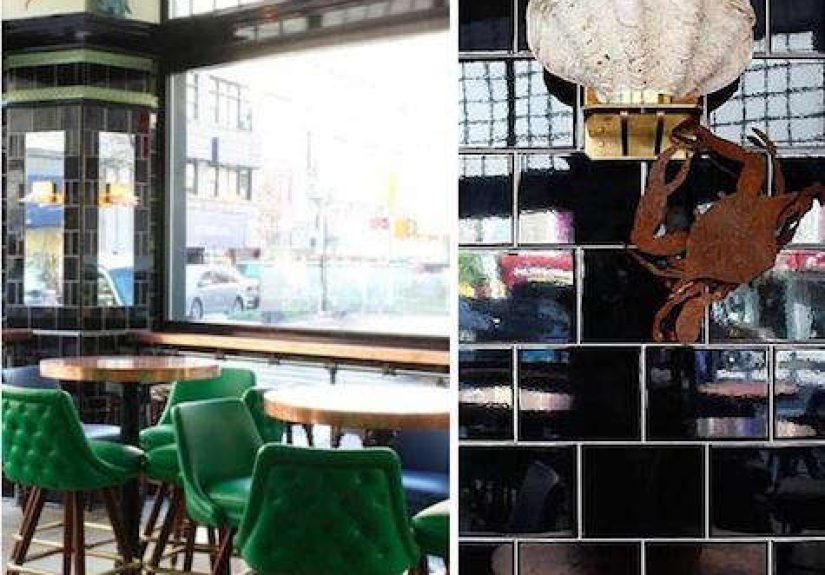
Inside, the most striking first impression was color. Oversized steel trusses overhead
were painted a sharp, acid green that cut across the ceiling like a graphic underline.
Against that, the walls and columns were wrapped in deep, shiny black tile banded with
narrow green stripes. It was a clever inversion of the classic white subway tile with
dark grout: here, dark tile and light grout created a moody, aquatic shimmer.
The “aquarium chic” vibe continued with sculptural shell sconces and mounted sea
creatures on the walls. Fish, crabs, and other nautical curios hung like trophies –
but the effect was more playful than serious, more seaside boardwalk than stuffy
yacht club. The central raw bar, mounded with ice, lemons, and glistening seafood,
glowed beneath pendant lights and made the whole room feel like the world’s most
glamorous fish market.
The seating sealed the deal: tufted bar stools in bright blue and green, perched
around marble-topped counters and slender round tables. The mix of color, shine, and
texture gave the space the feeling of a vintage postcard that had been digitally
remastered – nostalgic, but very much alive.
The Design Story: Roman and Williams at Their Playful Best
Behind all that visual drama was Roman and Williams, the New York design duo known for
layered, narrative-rich spaces. They also designed the rest of the Ace Hotel New York,
so John Dory Oyster Bar reads like one of their most extroverted chapters in the
building’s story.
Their signature mix of high and low was everywhere. The black ceramic wall tiles were
standard-issue Daltile, but used in a way that felt luxe and graphic. White grout
sharpened each edge, turning the walls into a grid-like backdrop for art, sconces,
and the glowing seafood display. The designers splurged not on rare materials, but on
lighting, custom millwork, and the sheer density of detail.
The bright green girders overhead were more than just a cool color choice. They
nodded to classic New York infrastructure – think train stations and iron bridges –
while their particular shade of green gave a subtle wink to the Paris Métro. With
that single move, Roman and Williams married two classic urban archetypes: the New
York oyster bar and the European grand café.
Behind the bar, mirrored shelves and rows of bottles amplified the sense of depth and
sparkle. Every surface seemed to reflect something: glass, marble, ceramic, metal.
But it never felt sterile. The room was warmed up by wood tables, worn leather, and a
curated jumble of framed prints and charts – the kind of ephemera you might find in an
old marine biology classroom if the professor happened to be extremely stylish.
Roman and Williams have described John Dory Oyster Bar as one of their more playful,
even “reckless” interiors, and that tracks. It’s bolder than many hotel restaurants,
with its unapologetic color palette and layers of visual noise. Yet it never strayed
into theme-park territory. The balance between serious craft and tongue-in-cheek
references is exactly what made it such a favorite for design sites like Remodelista.
On the Plate: Oysters, Pan Roasts, and Deep-Water Comfort Food
For all the visual fireworks, John Dory Oyster Bar was not just a pretty face. The
menu leaned hard into seafood, especially the raw bar. Diners could choose a mix of
East and West Coast oysters, chilled clams, and occasionally more adventurous options
like sea urchin, whelks, or Dungeness crab. The towers of shellfish mirrored the
layered design of the room: abundant, a little dramatic, and unapologetically indulgent.
Beyond the raw bar, the kitchen’s style of cooking drew on British gastropub roots,
coastal comfort food, and chef-style creativity. Crudo plates might pair hamachi or
sea trout with citrus, ginger, or apple, while heartier snacks included anchovy toasts,
smoked fish terrines, and even eel-and-parsley pie. It was the kind of menu that made
seafood obsessives very happy and gently nudged more cautious diners out of their
comfort zones.
One of the most talked-about dishes was the oyster pan roast, a rich, creamy bowl
that seemed designed for cold New York nights. It often showed up in reviews as a
can’t-miss item – a modern classic in the tradition of the city’s old-school oyster
houses, but with more swagger.
Prices, especially early on, were kept relatively accessible for this kind of
ingredient-driven restaurant, with many small plates and snacks under the typical
entrée range. That encouraged grazing: a couple of raw selections, a snack or two, a
pan roast to share, maybe a dessert if you had any room left.
The drinks were equally considered. Cocktails took cues from classic New York bars,
balancing bright, citrusy profiles that played well with seafood. A short but
interesting wine list and wines on tap kept things flexible for both casual sipping
and full-on feasts.
The Vibe: High-Energy Oyster Bar With Ace Hotel Edge
If you timed it right, you could slip into John Dory Oyster Bar in the late afternoon,
grab a seat at the counter, and feel like you’d discovered a secret pocket of the city.
But most of the time, the restaurant leaned loud and lively – in the best possible way.
The no-reservations policy meant wait times could be long during prime hours,
especially around happy hour when the lure of discounted oysters collided with the
after-work crowd. Some diners saw the wait as part of the adventure; others found it
frustrating. Either way, there was no denying the energy: chatter ricocheted off the
tiled walls, servers navigated the tight space with plates of shellfish and cocktails,
and the soundtrack of clinking shells and shaking ice buckets never quite stopped.
Being tethered to the Ace Hotel added its own layer of personality. The crowd was
always mixed: hotel guests in sneakers, fashion types in all black, neighborhood
regulars who treated the bar like their living room, and design fans who had clearly
come primarily to look around. It was an easy place to dine alone at the bar –
you could watch the shuckers, chat with the bartenders, and people-watch to your
heart’s content.
Despite the buzz, the service generally struck a balance between relaxed and
efficient. That slightly scruffy, downtown-cool hospitality style matched the décor:
polished, but not overly formal. You didn’t have to dress up, but if you did,
the room could absolutely handle your best outfit.
Why Remodelista Loved It: A Design Playbook in Oyster-Bar Form
Remodelista’s coverage of John Dory Oyster Bar focused squarely on the design, and it’s
easy to see why. The restaurant functioned as a live-inspiration board for both
restaurateurs and home renovators who wanted a hit of urban maritime charm without
going full “ship’s wheel and fish net” cliché.
Several key design moves stood out:
- High-contrast tile: Black ceramic tile with light grout created a
graphic, jewelry-box backdrop that worked day and night. - Bold structural color: Painting the ceiling trusses that bright
green turned a purely functional element into a visual signature. - Statement lighting: Shell sconces, globe-like fixtures, and
simple pendants over the bar added warmth and focal points amid all the shine. - Collectible décor: Mounted fish, charts, and nautical odds and
ends gave the space a sense of humor and personality. - Mix-and-match seating: Colorful, tufted bar stools and wood
tables kept the room from feeling too uniform or stiff.
For readers trying to “steal the look” at home, John Dory Oyster Bar offered a clear
formula: commit to a tight palette (black, white, green, blue), repeat strong
materials (tile, marble, wood), and layer in art and lighting that tell a story.
Even a small kitchen or dining nook can borrow pieces of the restaurant’s aesthetic –
a band of dark tile, a quirky shell sconce, a vintage fish print – to capture some
of that moody oyster-bar charm.
After Closing: What Remains of John Dory Oyster Bar
In early 2019, news broke that John Dory Oyster Bar would be closing, and a flagship
dessert shop would take over the space. For fans of the restaurant, it felt like the
end of an era – not just for the seafood but for one of the city’s most distinctive
dining rooms.
What survives now is a kind of digital afterlife. Photographs of the interior are
still widely shared on design blogs, in hospitality portfolios, and across social
media. The space is frequently cited in discussions of restaurant design,
particularly when people talk about memorable uses of color and tile.
The Ace Hotel New York itself remains a magnet for people who love design-forward
spaces, and walking through its lobby still gives a hint of the creative energy that
made John Dory Oyster Bar such a natural fit. While you can’t belly up to that
marble raw bar anymore, you can still use its design as a reference point – whether
you’re planning a restaurant, sketching your dream kitchen, or just saving images
to a “someday” Pinterest board.
Extended Experience: What It Felt Like to Dine at John Dory Oyster Bar
Imagine arriving on a chilly evening, coat collar turned up against the wind whipping
down Broadway. The corner windows of the Ace Hotel glow, and just inside, you can see
John Dory Oyster Bar lit like a stage. The black-tiled pillars and bright green
girders are instantly recognizable, even from the sidewalk – the visual equivalent
of hearing a favorite song from half a block away.
You step in, and the first thing you notice is the sound. The room hums: conversation,
the metallic rhythm of shucking knives, ice being scooped into metal tins, glassware
chiming as servers slide through the narrow space between tables. It’s not quiet, but
it feels alive rather than chaotic. Light bounces off the mirrors behind the bar and
glances off the marble at the raw bar, where oysters are nestled in crushed ice like
tiny, pearly sculptures.
You manage to snag a bar stool – green vinyl, tufted, with just the right amount of
swivel – and lean in to read the chalked daily selections. The bartender talks you
through the difference between a briny East Coast oyster and a sweeter, creamier
West Coast one, then suggests a half-and-half platter so you don’t have to choose.
A crisp, mineral-y white wine appears in front of you, beading with condensation.
Suddenly, your long day doesn’t seem quite so long.
As you wait, you take in the details that don’t always show up in photos: the
faintly worn edges of the floor where hundreds of chairs have scraped back; the way
the overhead green beams frame pockets of space; the tiny shadows cast by the shell
sconces on the glossy black tile. Someone at the neighboring stool is halfway through
a bowl of oyster pan roast, and the aroma – buttery, oceanic, a little smoky – drifts
your way.
When your platter arrives, it’s a small sculpture: crushed ice, oysters nestled in
their shells, lemon wedges, and simple mignonette in metal cups. You crack open the
first one, add just a few drops of sauce, and tip it back. The brine hits first – cold,
clean, unmistakably of the sea – followed by a sweetness that vanishes almost as soon
as you register it. The second oyster tastes completely different. That contrast is
the whole point, and the bar’s design seems to underline it: old and new, rough and
polished, high and low, all happening at once.
You follow the oysters with a warm dish from the kitchen, maybe that famous pan
roast or a cleverly composed crudo. The server drops it off with minimal fuss,
and you eat slowly, watching the room evolve as the night deepens. The early-evening
crowd of hotel guests gives way to date-night pairs and small groups who look like
they haven’t seen each other in weeks. There’s a gentle uptick in volume but also in
warmth; you can sense that, for a lot of people here, this is the highlight of their
night.
Eventually, you step back out into the city. So much of the experience was sensory –
taste, sound, light – but what sticks with you later is a feeling: the sense that you
were briefly inside a fully realized world where every tile, stool, and shell sconce
was part of the story. That’s why John Dory Oyster Bar continues to live on in design
features and travel write-ups. It wasn’t just a restaurant attached to a stylish
hotel; it was a complete, highly specific universe, and for an hour or two, you got
to be part of it.
For anyone looking back now, the lesson is simple: great restaurant design doesn’t
just frame the food, it amplifies the memory. Long after the last oyster is shucked
and the last cocktail is poured, the room itself can still make you hungry.







 Close
Close