
Table of Contents >> Show >> Hide
- Meet Stählemühle: Orchard Meets Industry
- Philipp Mainzer’s Minimalist Glamor
- Modern Rustic, German Edition
- A Masterclass in Experiential Design
- Design Lessons to Steal for Home and Hospitality
- Why “Rare Fruit” Still Feels Fresh Today
- On the Ground: Experiencing Design Distilled in Southern Germany
- Final Pour: Design, Distilled
Imagine a place where rare greengages, damsons, and tiny wild plums don’t just end up as jam on toast,
but are transformed into crystal-clear brandies inside a minimalist cathedral of copper and concrete.
That’s the magic of Stählemühle, a small-batch distillery in southern Germany whose interiors are so
considered, they’ve become a design pilgrimage in their own right. “Rare Fruit: Design Distilled in Southern
Germany” isn’t just a clever titleit’s a pretty accurate mission statement.
In this deep dive, we’ll explore how architect and designer Philipp Mainzer (also the founder of the
Frankfurt-based furniture brand e15) transformed an 18th-century mill complex into a quietly glamorous,
ultra-restrained interior that still feels warm, welcoming, and almost cinematic. Then we’ll steal a few of
his ideas for our own homes (no copper still required) and close with some on-the-ground experiences and
travel notes from this design-rich corner of Europe.
Meet Stählemühle: Orchard Meets Industry
Stählemühle sits on a historic steel mill estate in Eigeltingen, near Lake Constance in southern Germany.
From the outside, it still reads as rural countryside: farm buildings, old masonry, and the quiet rhythm of
a working estate. Step inside, though, and you’re in a world where industrial architecture, contemporary
furniture, and the alchemy of distilling all collide.
The distillery is the brainchild of Christoph Keller, a former art book publisher who decided that his next
act should involve transforming rare and heirloom fruits into high-proof works of art. Instead of mass-market
schnapps, he focuses on small runs of brandy made from obscure varietiesthink russet apples, myrobalan plums,
and other orchard treasures more likely to appear in a botanical textbook than on a supermarket shelf.
That devotion to rarity and quality set the tone for the building’s redesign. The space needed to feel
experimental and precise, but never cold. It had to nod to its agricultural roots while still functioning
as a state-of-the-art production facility and tasting room. Enter Philipp Mainzer, who approached the project
as both an architect and a furniture designer, distilling the design down to its most essential elements.
Philipp Mainzer’s Minimalist Glamor
Mainzer is known for what you might call “serious minimalism with a soft heart”: clean lines, honest materials,
and a refusal to add anything purely decorative. At Stählemühle, he leans into the building’s industrial bones
instead of covering them up, then pairs that raw backdrop with refined pieces from his e15 collection and a
carefully edited material palette.
If you’ve ever tried to copy minimalist spaces you’ve seen online and ended up with something that feels more
like an empty rental than a considered interior, Stählemühle is the antidote. The space proves that minimalism
works best when it’s rooted in context: original concrete walls, asphalt flooring, and patinated timber beams
share the stage with luminous copper stills and impeccably crafted oak furniture.
A Palette of Asphalt, Concrete, and Warm Wood
One of the most daring moves in the distillery is the use of asphalt as interior flooring.
While asphalt is normally reserved for driveways and streets, here it becomes a dark, matte surface that grounds
the rooms and subtly echoes the estate’s industrial history. Its soft sheen reflects light just enough to feel
finished but never precious.
The walls retain their concrete characterslightly rough, slightly mottled, and very honest. Rather than
hiding the structure behind plasterboard, the design lets the material’s history remain visible. Against this
backdrop, warm-toned woodsespecially oakstep in to provide balance. Benches, tables, and shelving introduce
grain, warmth, and human scale, stopping the space from sliding into Brutalist gloom.
The hero material, of course, is copper. The distillation equipment glows in the center of the space like
sculpture: domed stills, curving pipes, polished hardware. In a more cluttered environment, these would vanish
into visual noise. Here, they become the stars of the show, framed by quiet surfaces and neutral tones.
Light, Reflection, and the Theater of Copper
Lighting in Stählemühle is almost theatrical but never fussy. Narrow corridors are opened up with cut-out
light boxes that act like illuminated niches, stretching the narrow spaces visually and emphasizing the height
of the ceilings. In production areas, natural light washes across the polished copper stills, amplifying their
curves and giving the sense that you’re walking through a carefully staged installation.
Instead of relying on ornate fixtures, the scheme keeps luminaires simple and lets the materials do the work.
Light hits the copper and asphalt, bounces off glass bottles, and glides across concrete, creating subtle shifts
throughout the day. The result is an interior that feels alive even when nothing is moving.
Modern Rustic, German Edition
Stählemühle is a prime example of what you might call modern rustica design approach that combines
contemporary minimalism with heritage architecture. Instead of turning the distillery into a white-box gallery,
the design respects its age: original structural elements remain visible, the volumes of the rooms feel authentic,
and the patina of time is part of the story.
What keeps the space from feeling like a museum is the restrained, modern detailing. Doorways are clean-lined,
hardware is purposeful and unobtrusive, and the color palette focuses on soft neutrals: deep charcoal floors,
stone-gray walls, honey-colored timber, and the burnished glow of copper. Neutrals here are not a defaultthey’re
a deliberate framework to make the liquids in the bottles and the machinery of distillation stand out.
This approach echoes a broader movement in contemporary interiors where historic shells are paired with modern
insertions: think exposed beams with sleek built-ins, original brickwork alongside razor-sharp metal framing,
and antique windows sitting comfortably next to contemporary lighting. The trick is discipline: letting just a
few materials do most of the talking.
Neutral, Not Boring
If your mental image of neutrals is fifty shades of beige, Stählemühle is a useful corrective. Here, neutrals
are deployed across a wide spectrumfrom inky asphalt and shadowy concrete to warm wood and the soft milky tones
of unlacquered walls. The contrast between dark floor and lighter vertical surfaces subtly guides movement,
while the metallic warmth of copper functions almost like a color accent.
For homeowners, the takeaway is simple: a neutral palette doesn’t have to be flat. Mix temperatures (cool gray,
warm taupe, deep charcoal), vary textures (smooth metal, porous stone, structured textiles), and choose one or
two “hero” surfaces where the eye can restlike a concrete fireplace, a limewashed wall, or a single sculptural
light fixture.
Texture Over Decoration
The distillery is almost shockingly free of decoration. There are no wall decals, no gallery walls, no
trendy shelves styled within an inch of their life. Instead, Mainzer lets texture, proportion, and function
do the aesthetic lifting.
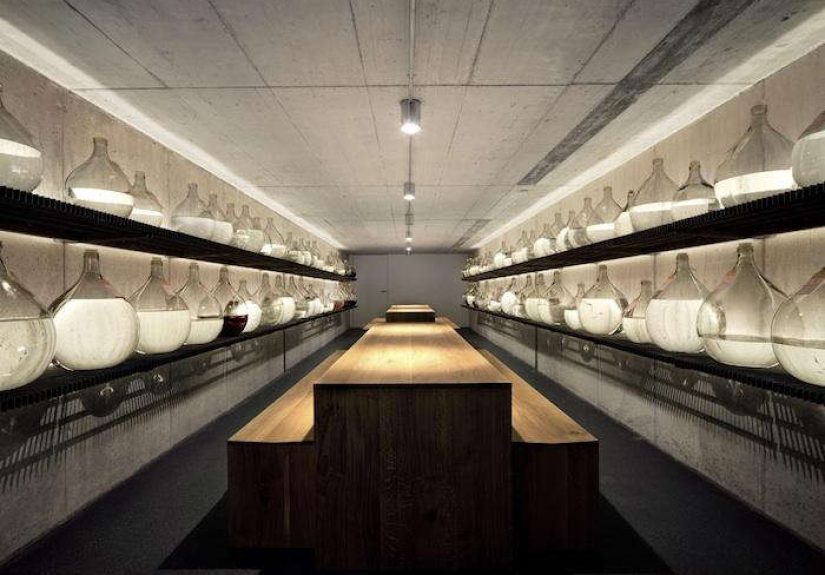
Bottles of aging spirits lining recessed niches read as art. Copper stills and pipes form sinuous lines.
Timber benches with visible joinery supply visual interest without shouting. It’s a masterclass in how to
make a space feel layered and rich using almost nothing “extra.”
A Masterclass in Experiential Design
Stählemühle doesn’t just look good in photos; it’s designed to be experienced. Distilleries, like cafes and
tasting rooms, are increasingly expected to deliver more than a productthey need to tell a story. Here,
that story is “rare fruits, distilled with obsessive care,” and every design decision supports it.
The arrival sequence is carefully choreographed. Guests move from the rural exterior, through restrained entries,
into interiors where the production process is partially on display. The architecture invites curiosity but
never feels like a theme park. Instead, it strikes the balance that many experiential retail spaces aim for:
immersive, but still authentic.
Flow, Function, and Storytelling
Circulation inside the distillery is streamlined. Public zoneslike tasting rooms and showroomsare legible at a glance.
Long sightlines allow visitors to understand where they are and where they’re going, which is especially important in
a building with multiple functions: production, storage, tasting, and education.
The design compresses and releases space deliberately. Narrow corridors with low light open into taller, brighter
rooms where the stills gleam and rows of bottles glow in recesses. That contrast makes the large spaces feel
more impressive and reinforces the idea that you are “entering” the world of distillation rather than just
walking into another room.
Atmosphere You Can Taste
In a distillery, smell and taste are as important as sight. Materials and finishes are chosen not only for durability
but for their sensory neutrality. Concrete, asphalt, glass, and metal keep visual noise down and don’t introduce
competing scents, so the aromas of fruit, fermentation, and aging spirits take center stage.
Seating areas and tasting tables are kept simple and generous. Instead of small, cluttered tables, long timber
surfaces encourage conversation and sharinga nod to communal tasting traditions. It’s the interior equivalent
of a well-edited menu: fewer choices, better focus.
Design Lessons to Steal for Home and Hospitality
You might not own a distillery perched on an old steel mill estate (if you do, please invite us over), but the
design principles behind Stählemühle are surprisingly transferable. Here’s how to channel “Rare Fruit” in your
own space.
1. Choose One Hero Material
In Stählemühle, asphalt and concrete form the backbone of the interior. At home, your hero material might be
polished concrete floors, wide-plank oak, or even a consistently used tile. The key is repetition: using the same
material in multiple places to create continuity rather than a patchwork of unrelated surfaces.
For example, you might repeat the same stone on your kitchen floor, backsplash, and window ledge, or extend the
timber you used for flooring onto a built-in bench or shelving. This “one-material” approach instantly makes
spaces feel calmer and more intentional.
2. Let Neutrals Carry the Mood
Instead of chasing the next big accent color, consider building your rooms on a neutral foundation. Think deep
gray floors, off-white walls, and warm wood furniture. Then, introduce color through things that can easily
change: glassware, textiles, artwork, or even the contents of your bar cart.
This strategy mimics the distillery’s logic: the space stays steady, while the bottles and fruits supply the
changing tones. The result is timeless rather than trendyand significantly easier to update.
3. Use Industrial Elements Sparingly
Industrial design is everywhere, but it works best in measured doses. Instead of turning your home into a faux
factory, take a cue from Stählemühle and choose a few elements that make sense: exposed concrete, a single
metal-framed glass door, a pared-back black faucet, or simple warehouse-style pendants.
The secret is contrast. Industrial pieces feel more refined when paired with soft linen upholstery, natural
fiber rugs, and tactile woods. Think of the industrial bits as punctuation marks, not an entire paragraph.
4. Curate, Don’t Clutter
The distillery’s most striking “decor” is functional: rows of bottles, working stills, and large-scale equipment.
At home, you can borrow this approach by letting your everyday items become the visual focusbeautiful cookware,
a collection of glassware, or a set of well-designed chairs around a simple table.
Instead of scattering small decorative objects everywhere, gather them in a few intentional vignettes or, better
yet, edit them down so that the pieces you do display have enough breathing room to be noticed.
5. Respect the Building’s Story
Above all, Stählemühle works because the design listens to what the building wants to be. It doesn’t force
a glossy hotel aesthetic onto a rural industrial site; it refines what’s already there.
In your own space, this might mean keeping original wood trim instead of replacing it with something generic,
exposing a brick wall rather than covering it up, or choosing finishes that feel aligned with the building’s age
and character. Design looks betterand ages betterwhen it has a sense of place.
Why “Rare Fruit” Still Feels Fresh Today
Even though Stählemühle’s redesign dates back more than a decade, it still feels current because it leans on
enduring principles rather than fleeting trends: honest materials, disciplined palettes, and spaces that make
sense for how people really move and gather.
It also anticipates themes that are even more urgent now: sustainability, reuse of existing structures, and a
desire for experiences that feel grounded and real. Transforming an old mill into a distilleryand then treating
the interior as an exercise in restraintsits squarely at the intersection of adaptive reuse and contemporary
hospitality design.
In a world of endlessly scrollable interiors, “Rare Fruit” offers something better than a quick visual hit: a
slow, thoughtful example of how design can frame craft, celebrate history, and give a small rural business an
unmistakable identity.
On the Ground: Experiencing Design Distilled in Southern Germany
So what is it actually like to move through a place like Stählemühleand through southern Germany’s design
landscape more broadly? Picture this: you arrive by car, weaving through fields, orchards, and small villages.
The GPS swears a distillery is nearby, but the landscape feels more fairy tale than factory. When you finally
pull into the estate, the first impression is quiet and almost modest: traditional forms, weathered structures,
nothing showy.
Then you step inside. The air changes firstcooler, with the faint scent of fruit and oak casks. Your eyes take
a moment to adjust from the daylight to the deeper tones of asphalt and concrete. There’s a subtle thrill in the
contrast: outside, everything is layered greens and blues; inside, it’s shadows and metals and honey-colored wood.
A guide leads you through the production area, explaining how each fruit variety is harvested, fermented, and
distilled. The copper stills are so polished they almost look unreal, like props from a film. You find yourself
slowing down, not just to listen but to notice detailsthe way a beam cuts across the ceiling line, the soft shine
of bottles in a wall niche, the rhythm of floor joints across the asphalt.
Later, in the tasting room, you sit at a long timber table. The atmosphere is remarkably calm. There’s no
clutter, no branded merch wall, no unnecessary noise. Just glasses, bottles, and a few well-chosen pieces of
furniture. That absence of distraction makes you more aware of everything that is present: the color of the
liquid in the glass, the aroma when you swirl it, the warmth as it lands.
If you extend your trip through southern Germany, you’ll notice similar design instincts surfacing in other
places tooboutique hotels in converted manor houses, cafes tucked into former industrial buildings, small
guesthouses that mix contemporary furniture with centuries-old shells. The throughline is respect: for
craft, for landscape, for history, and for the experience of the visitor.
Traveling here as a design-obsessed visitor, you start to read interiors the way you might read labels on a
bottle. You notice when a material feels honest, when a renovation keeps just enough of the original bones,
and when a space has been edited instead of over-designed. By the time you leave, you may find yourself craving
not only another sip of rare fruit brandy, but also a bit of that distilled clarity in your own home.
Back at your desk, scrolling through photos of Stählemühle, you realize that what makes the project so enduring
isn’t a single dramatic gesture. It’s the calm consistency: the way every detailfrom asphalt floor to copper
still to timber benchfeels like part of the same thought. In a noisy world, that kind of coherence is its own
luxury.
Final Pour: Design, Distilled
“Rare Fruit: Design Distilled in Southern Germany” is more than a pretty story about a picturesque distillery.
It’s a reminder that design is at its best when it clarifies rather than complicateswhen it amplifies a place’s
strengths instead of burying them. Stählemühle’s serene minimalism lets the truly special elements shine: the
rare fruits, the craft of distillation, the history in the walls.
Whether you’re planning a design-focused trip through Germany, dreaming up your own adaptive reuse project,
or just rethinking your living room, there’s a lot to borrow from this quiet gem: fewer materials, more intention,
and a healthy respect for what’s already there. In other words, designlike a good spiritis best when it’s
thoughtfully distilled.







 Close
Close