
Table of Contents >> Show >> Hide
- What Was Project Horizon, Really?
- The Plan in Numbers: Timeline, Launches, Cargo, and Cost
- Where Would the Base Go? Site Selection, Latitude Limits, and Lunar Reality
- How Would the Outpost Be Built?
- Logistics on the Moon: The Real Boss Fight
- Communications and Surveillance: Why the Moon Looked Useful
- Why Project Horizon Didn’t Happen
- What Project Horizon Got Surprisingly Right
- Project Horizon vs. Today’s Lunar Return: A Useful Comparison
- Experience Add-On: A Grounded “Day-in-the-Life” of a Horizon-Style Lunar Outpost (Thought Experiment)
- Conclusion: The Moon Base That Never Was (But Still Teaches)
In 1959while America was still figuring out how to keep a human alive in a tin can for more than a coffee breakthe U.S. Army quietly asked a bold question: What if we put an Army outpost on the Moon? Not a flag-and-photo-op. Not a “we’ll swing by and bring back rocks.” A permanent lunar installation, staffed by soldiers, powered for long-term operations, and designed to protect U.S. interests in the ultimate “high ground.”
The result was Project Horizon, a detailed feasibility study produced in June 1959 that outlined how the Army could land personnel on the Moon, build a base, and keep it supplied. It read less like science fiction and more like an early draft of a logistics orderexcept the “motor pool” was orbit, the “construction materials” were rocket payloads, and the “weather report” included temperature swings that would make Phoenix and Antarctica both ask for a sweater.
Horizon never became an actual program. But it matteredbecause it showed how quickly the Cold War turned outer space into strategy, budgets, schedules, and debates about who should control America’s future beyond Earth: a military service, or a civilian space agency.
What Was Project Horizon, Really?
Project Horizon was a U.S. Army study that explored the feasibility of establishing a lunar military outpost in the mid-1960s. It was built around a simple premise: if the Soviet Union could claim prestige and potential advantage by being first on the Moon, the United States could not afford to be secondpolitically, psychologically, or strategically.
The report framed the Moon as a platform for multiple objectives: surveillance, communications relay, scientific investigation, and (if national policy demanded it) military operations on the lunar surface. In plain terms: the Army wanted the option to stand watch from the Moon the way it stood watch from bases around the globe.
The Cold War Context: When “High Ground” Meant Lunar High Ground
Horizon was born during the post-Sputnik shockwave. In the late 1950s, “space” wasn’t just a frontier; it was a scoreboard. Sputnik proved that Soviet rockets could reach orbitmeaning they could plausibly reach anywhere. That reality drove U.S. defense thinking toward rapid, ambitious concepts, including some that sound wild today until you remember that the era also produced atomic cannons and other “let’s-try-everything” ideas.
The Army’s interest also reflected a bureaucratic truth: in the late 1950s, the boundaries between services, missiles, and “space missions” were still being negotiated. NASA had only recently been created, and the shape of the national space program was still up for grabs.
The Plan in Numbers: Timeline, Launches, Cargo, and Cost
When Would Soldiers Land?
Horizon projected initial manned landings in spring 1965, with cargo deliveries beginning earlier that year. The study envisioned the outpost becoming ready for “beneficial occupancy” and staffed by a 12-man task force by November 1966.
How Would They Get There?
The backbone of Horizon was a rocket fleet labeled Saturn I and Saturn IIlarge multi-stage launch vehicles associated with the Army’s missile development world. The study described an aggressive cadence: enough launches to build a base, sustain construction, and keep people alivewithout skipping the part where everything has to work perfectly in vacuum, at extreme temperatures, while covered in abrasive lunar dust.
How Many Launches?
Here’s where Horizon gets wonderfully, terrifyingly specific. To build up the outpost through late 1966, the study estimated a requirement for 61 Saturn I and 88 Saturn II launchesaveraging about 5.3 launches per monthdelivering roughly 490,000 pounds of useful cargo to the lunar surface. Then, during the first operational year (December 1966 through 1967), it scheduled 64 additional launches to deliver another 266,000 pounds.
How Much Would It Cost?
The report estimated the total cost of the eight-and-a-half-year program at $6 billion (in 1959 dollars), averaging roughly $700 million per year. Depending on the inflation calculator you use, that becomes “a lot more than $6 billion” in today’s moneya figure that helps explain why Horizon became a fascinating document rather than an actual base with a zip code.
Where Would the Base Go? Site Selection, Latitude Limits, and Lunar Reality
Horizon’s site selection was not “pick a scenic crater.” It was constrained by energy and mission requirements. The study suggested that, based on rocket vehicle energy requirements, an area bounded by roughly ±20° latitude/longitude from the Moon’s optical center appeared favorable, and it identified multiple candidate sites within that region.
This is a subtle but important point: even early lunar base concepts had to think like mission planners. The Moon is close enough to tempt youbut far enough that small choices in trajectory, landing site, and communications geometry can snowball into big costs and big risks.
How Would the Outpost Be Built?
Modular Habitats: Think “Cylinders,” Not “Moon Castle”
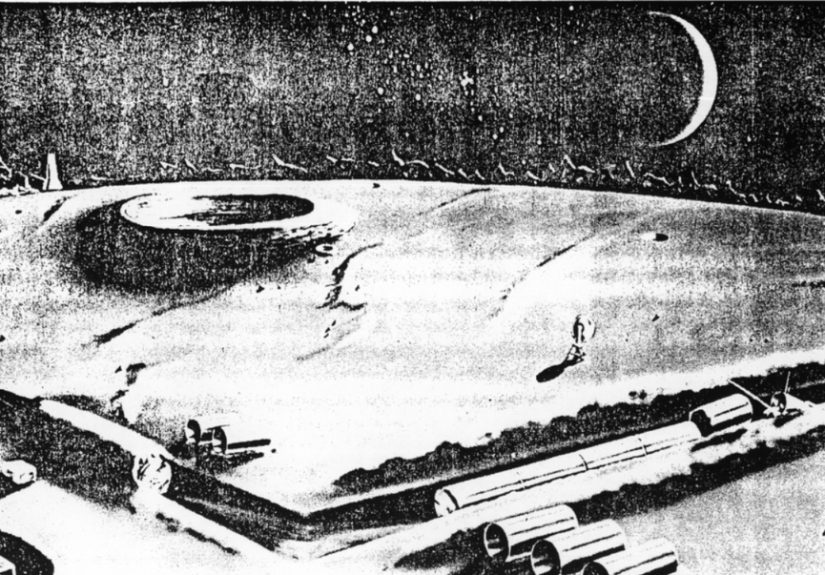
Horizon’s construction concept centered on modular compartmentscylindrical metal tanks about 10 feet in diameter and 20 feet longassembled into living and working spaces. The study anticipated burying key structures under lunar material, which is both practical and oddly relatable: if you can’t buy insulation at Home Depot, you use what’s on-site.
Why Bury the Habitats?
Burying structures addressed several lunar problems at once:
- Radiation exposure (no protective atmosphere)
- Micrometeoroid impacts (space is not a gentle neighborhood)
- Temperature stability (subsurface temperatures are far less chaotic than surface extremes)
The study emphasized that lunar environmental conditions were unfamiliar and harsh: essentially no atmosphere, gravity around one-sixth of Earth’s, and massive temperature swings. It even noted that maximum subsurface temperature at the lunar equator was around -40°F, a “cozy” baseline compared to surface extremes that could swing from blistering to brutal.
Power: The Plan Included Nuclear Reactors
Horizon did not bet the base on solar panels and good vibes. The construction camp concept included nuclear reactors placed in holes to provide power for early operations and construction equipment. In the late-1950s mindset, nuclear power wasn’t a last resortit was the obvious way to run a remote outpost where darkness lasts about two Earth weeks at a time.
Logistics on the Moon: The Real Boss Fight
Horizon’s most impressive feature is not that it imagined soldiers on the Moon. Plenty of people imagined that. The impressive part is that it tried to answer the painfully unglamorous questions: How do you feed people? How do you rotate them? How do you build anything with limited payload? How do you keep the supply chain from collapsing?
Cargo Before Crew
The plan emphasized cargo buildup before major construction, with early missions delivering supplies and verifying conditions. The initial two-person landing was framed as verification and confirmationchecking site selection and validating environmental databefore larger crews arrived.
Rotation and Human Factors
Horizon treated people as operational constraints, not decorative passengers. It discussed rotation limits (with tours not exceeding about a year in some phases), leadership needs (construction-focused command during buildout), and the reality that isolation, confinement, and risk would shape everything from training to crew selection.
Communications and Surveillance: Why the Moon Looked Useful
The study envisioned the Moon as a platform for communications relay and lunar-based observation. In the Cold War imagination, a lunar outpost could support global communications and provide a strategic advantage in understanding adversary activity.
To modern readers, “spy from the Moon” sounds like a comic-book panel. But the underlying ideause space-based vantage points for intelligence and communicationwas directionally aligned with what would soon become reality through satellites. Horizon’s Moon-based version was simply the most extreme interpretation of a trend that was already emerging.
Why Project Horizon Didn’t Happen
1) Cost and Complexity Were Enormous
Even with optimistic assumptions, Horizon required a sustained launch tempo, vast infrastructure, and mission reliability far beyond what the U.S. had demonstrated in 1959. The plan’s own numbersdozens upon dozens of heavy launcheshint at the scale. It’s one thing to write “64 launches scheduled” in a report; it’s another to actually execute that schedule without a single catastrophic failure.
2) The U.S. Chose a Civilian Moon Program
The early space era saw intense debate over whether U.S. space leadership should be military or civilian. Over time, national policy tilted toward NASA-led exploration, with military space efforts focusing heavily on satellites, missiles, and later specialized defense missions. Horizon became part of that “what might have been” space-history shelf: right between “amazing engineering thought” and “we do not have enough money for this, please stop.”
3) Organizational Shifts Reshaped Rocket Talent and Ownership
The late 1950s and early 1960s were full of reorganizations that moved people and programs between agencies. Key rocket teams and capabilities that once sat within the Army orbit increasingly supported NASA’s launch vehicle needs as national priorities clarified. Horizon was written at the exact moment the U.S. was deciding who would drive the next chapter of spaceflight.
What Project Horizon Got Surprisingly Right
Horizon is easy to dismiss as a Cold War fever dreamuntil you notice how many of its design instincts still show up in modern lunar planning.
Regolith Shielding
Bury habitats, use local material for protection, reduce exposurethis remains a serious concept today because physics hasn’t changed just because our graphics got better.
Staged Buildup and Redundancy
Deliver cargo first, validate the environment, build incrementally, maintain return capability earlyHorizon’s phased approach reads like a classic risk management playbook.
Nuclear Power for Remote Operations
The Moon’s long nights and harsh conditions make reliable power a central problem. Horizon treated power as foundational, not optional. Whether the solution is nuclear, solar plus storage, or a hybrid, the underlying lesson stands: no power, no outpostjust a very expensive memorial plaque.
Project Horizon vs. Today’s Lunar Return: A Useful Comparison
Modern lunar programs emphasize exploration, science, international partnerships, and commercial involvement. But the strategic dimension never completely disappeared. Space supports communications, navigation, intelligence, and national poweroften quietly, sometimes loudly.
Horizon’s value today is not that it was “the plan we should have done.” Its value is that it shows how a serious organization, with serious engineers, can take an outrageous-sounding objective and translate it into: schedules, payload math, habitat layouts, power assumptions, training needs, and budget estimates.
In other words: Horizon is a reminder that “going to the Moon” is never just a destination. It’s a systemand the system is always bigger than the flag.
Experience Add-On: A Grounded “Day-in-the-Life” of a Horizon-Style Lunar Outpost (Thought Experiment)
The best way to understand Project Horizon is to imagine not the launchbut the Tuesday after the launch, when the novelty wears off and someone still has to do maintenance checks. The following is a grounded thought experiment based on the kinds of operational realities Horizon described: construction-first priorities, buried habitats, nuclear power, cargo dependency, and strict routine. It’s not a historical diary (nobody actually served a Horizon tour), but it is the kind of experience the plan implicitly demanded.
You wake up “morning,” except the Moon does not care about your circadian rhythm. The outpost runs on a schedule because humans need one, not because the sky politely provides sunrise at a reasonable hour. Your first job is the same as it would be in any remote post: check what can kill you today. On Earth, that might be weather, fuel, or the generator. Here it’s pressure integrity, CO2 scrubbing, and whether last night’s micrometeoroid alarms were real or just the Moon reminding you it has zero interest in your comfort.
Breakfast is efficientcalories and hydration first, culinary joy second. Even in 1959, Horizon’s math implied that every pound mattered. The humor in that becomes obvious when you realize “extra hot sauce” isn’t a flavor preference; it’s a morale asset with mass. Somebody jokes that if the supply chain fails, you’ll be eating “regolith à la mode.” Nobody laughs too hard, because everyone understands the rules: this is a logistics war against distance.
The workday begins with suit checks. You don’t step outside casually. You suit up like an astronaut and move like a construction worker who suddenly weighs one-sixth as much as usual. That sounds fun until you try to handle tools with pressurized gloves and discover that every bolt is now a grip-strength competition. Low gravity changes everything: carrying becomes bouncing, hammering becomes over-hammering, and if you’re not careful, you can literally push yourself away from the worksite like a human pogo stick. PT is weird toojump squats are impressive, but you still have to keep your muscles and bones from quietly resigning.
Construction is the center of gravity (pun intended). Horizon imagined modular compartments and burying structures under lunar material. That means excavation, emplacement, sealing, and repeat. Dust is constant. Lunar regolith is sharp, clingy, and irritatingthe kind of “sand” that doesn’t belong at the beach, and definitely does not belong inside your lungs. You learn fast: contamination control is not a suggestion. The airlock becomes sacred space, where you brush, wipe, and curse the dust before you bring it inside to chew up seals and filters.
Power management is everyone’s business. Horizon included nuclear reactors because reliability is life. That also means you treat your power system the way a submarine treats its reactor room: with discipline, checklists, redundancy, and a deep respect for the idea that failure is not “inconvenient,” it is “mission-ending.” Someone is always monitoring load, temperature, and anomalies. You don’t “wing it” on the Moon.
The psychological experience is the part you can’t fully simulate. The Earth is visible, but it’s not reachable. Communications feel both instant and delayedenough time for you to remember you’re far away, but not enough time to pretend you’re alone. You develop small rituals: a shared meal, a scheduled call, a rotating “dumb joke of the day” board. Morale is maintained like equipment: proactively. Horizon’s implied truth is simpleif you want a permanent outpost, you must design for the human mind, not just the rocket.
By the end of the day, you log progress like any unit would: what was built, what broke, what’s needed next. The difference is that your “next delivery” is a rocket launch schedule measured in weeks and months, not trucks measured in hours. You fall asleep with the hum of life support in your earscomforting, because it means you’re still alive. And in the quiet between systems, the Moon offers its final reminder: it’s beautiful, it’s hostile, and it does not care how tough you are. Only whether your engineeringand your teamworkare tough enough.
Conclusion: The Moon Base That Never Was (But Still Teaches)
Project Horizon wasn’t a joke, a rumor, or a lazy headline. It was a serious 1959 attempt by the U.S. Army to define what it would take to build and operate a permanent lunar outpostcomplete with timelines, launch cadence, modular habitat concepts, buried structures, nuclear power, and logistics planning.
It failed for understandable reasons: cost, complexity, shifting national priorities, and the rise of a civilian-led space program. But Horizon remains valuable because it shows how national ambition becomes engineeringand how engineering becomes logisticsand how logistics, in the end, becomes the real limit of “big ideas.”
If you want the enduring lesson of Project Horizon, it’s this: getting to the Moon is hard. Staying on the Moon is harder. And writing a plan that admits thatwhile still trying anywayis exactly why Horizon still earns a place in space history.







 Close
Close