
Table of Contents >> Show >> Hide
- A Piece of Glass That Thinks? Sort Ofand That’s the Fun Part
- What Is a Neural Network in Glass?
- How the Glass Recognizes Handwritten Numbers
- Does It Truly Require No Power?
- The Science Behind the Smart Glass
- Why This Matters for Machine Vision
- Potential Applications of Power-Free Optical Recognition
- Challenges Before Smart Glass Becomes Everyday Technology
- How This Fits Into the Bigger Future of Optical AI
- Experience-Based Reflections: What Working With This Idea Teaches Us
- Conclusion: The Future May Be Clear, Thin, and Surprisingly Smart
Note: This article synthesizes real research and reputable technical reporting on nanophotonic neural media, optical neural networks, smart glass, and low-power machine vision.
A Piece of Glass That Thinks? Sort Ofand That’s the Fun Part
Imagine holding up a thin piece of glass, showing it a handwritten number, and watching it “decide” whether the scribble is a 3, an 8, or that mysterious symbol your uncle insists is a 5. No battery. No chip. No tiny fan screaming like a gaming laptop. Just light passing through a carefully designed material.
That is the charmingly strange idea behind a neural network in glass: a passive optical system that uses the physics of light to perform a simple version of artificial intelligence. The research, led by scientists associated with the University of Wisconsin–Madison, MIT, and Columbia University, explored a nanophotonic neural mediuma glass-like structure filled with microscopic features that bend, scatter, and guide light in useful ways.
The headline sounds almost like science fiction: glass requires no power and recognizes numbers. The more accurate version is even more interesting: the glass does not need external electrical power for inference. It uses incoming light as the signal and lets physics do the computation. In other words, the “processor” is not a silicon chip. It is the structure of the material itself.
What Is a Neural Network in Glass?
A traditional artificial neural network runs on digital hardware. Images become numbers, numbers move through layers of mathematical operations, and the system eventually outputs a prediction. For handwritten digit recognition, the input might be a small grayscale image, and the output might be one of ten labels: 0 through 9.
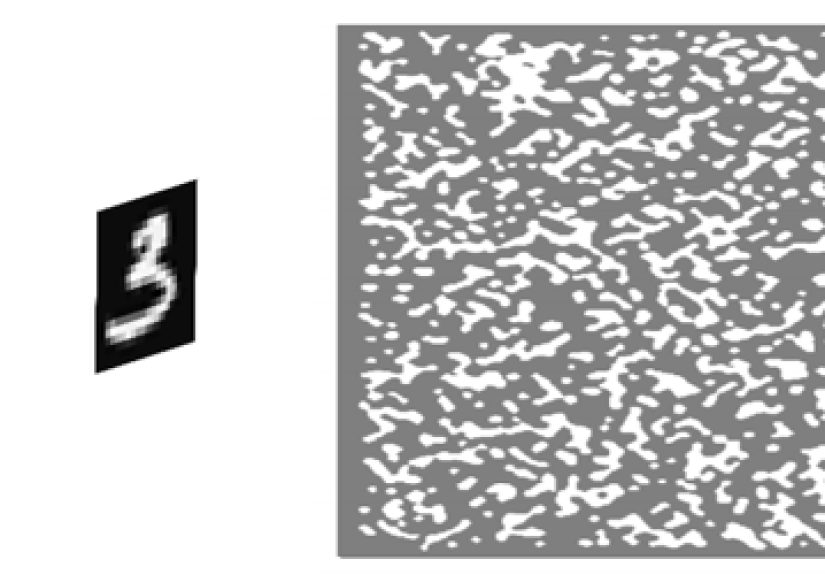
A glass neural network turns that process into an optical journey. Instead of sending pixels through software, the image is encoded into light. That light enters the glass. Inside the material, tiny structuressuch as air bubbles, impurities, or light-absorbing elements like graphenescatter the light in carefully planned ways. When the light exits, it focuses toward a particular output location. Each output spot corresponds to a number.
If the light lands strongest at the “8” output port, the system recognizes the input as an 8. If it lands strongest at the “3” port, the glass calls it a 3. It is not thinking in the human sense, of course. It is doing what trained neural networks do: mapping an input pattern to an output class. The delightful twist is that the mapping is physically baked into the glass.
The “Weights” Are Not CodeThey Are Tiny Structures
In a digital neural network, training adjusts weights. In this smart glass concept, training determines where microscopic inclusions should go and how they should affect light. The locations, shapes, sizes, and optical properties of those inclusions become the physical equivalent of learned parameters.
That makes the material a kind of frozen machine-learning model. Once designed and fabricated, it does not need to run software to perform its task. It simply interacts with light. The result is passive artificial intelligence: a task-specific device that can classify simple images using optics alone.
How the Glass Recognizes Handwritten Numbers
The proof-of-concept focused on handwritten numbers because digits are the fruit flies of machine vision: small, familiar, useful, and scientifically convenient. Handwritten digit recognition has been a standard benchmark for decades, especially through datasets such as MNIST, which contains tens of thousands of grayscale digit images used to test image-recognition systems.
In the nanophotonic glass design, a digit image is represented as a pattern of light intensity. Bright and dark areas of the digit become variations in the incoming wavefront. When that wavefront enters the trained glass, the embedded nanostructures scatter and redirect it. The scattered waves interfere with one another, sometimes adding together and sometimes canceling out. This interference is not a bug; it is the whole trick.
By the time the light reaches the other side, the energy is concentrated at one of several output points. Think of it like a marble maze, except the marble is a wave of light, the maze is smaller than a dust speck in important dimensions, and the “correct hole” at the end represents a digit label. Simple? Not exactly. Beautiful? Absolutely.
Why the Number 8 Matters
One memorable demonstration described how the system could respond when a handwritten 3 was changed into an 8. That example matters because it shows the glass is not merely detecting one fixed stencil. It is reacting to a changing optical pattern. When the input changes, the light field changes, and the output spot shifts accordingly.
This is why researchers are excited about optical AI. The classification happens through propagation, scattering, and interference. There is no separate camera feeding a processor, no cloud server crunching data, and no digital model waking up to drain a battery. The material itself acts as the front-end intelligence.
Does It Truly Require No Power?
Here is where we gently rescue the phrase “no power” from marketing goblin territory. The glass does not require electrical power to perform the classification step after it is made. However, it still needs light. Light carries energy, and without incoming light, the glass has nothing to process. A completely dark room is not a great workplace for optical computingunless the task is “identify darkness,” in which case congratulations, the glass is already overqualified.
So the honest statement is this: the system can perform inference without external electrical power, sensors, or conventional electronic circuits. The incoming optical signal provides the information, and the trained structure redirects that signal. This distinction is important because it keeps the concept realistic while preserving what makes it extraordinary.
Why Passive Computing Is a Big Deal
Modern artificial intelligence often requires significant computing resources. Even small image-recognition tasks usually involve sensors, analog-to-digital conversion, memory movement, processors, and software. Each step consumes power and adds latency. For smartphones, drones, robots, smart locks, autonomous vehicles, and tiny sensors at the edge, power is not a tiny detailit is the entire drama.
A passive optical neural network could reduce that burden by performing some recognition tasks before electronics ever get involved. Instead of capturing every image and sending it to a processor, a smart optical surface could act as a filter, classifier, or preprocessor. It could answer simple questions quickly: Is this the right number? Is this the expected symbol? Does this face match a specific authorized pattern? Is this traffic sign in the known category?
The Science Behind the Smart Glass
The core field behind the concept is nanophotonics, which studies how light behaves at extremely small scales. At this scale, tiny structures can control optical waves with surprising precision. Engineers can design materials that bend, scatter, delay, absorb, or focus light in ways ordinary glass cannot.
The proposed glass is not smart because the material is secretly running Python. It is smart because its internal structure has been optimized for a task. During training, researchers use computational models based on electromagnetic physics, including Maxwell’s equations, to predict how light moves through the medium. The system is adjusted again and again until the output light pattern matches the desired classification.
Training Happens Before the Glass Is Used
This is an important point for readers who are imagining a window pane attending machine-learning boot camp. The glass does not learn on the fly in the same way a digital model might be retrained. The heavy training work happens beforehand, often in simulation. Once the structure is designed, the glass can be fabricated to perform that specific trained function.
That gives the technology both a strength and a limitation. The strength is efficiency: after fabrication, the device can classify input patterns passively and extremely fast. The limitation is flexibility: a piece of glass trained to recognize digits is not automatically ready to recognize dogs, bicycles, or whether your lunch leftovers are still safe. For each new task, the optical structure may need to be redesigned.
Why This Matters for Machine Vision
Machine vision usually follows a familiar pipeline. A camera captures an image. A sensor converts light into electrical signals. Hardware digitizes the data. A processor runs algorithms. A neural network outputs a prediction. That pipeline works, but it consumes energy and time.
A neural network in glass challenges that pipeline. It asks: what if the first layer of intelligence happened before the image became data? What if optics could sort, compress, or classify information while the light is still light?
This idea fits into a broader wave of research in photonic computing and optical neural networks. Other projects have explored diffractive deep neural networks, metasurface-based classifiers, and on-chip photonic systems capable of image classification at extremely low latency. The shared goal is not to replace every digital computer. It is to move certain operations into physics, where light’s speed and parallelism can be used directly.
Edge AI Without the Battery Anxiety
Edge AI means running intelligence close to where data is collected: inside a camera, sensor, robot, lock, vehicle, or wearable device. The challenge is that edge devices are often small and power-constrained. A smart camera mounted outdoors cannot behave like a data center wearing a raincoat.
Passive optical classification could help with narrowly defined edge tasks. A smart glass element might allow only certain patterns to trigger electronics. A security system could wake up only when the optical front end sees a matching signal. A low-power sensor could classify simple symbols or shapes before sending anything to a processor.
That may sound modest, but modest tasks are everywhere. The world is full of machines that do not need a giant AI model. They need fast, cheap, reliable answers to specific questions. In those cases, a task-specific optical device could be more practical than a general-purpose processor.
Potential Applications of Power-Free Optical Recognition
The most obvious application is biometric access. A piece of glass could, in theory, be tuned to recognize a specific face or pattern. Because it would not require power for the recognition step, it could act like a passive optical lock. That does not mean tomorrow’s bank vaults will be guarded by magical windows, but the concept is compelling for long-life security systems.
Another application is low-power visual filtering. A device could use smart glass to detect whether an image belongs to a certain category before activating more expensive electronics. In autonomous systems, a passive optical layer might help identify signs, lane markers, symbols, or known objects. In industrial settings, it could check whether a part has a specific shape or mark.
There are also possibilities in privacy-preserving sensors. If optical hardware performs classification directly, it may reduce the need to store or transmit full images. Instead of recording everything, a device might only produce a simple output: match or no match, digit class, symbol class, or alignment status.
Not a Replacement for General AI
Still, this technology is not a glass version of a large language model. It will not write emails, explain tax law, or comfort you after your sourdough starter collapses. Its power lies in specialization. A trained optical medium can be designed for a limited recognition task and perform that task with remarkable efficiency.
That specialization is not a weakness; it is the point. The future of AI hardware will likely include many types of intelligence: large cloud models, efficient mobile chips, neuromorphic processors, photonic accelerators, and passive optical elements. Smart glass belongs to the “tiny specialist” categorya quiet expert that does one job without asking for a charger.
Challenges Before Smart Glass Becomes Everyday Technology
The idea is exciting, but there are real engineering challenges. First, the original smart glass concept was a research demonstration and modeling effort, not a mass-produced consumer product. Turning a simulated nanophotonic design into a robust, affordable, repeatable object is difficult.
Second, fabrication tolerances matter. If microscopic bubbles or inclusions are even slightly misplaced, the light may not travel as expected. At nanophotonic scales, tiny errors can produce big performance changes. Manufacturing would need to be precise enough to preserve the trained optical behavior.
Third, real-world light is messy. Laboratory and simulation conditions are easier to control than a sunny sidewalk, a dusty factory, or a rainy intersection. Background light, viewing angle, wavelength changes, motion, dirt, scratches, and imperfect alignment could all affect performance. For practical applications, smart glass would need to handle environmental noise gracefully.
Accuracy Has Room to Grow
Early optical neural systems have shown promising but limited accuracy compared with mature digital neural networks. Handwritten digit recognition is a useful benchmark, but modern digital models can achieve extremely high performance on digit datasets. Optical systems must prove that their efficiency benefits justify their constraints.
One likely path forward is hybrid design. Smart glass may not need to make the final decision alone. It could serve as an ultra-efficient optical front end, reducing the amount of data sent to electronic processors. In this role, it would not replace digital AI; it would help digital AI work less hard. And honestly, anything that helps computers stop panting under the weight of endless image data deserves applause.
How This Fits Into the Bigger Future of Optical AI
The smart glass neural network is part of a larger movement toward computing with light. Diffractive deep neural networks have used carefully designed passive layers to classify images. On-chip photonic neural networks have demonstrated extremely fast image processing. Newer optical generative models are exploring how light-based systems might create images, not just classify them.
The common theme is simple: light is fast, parallel, and already central to how we collect visual information. If machines see using light, why convert everything into electrons before doing any useful work? Optical AI tries to answer that question by keeping more computation in the optical domain.
Of course, digital electronics are not going anywhere. They are flexible, programmable, and astonishingly capable. But photonics may become increasingly valuable for specialized tasks where speed, energy efficiency, and low latency matter. A future camera might combine optical preprocessing, photonic acceleration, and digital reasoning in one layered system.
The Best Mental Model: A Lens That Learned
The easiest way to understand the glass neural network is to think of it as a lens that learned a job. A normal lens focuses light to form an image. A trained nanophotonic medium focuses light to form an answer. Instead of “here is a picture,” it says, “this pattern most likely belongs to class 8.”
That shiftfrom image formation to decision formationis the big conceptual leap. It turns optical materials into computational objects. Glass stops being only a window and becomes a tiny specialist in pattern recognition. Not bad for something we usually blame for fingerprints.
Experience-Based Reflections: What Working With This Idea Teaches Us
When you first explain a neural network in glass to someone, the reaction is usually a raised eyebrow followed by the phrase, “Wait, what?” That confusion is actually useful. It reveals how strongly we associate artificial intelligence with screens, chips, keyboards, cloud servers, and glowing rectangles. The smart glass concept breaks that mental habit. It reminds us that computation does not always have to look like computation.
One practical experience from studying this topic is that the word “intelligence” can be misleading if we are not careful. The glass is not aware. It does not understand numbers the way a child does. It performs a physical transformation that maps visual patterns to output locations. Yet that is also true, in a different form, for many machine-learning systems. A digital digit recognizer does not understand mathematics; it learns statistical patterns in pixel data. The glass version simply performs the mapping with waves instead of transistor switching.
Another lesson is that low-power AI is often about moving the right task to the right medium. A general processor is wonderful when you need flexibility. But if you need to classify one specific type of pattern millions of times, a fixed physical system can be more efficient. This is similar to using a wrench instead of a robotic arm to turn one bolt. The robotic arm is impressive, but the wrench is hard to beat when the job is narrow and repetitive.
There is also a refreshing humility in the current state of optical AI. The technology is promising, but it is not magic. Alignment matters. Lighting matters. Fabrication matters. Data matters. The training phase can be computationally demanding even if the final device is passive. Anyone who has worked with cameras, lenses, sensors, or machine-learning datasets knows the tiny monsters hiding in the details. A smudge, shadow, angle shift, or unexpected background can make a clean demo suddenly behave like it forgot its morning coffee.
For engineers, the most exciting experience is imagining new workflows. Instead of designing a camera first and adding AI later, you might design the optics and the intelligence together. The lens, filter, surface, and classifier could become one integrated object. That changes how we think about product design. A future sensor might not simply capture data; it might shape the data into a decision before electronics ever see it.
For writers, educators, and curious readers, this topic is a gift because it makes invisible physics feel tangible. You can picture light entering a sheet of glass, bouncing through tiny structures, and emerging as a classification. That mental image is easier to grasp than a stack of matrix multiplications. It is also a wonderful reminder that innovation often happens when fields collide: optics meets machine learning, materials science meets computer vision, and suddenly a piece of glass starts recognizing numbers like it has been studying after hours.
The biggest takeaway is not that glass will replace AI chips. The real takeaway is broader: intelligence can be embedded into the physical world in surprising ways. Some future devices may compute with electrons, some with photons, some with mechanical motion, and some with materials designed so cleverly that the “algorithm” is inseparable from the object. That is the charm of smart glass. It does not shout. It does not boot up. It just sits there, lets light pass through, and quietly performs a job that once required electronics.
Conclusion: The Future May Be Clear, Thin, and Surprisingly Smart
The idea of a neural network in glass sounds like a party trick from a very nerdy magician, but it points toward a serious future for optical neural networks and low-power machine vision. By designing microscopic structures inside glass, researchers can guide light in ways that classify images such as handwritten numbers. The result is a passive, task-specific form of artificial intelligence that performs inference without conventional electrical power.
This technology is still developing. It faces challenges in fabrication, real-world lighting, accuracy, and scalability. Yet its promise is hard to ignore. If optical materials can recognize simple patterns, they may eventually help build faster, cheaper, more energy-efficient systems for security, robotics, smart sensors, and edge AI.
In the end, smart glass is not about replacing every computer. It is about asking a better question: how much intelligence can we build directly into the materials around us? If the answer is “enough to recognize numbers with light,” then the window to the future may be more literal than we expected.





 Close
Close