
Table of Contents >> Show >> Hide
- What Mazda Means by “Carbon-Negative”
- The Vision X-Coupe Is More Than a Science Project
- Why Mazda Still Believes in the Rotary Engine
- How the Microalgae Fuel Pitch Works
- The Carbon-Capture Trick Is the Real Conversation Starter
- So, Is the Carbon-Negative Claim Legit?
- Why This Matters in the Bigger Auto Industry Debate
- The Design Message Is Almost as Important as the Engineering
- The Catch Nobody Should Ignore
- Final Verdict: Brilliant Idea, Big Questions
- Related Experiences: What a Carbon-Negative Mazda Could Feel Like in the Real World
- SEO Tags
Note: Clean HTML body only for web publishing. No source links or oaicite artifacts included.
Leave it to Mazda to look at the auto industry’s giant climate debate and say, “What if we made it weirder, prettier, and a little more rotary?” That is basically the vibe of the Mazda Vision X-Coupe, a dramatic concept car that does not merely promise lower emissions, or carbon-neutral driving, or the usual “future of mobility” word salad. No, Mazda went a step further and said this new concept could be carbon-negative. In plain English, that means the car would, in theory, help remove more carbon dioxide from the atmosphere than it adds.
That is a bold claim. It is also the kind of claim that makes engineers lean forward, marketers grin, and skeptics immediately reach for a calculator. Still, it is hard not to admire the ambition. The Vision X-Coupe is not just another shiny show car with giant wheels and no door handles. It is Mazda’s attempt to argue that internal combustion, electrification, biofuels, and carbon capture might be able to coexist in one wildly unconventional package.
So what exactly is Mazda selling here: science, strategy, design theater, or a clever way to keep the combustion engine alive in an EV-first world? The answer is a little bit of all four. And that is what makes this story so interesting.
What Mazda Means by “Carbon-Negative”
Most carmakers are still working to get to carbon-neutral. Mazda is talking about going past zero. Its concept revolves around two linked ideas. First, the Vision X-Coupe is designed to run on microalgae-derived carbon-neutral fuel. Second, it uses an onboard carbon-capture system that pulls some CO2 out of the exhaust before it escapes into the atmosphere.
The headline logic goes like this: microalgae absorb carbon dioxide while they grow. That algae is then processed into fuel. When the fuel is burned, the emissions are partly offset by the carbon the algae already absorbed during cultivation. Add a capture device that recovers a portion of the exhaust gas, and Mazda says the total equation can go beyond net zero.
It is a neat concept, and on paper it sounds almost magical. The more you drive, the cleaner the planet gets? That is the sort of sentence that would make a PR team cry tears of joy. But Mazda’s pitch is not pure fantasy. It is built around real research areas: algal biofuels, lifecycle emissions analysis, and post-combustion carbon capture. The part that is still very much in question is whether those pieces can scale affordably, efficiently, and consistently in the real world.
The Vision X-Coupe Is More Than a Science Project
One reason the concept has grabbed attention is that Mazda did not wrap this sustainability argument in a boring eco-pod. The Vision X-Coupe looks sleek, low, and expensive in the best possible concept-car way. It is a four-door shape that Mazda still calls a coupe, because apparently the auto industry made peace with that argument years ago and no one has the energy to fight anymore.
The powertrain is equally dramatic. Instead of offering a simple battery-electric setup, Mazda built the concept around a plug-in hybrid system with a two-rotor rotary turbo engine, electric motor, and battery. That choice matters. Mazda is not just making a design statement. It is making a philosophical statement. The company is saying that the future may not belong to one propulsion technology alone. In its view, the best path could be a mix of electrification, alternative fuels, and cleaner combustion.
That is classic Mazda behavior, honestly. This is the same brand that has spent years politely refusing to do things the obvious way. When other companies chase a trend, Mazda tends to ask whether there might be a stranger, more elegant solution hiding around the corner. Sometimes that leads to brilliance. Sometimes it leads to the automotive equivalent of a jazz solo at a staff meeting. Either way, it rarely leads to dullness.
Why Mazda Still Believes in the Rotary Engine
If you know Mazda, you know the rotary is not just an engine layout. It is practically a personality trait. The rotary engine helped define Mazda’s performance identity, but it also became famous for the exact sort of emissions and efficiency issues that make climate-conscious regulators break out in hives.
So why bring it back in a carbon-negative concept? Because the rotary’s compact size still gives Mazda packaging and design advantages, especially in electrified applications. In recent years, Mazda has increasingly positioned the rotary less as a traditional main engine and more as a flexible part of an electrified system. In concept form, that means you can keep the distinctive character and compactness of a rotary while using electricity for part of the drive experience and cleaner fuels for combustion.
That move also lets Mazda preserve one of its most valuable assets: brand identity. Plenty of companies can build an electric crossover. Fewer can make a convincing case that driving joy, emotional design, and technical eccentricity still deserve a seat at the sustainability table. Mazda wants to be one of them.
How the Microalgae Fuel Pitch Works
The microalgae piece is arguably the most fascinating part of Mazda’s argument. Algae-based fuels have long been attractive because algae can produce oils that can be refined into fuel, and they can potentially do so without using the same kind of prime agricultural land required by some traditional biofuel crops. In theory, that makes algae a promising feedstock in a lower-carbon fuel future.
Mazda’s version adds another twist: the company talks about using the leftover biomass after oil extraction for other products, such as fertilizer, feed, supplements, or other useful materials. That matters because advanced fuels often live or die on economics, and economics get much friendlier when one process can produce several valuable outputs instead of just one expensive gallon of fuel.
There is also a nice circular logic to the idea. Carbon is absorbed while the algae grow, the algae become fuel, the fuel powers the car, and captured CO2 from the exhaust could theoretically be used again in future cultivation or other industrial applications. It is the kind of closed-loop narrative engineers love and sustainability strategists adore.
But here comes the less glamorous part: even promising algae biofuel systems face real hurdles in cultivation, harvesting, oil extraction, processing, energy inputs, and cost. That is not Mazda being uniquely optimistic. That is the reality of the entire field. The science is real. The commercial pathway is hard.
The Carbon-Capture Trick Is the Real Conversation Starter
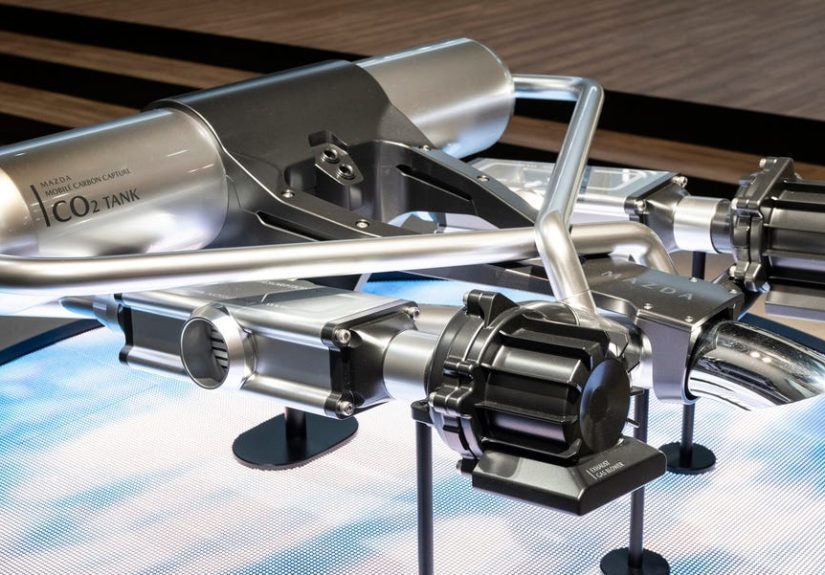
Mazda’s Mobile Carbon Capture system is what pushes the concept from “interesting alt-fuel hybrid” into “wait, what?” territory. The idea is to capture some of the CO2 directly from the exhaust stream using onboard adsorption technology. In other words, the car does not just emit; it also collects.
That is a major reason the Vision X-Coupe is being discussed so widely. A lot of concept cars showcase futuristic styling. Far fewer showcase a future in which the tailpipe becomes part of a climate mitigation story. It is audacious, and it immediately raises all the right questions: How much carbon can it capture? How heavy is the system? How is the captured material stored? How often would it need to be serviced or emptied? What is the energy penalty? What happens in real traffic, real weather, and real long-term use?
Those questions are not nitpicks. They are the difference between a concept stand and a production line. Carbon capture tends to be more straightforward at large industrial sites than in moving passenger vehicles, where space, weight, cost, maintenance, and durability become brutal constraints. Mazda deserves credit for exploring the idea, but the gap between “technically possible” and “commercially practical” is where many ambitious clean-tech dreams go to take a nap.
So, Is the Carbon-Negative Claim Legit?
The fairest answer is this: the claim is plausible as a theoretical lifecycle model, but not yet proven as a mainstream real-world transportation solution. That distinction matters.
If the algae cultivation process absorbs enough CO2, if the fuel production chain is efficient enough, if the vehicle’s carbon-capture system works at the intended rate, if the energy inputs are low enough, and if the captured carbon is reused or stored in a meaningful way, then Mazda’s math can make sense. But all of those “ifs” are doing a lot of heavy lifting.
This is the same challenge that shadows many breakthrough sustainability claims. A technology can be directionally smart and still not be ready for prime time. In fact, that is often how real innovation begins: with an idea that sounds suspiciously like science fiction until engineering, policy, infrastructure, and economics slowly drag it into reality.
Mazda is not claiming that every future production car next year will clean the atmosphere while carving canyon roads. It is presenting a concept that points to a possible path. That is a meaningful difference, and it makes the story more credible, not less.
Why This Matters in the Bigger Auto Industry Debate
The Vision X-Coupe arrives at a moment when the car industry is wrestling with a simple but uncomfortable truth: decarbonization is not as simple as replacing every gas car with a battery-electric one overnight. EVs remain central to the future, but there are still serious conversations around charging infrastructure, battery materials, electricity generation mix, regional energy realities, and how quickly different markets can transition.
Mazda’s concept is essentially a rebuttal to one-size-fits-all thinking. It suggests that combustion engines, when paired with electrification, low-carbon fuels, and carbon capture, might still have a role to play. That argument will not convince everyone. Some people will see it as a clever bridge technology. Others will see it as a detour. But in either case, it pushes the conversation beyond the usual “gas bad, EV good, end scene” script.
It also highlights a strategic truth about smaller automakers. Mazda does not have the scale of Toyota, Volkswagen, or GM. It has to be selective. That often means looking for differentiated solutions rather than simply matching bigger rivals feature for feature. A carbon-negative rotary hybrid concept is very Mazda: technically ambitious, emotionally loaded, and just odd enough to stand out in a crowded field.
The Design Message Is Almost as Important as the Engineering
There is another reason this concept matters: it refuses to treat sustainability as an aesthetic punishment. For years, green-car design often came with an unspoken message that ecological responsibility had to look apologetic, softened, or slightly joyless. The Vision X-Coupe rejects that. It says a lower-carbon future can still be beautiful, dramatic, and a little theatrical.
That may sound superficial, but it is not. People do not buy cars as spreadsheets. They buy them as experiences, aspirations, and extensions of identity. If sustainable mobility is going to win culturally, not just regulatorily, it has to appeal to the heart as well as the carbon ledger. Mazda understands that better than most.
The Catch Nobody Should Ignore
For all the excitement, the catch is obvious: concepts are not contracts. This is not a showroom model, and it is certainly not proof that carbon-negative passenger cars are about to become normal. The fuel pathway remains difficult. The onboard carbon-capture hardware remains highly experimental in this context. Infrastructure remains a massive question mark. And cost, as always, lurks in the background like the world’s least romantic third wheel.
That does not make the Vision X-Coupe meaningless. It makes it exactly what a concept car should be: a machine that reveals where a company’s imagination is headed. Mazda is telling us that it still believes there is life left in enthusiast-friendly combustion, but only if that combustion gets radically cleaner, smarter, and more circular.
Final Verdict: Brilliant Idea, Big Questions
Mazda says its new concept car is carbon-negative, and the most interesting part is that the company has offered an argument detailed enough to discuss seriously. This is not just empty buzzword confetti. There is a real technical framework here involving microalgae biofuel, lifecycle emissions reduction, and onboard carbon capture. That framework is not fully proven, not commercially mature, and not ready to stroll casually into your local dealership. But it is real enough to matter.
The Vision X-Coupe is best understood as a provocative thesis on the future of performance and sustainability. It asks whether a beautiful, powerful, emotionally engaging car can also serve as a tool for reducing atmospheric CO2. That is a huge question. Mazda has not answered it yet. But it has made the question far more interesting than most automakers do.
And honestly, that may be the most Mazda thing of all. Not content with merely building a stylish concept, the company built a stylish concept with a rotary engine, microalgae fuel, and a carbon-snatching tailpipe. It is either delightfully bold or gloriously unhinged, depending on your mood. Probably both. Either way, it is one of the most fascinating climate-tech conversations currently happening in the car world.
Related Experiences: What a Carbon-Negative Mazda Could Feel Like in the Real World
Imagine walking up to the Vision X-Coupe at an auto show. Before anyone says a word about carbon accounting, you notice the proportions. It sits low. It looks expensive. It feels like a machine designed by people who still think driving should stir up emotion before it stirs up a debate. That first impression matters because it changes the way the sustainability story lands. Instead of feeling like homework, it feels like a temptation.
Now imagine the second layer of the experience: somebody explains that the car is not simply a plug-in hybrid, but a rotary-assisted plug-in hybrid running on microalgae-derived fuel with a built-in carbon-capture system. You do not need to be an engineer to understand the basic appeal. The pitch is emotionally satisfying. It tells the driver, “You do not have to give up beauty, sound, or character to participate in a cleaner future.” That is a powerful message, especially for enthusiasts who have spent years fearing that environmentally responsible cars would all become appliances with cupholders.
The ownership experience, if something like this ever reached production, would probably be unlike that of any normal performance sedan. Fueling would not just be a transaction; it would be part of a narrative. Drivers would care where the fuel came from, how it was produced, and whether the captured carbon was actually being reused. In other words, the ownership experience would extend beyond the cabin and into the supply chain. That is unusual for car culture, but it could also be refreshing. A car would no longer just burn a resource. It would participate in a loop.
Then there is the driving experience itself. A rotary-based electrified powertrain would likely feel smoother and more unusual than a standard gas engine setup. Electric torque would give immediate response, while the rotary would add character and range. If Mazda got the tuning right, the sensation could be something enthusiasts rarely get anymore: a futuristic car that still feels mechanical, still feels alive, and still has a personality. That matters because the best cars are not remembered for their mission statements. They are remembered for how they make a driver feel on an ordinary Tuesday.
There is also a quieter emotional experience here. Many drivers love cars and feel increasingly conflicted about that love in a carbon-conscious era. A concept like this speaks directly to that tension. It offers a picture, however theoretical, in which enjoyment and responsibility are not enemies. That does not erase the engineering and infrastructure challenges, but it does change the emotional frame. Instead of guilt, the driver is offered agency.
Even the maintenance experience would be different. A vehicle with onboard carbon capture would not be a simple “fill it and forget it” machine. It might require new kinds of service routines, new driver education, and new questions about how stored carbon is handled. Oddly enough, that complexity could become part of the appeal. Enthusiasts have always tolerated a little inconvenience when they believe the machine is worth it. The difference here is that the inconvenience would be tied not only to performance, but also to environmental purpose.
Ultimately, the real experience surrounding a car like Mazda’s Vision X-Coupe would not just be about acceleration, design, or efficiency. It would be about participating in a different story of mobility. One where a drive is not merely consumption, but contribution. Whether that future arrives exactly as Mazda imagines is still uncertain. But as an experience, as an idea, and as a challenge to the industry’s stale assumptions, it is already doing something important: making people want the future to be both cleaner and more exciting at the same time.






 Close
Close