
Table of Contents >> Show >> Hide
- Why Lecture Slides Are So Easy to Mess Up
- The Rule That Decides Everything: Recoverable vs. Unrecoverable Sources
- Basic APA Reference Format for Lecture Slides
- How to Write the In-Text Citation
- How to Cite Lecture Slides in APA Step by Step
- Common Mistakes to Avoid
- Special Situations
- Copy-and-Adapt Examples
- Final Thoughts
- Real-World Experiences With Citing Lecture Slides in APA
- SEO Metadata
If citing a lecture slide in APA has ever made you stare at your screen like it personally offended you, welcome to the club. Lecture slides look simple until you actually have to cite them. Then the questions start flying: Is it a PowerPoint? A class handout? A website? A personal communication? A tiny educational mystery wrapped in bullet points and questionable clip art?
The good news is that APA 7th edition does have a workable logic for citing lecture slides. The trick is not memorizing one magic formula. The trick is figuring out where the slide lives, whether your reader can retrieve it, and what kind of course material it really is. Once you know that, the rest is mostly formatting, punctuation, and resisting the urge to put random capital letters everywhere.
In this guide, you’ll learn how to cite lecture slides in APA, when to treat slides as recoverable course materials, when to cite them as personal communication, how to format in-text citations, and what to do with awkward cases like missing dates, no title, or slides hidden behind a learning management system. You’ll also get specific examples you can adapt for your own paper, because nothing says academic survival like a copy-ready template.
Why Lecture Slides Are So Easy to Mess Up
Students usually assume every slide deck should be cited the same way. That is where the chaos begins. In APA, lecture slides are not all treated as identical sources. A publicly posted slide deck on a website is not quite the same as a deck uploaded in Canvas for one class section, and neither of those is the same as a live lecture you heard in person and scribbled into your notebook while the projector flickered like it had stage fright.
That is why APA lecture slide citation depends on access. If your audience can retrieve the material, you can usually create a reference list entry. If they cannot retrieve it, APA generally treats it like personal communication, which means it gets cited in text only and does not appear on the reference page.
That one distinction solves most of the confusion.
The Rule That Decides Everything: Recoverable vs. Unrecoverable Sources
1) Publicly Available Lecture Slides
If the lecture slides are posted on a public website where readers can access them, they are recoverable. In that case, you should create a full reference list entry. This applies to slides posted on a university webpage, a faculty site, a public resource page, or a platform where the presentation is openly available.
Think of these slides as online content with a clear author, date, title, format, source, and URL. In APA, the format label usually appears in square brackets, such as [PowerPoint slides] or [Lecture notes].
2) Slides Available in Canvas, Blackboard, Moodle, or Another LMS
If the slides are available inside a course platform and your instructor expects the class to use them, the source may still be treated as recoverable for that audience. In practice, many APA guides recommend citing the slide deck with the instructor as author, the date, the title in italics, a bracketed description, the name of the learning management system, and the course login or course homepage URL.
That last part matters. You usually should not paste some giant, temporary, session-based link that expires in six minutes and dies alone in the dark. Use the stable login page or course home page instead.
3) A Live Lecture, Classroom Remarks, or Your Own Notes
If you are citing something your professor said during class, material from a live lecture that is not retrievable, or your own notes from that lecture, APA usually treats it as personal communication. That means you cite it only in the body of your paper. It does not get a reference entry.
So if your professor explained a concept aloud but did not publish the lecture in a retrievable format, your citation belongs in text only. The same goes for your handwritten notes, annotated printouts, or those heroic half-sentences you typed while your laptop battery hovered at 3 percent.
Basic APA Reference Format for Lecture Slides
When the slide deck is recoverable, the basic APA 7 lecture slides format looks like this:
Author, A. A. (Year, Month Day). Title of lecture or slide deck [PowerPoint slides]. Website or LMS Name. URL
If the material is labeled as lecture notes instead of slides, swap the format label:
Author, A. A. (Year, Month Day). Title of lecture or notes [Lecture notes]. Website or LMS Name. URL
Here is a sample citation for public slides:
Lopez, M. R. (2025, September 18). Behavioral economics in everyday life [PowerPoint slides]. University of North City. https://www.example.edu/behavioral-economics-slides
Here is a sample citation for slides housed in a course platform:
Patel, S. J. (2026, February 4). Week 4: Social cognition and bias [PowerPoint slides]. Canvas. https://canvas.example.edu/
Notice what APA is doing here: author, date, title, format, source, URL. Same architecture, different outfit.
How to Write the In-Text Citation
Once your reference is built, the in-text citation for lecture slides in APA is pretty straightforward.
Paraphrasing a Slide
Use the author’s last name and year:
(Patel, 2026)
Or in narrative form:
Patel (2026)
Quoting Directly From a Slide
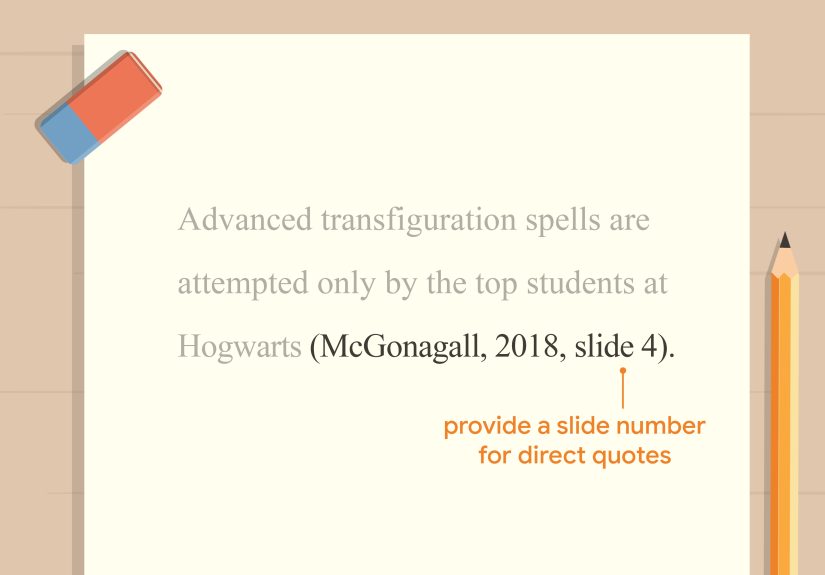
If you quote from a specific slide, include the slide number:
(Patel, 2026, slide 12)
In narrative form:
Patel (2026, slide 12)
Even when you are not quoting word-for-word, adding the slide number can be helpful if you are referring to a specific chart, definition, or diagram. It gives your reader a cleaner trail to follow and makes your citation look like it actually knows where it’s going.
Personal Communication In-Text Citation
If the lecture material is unrecoverable, use this pattern:
(J. A. Patel, personal communication, February 4, 2026)
There is no matching reference list entry for that citation.
How to Cite Lecture Slides in APA Step by Step
Step 1: Identify the Author
The author is often the instructor who created the slide deck. If the deck was clearly published by a department, institution, or organization instead, that group can serve as the author. Do not automatically use the university name unless the university actually authored the material.
Step 2: Find the Date
Use the most specific date available. If the slides include a full publication or posting date, use year, month, and day. If you only have a year, use the year. If there is no date at all, use (n.d.).
Step 3: Use the Exact Title in Sentence Case
Write the title in sentence case, which means only the first word, proper nouns, and the first word after a colon are capitalized. Italicize the title. APA does not want title case here. It wants calm, controlled punctuation energy.
Step 4: Add the Format in Square Brackets
After the title, include a bracketed description such as [PowerPoint slides] or [Lecture notes]. This tells readers what kind of source they are dealing with.
Step 5: Name the Website or LMS
If the material is posted online, include the name of the website or the learning management system, such as Canvas or Blackboard. This helps readers understand where the content is housed.
Step 6: Add the URL
For public materials, use the direct URL. For restricted course content, use the stable login or course home page URL if that is the access point your audience would use.
Common Mistakes to Avoid
Using “personal communication” for everything
Not all lecture slides are personal communication. If readers can retrieve the deck from a public site or course platform, a reference entry may be appropriate.
Citing your own notes as if they were published slides
Your notes are your record of the lecture, not a retrievable publication. Cite them in text only as personal communication when needed.
Forgetting the format label
APA likes labels for nonstandard source types. If you skip [PowerPoint slides] or [Lecture notes], your reference loses useful information.
Using title case instead of sentence case
Week 4: Social cognition and bias is correct. Week 4: Social Cognition and Bias is not the APA favorite.
Leaving out the slide number for a direct quote
If you quote specific wording from one slide, include the slide number in the in-text citation. Your reader should not have to go on a scavenger hunt.
Forgetting to cite the original source behind the slide
If a lecture slide summarizes a study, article, or theory, it is often better to cite the original source whenever possible. Slides are useful, but they are sometimes one step removed from the actual research. APA generally prefers that writers cite the most direct, retrievable source of the information they used.
Special Situations
No Author
If no individual author is named, start with the group author if one exists. For example, a department, school, or training office may be the author.
Department of Psychology. (2026). Memory systems overview [PowerPoint slides]. Blackboard. https://blackboard.example.edu/
No Date
Use (n.d.) in the reference and in-text citation.
Garcia, T. L. (n.d.). Introduction to community health [Lecture notes]. Canvas. https://canvas.example.edu/
No Title
If the slides truly have no title, create a short descriptive title yourself and place it in square brackets in the title position. Keep it concise and accurate.
Wilson, E. R. (2026, January 22). [Lecture slides on gene expression] [PowerPoint slides]. Canvas. https://canvas.example.edu/
Google Slides vs. PowerPoint
APA usually cares more about the source type than the software brand. In most academic writing, [PowerPoint slides] remains a clear and widely understood format label even if the presentation was built in Google Slides. If your institution specifically labels the file another way, you can match that description more closely as long as it stays clear and consistent.
Copy-and-Adapt Examples
Publicly Available Lecture Slides
Nguyen, A. T. (2025, October 3). Media literacy in digital culture [PowerPoint slides]. Western State University. https://www.example.edu/media-literacy
In text: (Nguyen, 2025)
Direct quote: (Nguyen, 2025, slide 8)
Slides in an LMS
Brooks, L. M. (2026, February 10). Week 6: Ethics and persuasion [PowerPoint slides]. Blackboard. https://blackboard.example.edu/
In text: (Brooks, 2026)
Lecture Notes Instead of Slides
Chen, D. P. (2026, January 14). Foundations of qualitative research [Lecture notes]. Canvas. https://canvas.example.edu/
Unrecoverable Live Lecture
(D. P. Chen, personal communication, January 14, 2026)
Final Thoughts
Learning how to properly cite a lecture slide in APA is really about learning to ask two smart questions. First, can my reader retrieve this material? Second, what exactly am I citing: a posted slide deck, lecture notes, or a live classroom explanation? Once you answer those questions, the citation usually falls into place.
So yes, APA can feel fussy. It cares about brackets, dates, italics, and whether your source lives on a public webpage, a course platform, or only in your frantic notes from Tuesday morning. But that fussiness has a purpose. Good citation tells readers what you used, where it came from, and how they can find it. That is not just formatting. That is academic honesty with better punctuation.
And honestly, when you finally get an APA citation for PowerPoint slides right on the first try, it feels a little magical. Not fireworks magical. More like “I have defeated the tiny bureaucratic goblin of citation style” magical. Still counts.
Real-World Experiences With Citing Lecture Slides in APA
One of the most common experiences students have with APA lecture slide citation happens late at night, usually when the paper is done, the deadline is close, and the only thing standing between them and freedom is one miserable reference entry. The student opens the slide deck, sees the professor’s name on the first slide, notices there is no obvious publication date, and immediately begins bargaining with the universe. Maybe the title slide counts as enough information. Maybe “Week 5 Lecture” is a real title. Maybe citations are just a social construct. Sadly, APA remains unconvinced.
Another familiar experience is the LMS trap. The student has a deck in Canvas, Brightspace, or Blackboard and assumes it must be treated like a public website. Then they copy the entire page URL from the browser, including what looks like a small encrypted novel at the end of the address. The result is a citation that works for approximately seventeen seconds and then collapses like a folding chair. This is why experienced writers learn to use a stable course login page or homepage when the material is only available through the class platform. A citation should help a reader find the source, not challenge them to break into your browser history.
There is also the classic “my notes are not the slides” moment. Students often take detailed notes during lecture and later cite those notes as though they were a published course handout. But your notes are your record of what happened, not a retrievable source another reader can consult. That distinction feels small until your instructor points it out in red ink. Once you understand it, though, it changes how you think about citation. APA is not asking whether you personally saw the information. It is asking whether your reader can trace it too.
Many writers also discover that lecture slides are often not the best source to cite in the first place. A slide may summarize a theory, define a term, or quote a study, but the strongest paper usually cites the original article, book, or report behind that slide. This is a surprisingly useful habit. It improves credibility, gives you fuller context, and helps you avoid building an argument on somebody else’s bullet-point summary of somebody else’s research. In other words, whenever possible, go upstream.
Then there is the oddly satisfying experience of finally understanding the pattern. Once students realize that most citation problems come down to author, date, title, format, source, and retrievability, the stress level drops fast. Suddenly, citing lecture slides is no longer a weird academic ambush. It becomes a checklist. Find the author. Check for a date. Use sentence case. Add [PowerPoint slides]. Name the LMS or website. Include a stable URL if readers can retrieve it. Use personal communication if they cannot. Done. The beast is tamed.
And that may be the most useful experience of all. Learning how to cite slides properly in APA teaches more than one citation rule. It teaches you how to evaluate a source, think about audience access, and document information responsibly. Those skills follow you into research papers, presentations, graduate work, and professional writing. So while nobody wakes up excited to format a reference entry for a lecture deck called Week 7: Semiotics and consumer culture, learning how to do it correctly is one of those small academic skills that quietly pays off again and again.







 Close
Close