
Table of Contents >> Show >> Hide
- Why Junk Drawers Become Chaos Zones
- The Step-by-Step Guide to Organizing a Junk Drawer
- Smart Tips and Examples for Better Drawer Organization
- Common Junk Drawer Mistakes to Avoid
- The Emotional Side of a Junk Drawer
- Extended Experiences: What I Learned After Organizing Dozens of Junk Drawers ()
- Conclusion
If you’ve ever opened your junk drawer and felt like you were staring into the abysswhere rogue rubber bands mingle with mystery keys and twist ties from 2008you’re not alone. Every home in America seems to have one. The junk drawer is the Bermuda Triangle of household essentials: things go in, but they rarely come out. The good news? You can reclaim it. And yes, you can do it without losing your sanity or accidentally rediscovering 17 expired coupons.
In this guide, we’ll walk through practical, research-backed strategies from top U.S. home-organization and lifestyle sitesthink Better Homes & Gardens, Real Simple, The Spruce, Apartment Therapy, Martha Stewart, and moreto help you transform your junk drawer from a clutter cave into a calm, functional command center. And we’ll do it with humor, because organizing should be fun (or at least feel less like a punishment).
Why Junk Drawers Become Chaos Zones
Before we dive into sorting, let’s call out the truth: junk drawers are not evil. They’re necessary. Modern households need a quick-drop zone for things like batteries, pens, glue sticks, tape, charger cables, and that little baggie of screws that came with your bookshelf.
The problem is what experts call “decision fatigue.” When something doesn’t have a clearly assigned home, we toss it into the junk drawer “temporarily.” Multiply that by 365 days, and suddenly your drawer has become a confusing mash-up of everyday items, obsolete gadgets, and tiny objects you swear you’ll deal with “later.”
But with a little structureand a refreshed mindsetyou can redefine the junk drawer as a purposeful utility drawer that actually works.
The Step-by-Step Guide to Organizing a Junk Drawer
Step 1: Empty It Completely
Dump. It. Out. This is the moment of truth. Pull the entire drawer out if needed and place everything on a counter or table. You’ll instantly see categories forming: office supplies, tech accessories, hardware bits, kitchen tools, personal items, and mystery artifacts that may or may not belong to a different dimension.
Most organization experts agree that you need a full reset to make real change. Don’t try to tidy around existing messesstart fresh.
Step 2: Sort Into Categories
Create piles (or zones) for each category. A few common ones:
- Writing utensils
- Tools and hardware
- Cords, chargers, and tech accessories
- Batteries
- Tape, adhesives, and glues
- Miscellaneous household essentials (flashlights, lighters, scissors)
- “Why do I even have this?” items
The last pile is key, because it will be bigger than you think. That’s normal. Welcome to the human experience.
Step 3: Purge Ruthlessly
Once sorted, you’ll quickly see duplicates, dried-out pens, dead batteries, and random plastic bits that don’t fit anything you own anymore. Let them go. Most U.S. organizing pros recommend eliminating at least 25–40% of junk drawer contents during cleanup.
Throw away broken items, donate usable extras, and recycle what can be recycled. The goal: keep only what you actually use and need.
Step 4: Clean the Drawer
Use a damp cloth or disinfecting wipe to clean crumbs, dust, and those random glitter specks you swear you didn’t put there. Then line the drawer with a non-slip mat so organizers stay in place.
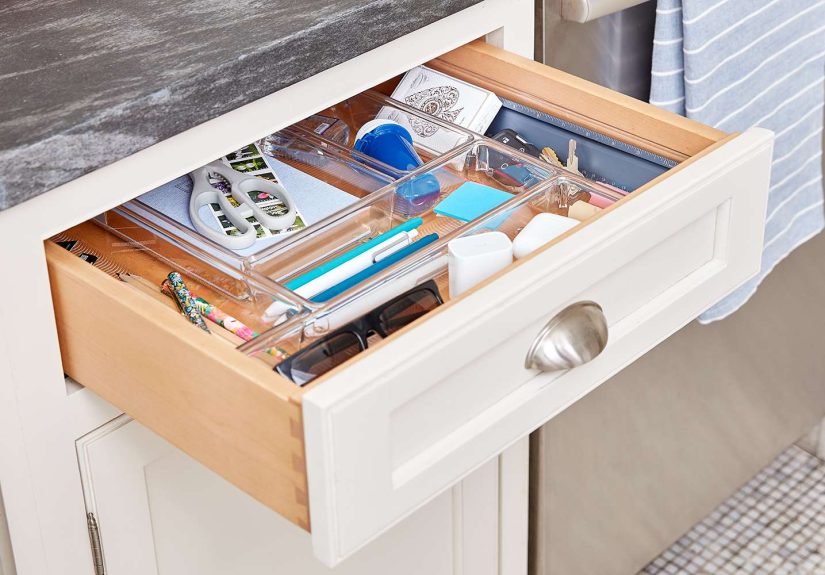
Step 5: Choose the Right Organizers
Experts from The Container Store, Target, HGTV, and Real Simple all agree: drawer organizers are the secret sauce. You can use:
- Modular plastic bins
- Bamboo drawer dividers
- Adjustable trays
- Silicone expandable compartments
- Repurposed small boxes (tea boxes, gift boxes, clean takeout containers)
Measure your drawer before buying anythingthis avoids the classic “organizer doesn’t fit and now I have more junk” situation.
Step 6: Create Logical Zones
Every category gets a specific, clearly defined home. For example:
- Pens and pencils → front left compartment
- Batteries → small bin in the middle
- Charging cables → coiled neatly in a tech tray
- Tape and sticky notes → rear compartment
- Mini tools → small, sturdy bin on the right
The more intuitive the categories, the easier it will be to maintain. Prioritize the items you use most and place them in the front for easy access.
Step 7: Label (Optional but Very Effective)
Labeling doesn’t make you extrait makes your future self grateful. Consider labeling bins with categories like “Cords,” “Batteries,” “Writing Tools,” or “Tape.” This adds clarity, reduces clutter, and prevents mystery items from sneaking back in.
Step 8: Set a Maintenance Routine
Now that your junk drawer is looking fabulous, maintain it with micro-cleanups. Every 1–2 months, spend one minute removing trash, returning misplaced items, and checking for duplicates.
Some experts recommend doing this seasonally, others say monthly, but the key is consistency. A 60-second tidy goes a long way.
Smart Tips and Examples for Better Drawer Organization
Use Vertical Dividers for Long Items
If your drawer is deep, add vertical dividers for scissors, rulers, flashlights, or zip-lock bags. This prevents long items from sliding around like kids at a water park.
Try the “One Drawer, One Purpose” Rule
If you have multiple junk drawers (no judgment), assign each a specific role:
- Utility drawer – tape, tools, screwdrivers, super glue
- Office drawer – pens, paper clips, sticky notes
- Tech drawer – headphones, chargers, USB sticks
This keeps things from merging into chaos.
Use Containers Inside Larger Containers
Nested organizers give you micro-zones for tiny items such as thumbtacks, rubber bands, or extra keys.
Store Batteries Safely
Loose batteries rolling around can drain or become unsafe. Store them upright in a battery case or a small divided bin.
Bundle Cords Properly
Wrap cables with Velcro ties or twist ties to prevent tangling. It’s a small step with huge payoff.
Common Junk Drawer Mistakes to Avoid
- Using too few organizers. Wide open spaces equal chaos.
- Over-storing items. Keep only what fits comfortably in the drawer.
- Throwing in mail or papers. Junk drawers aren’t mini filing cabinets.
- Letting expired items linger. Coupons, old receipts, and dead batteries? Toss.
- Not giving items a real home. A junk drawer cannot contain the entire universe.
The Emotional Side of a Junk Drawer
Yes, organizing a drawer can feel emotional. You may find old photos, tiny souvenirs, or weird home-repair items that remind you of past projects. Part of the process is accepting that it’s okay to let go of things that no longer serve a purpose. A tidy junk drawer is not just convenientit’s therapeutic.
Extended Experiences: What I Learned After Organizing Dozens of Junk Drawers ()
Even though every home has a junk drawer, no two are exactly alike. After working through dozens of drawer makeovers and studying insights from American organization experts, bloggers, and home-editing professionals, a few universal truths always emerge.
1. The real clutter comes from tiny things.
It’s never the big itemsthose find homes easily. It’s the tiny screws, orphaned keys, dried-out pens, random toy pieces, and endless twist ties that cause chaos. Once you containerize them, the drawer suddenly looks 10 times cleaner.
2. People keep things “just in case”and that’s the trap.
The junk drawer becomes a purgatory for items that feel important but aren’t actively used. When organizing, I often ask: “If you needed this, would you know it was here?” If the answer is no, it doesn’t belong.
3. Drawer organizers are life-changing.
Even inexpensive organizers from Dollar Tree or Target instantly create structure. The magic happens when each organizer is sized to fit only the necessary amount of each item. Limited space forces intentional decisions.
4. Maintenance is surprisingly easy once the system works.
People assume their drawer will return to chaos within weeks. But when categories are intuitive and clearly defined, the opposite is trueyour brain automatically puts things where they belong. It becomes muscle memory.
5. Kids love organized drawers.
This surprised me most. When drawers are sectioned and labeled, kids put things away more often. Tidiness becomes a game rather than a chore.
6. The best junk drawers balance utility and personality.
A truly great junk drawer has a mix of household essentials and small personal items that bring joy. Maybe it’s a favorite pen, a lucky coin, or a tiny keepsake. Organization isn’t about minimalism; it’s about intentionality.
7. Overstuffing the drawer guarantees failure.
A junk drawer should have breathing room. When it’s packed tight, items shift and mix, and suddenly you’re back to square one. Leave empty spaceit’s not wasted, it’s wise.
8. The transformation feels bigger than the project.
Organizing a junk drawer can take as little as 20 minutes, yet the sense of order often radiates throughout the whole kitchen or office. It gives a feeling of being “on top of things,” even when life is busy.
Ultimately, organizing a junk drawer is not just a cleaning taskit’s a small act of empowerment. When you create order in a tiny space, you prove to yourself that organization is manageable, even in a chaotic world.
Conclusion
Your junk drawer doesn’t have to stay a clutter magnet. With smart strategies, clear categories, the right organizers, and a routine you can actually stick to, it can become one of the most functional spaces in your home. Remember: organization is not about perfectionit’s about making your life easier one drawer at a time.






 Close
Close