
Table of Contents >> Show >> Hide
- Why stock kitchen cabinets make a surprisingly great bed base
- Plan first: the three measurements that decide everything
- Choose the right cabinets for a built-in bed
- Tools and materials checklist
- Step-by-step: build a built-in bed with stock kitchen cabinets
- Step 1: Sketch the layout (yes, even a “rough sketch” counts)
- Step 2: Build a level base (plinth) so your cabinets start square
- Step 3: Set the cabinets, shim, clamp, and fasten
- Step 4: Tie everything together with a “bed deck” frame
- Step 5: Build the mattress platform (ventilation matters)
- Step 6: Add under-platform storage (optional, but highly satisfying)
- Step 7: Make it look built-in (scribes, fillers, and trim)
- Step 8: Finish strong (paint, hardware, lighting, and little luxuries)
- Two proven layout ideas (with real-world logic)
- Common mistakes (and how to avoid them)
- FAQ: Quick answers before you start cutting
- Conclusion
- Field Notes: Real-World Experiences DIYers Keep Mentioning (So You Don’t Have to Learn the Hard Way)
If your bedroom feels like it’s playing Tetris with your stuff (and losing), a built-in bed using stock kitchen cabinets
is the kind of DIY that makes a room feel customwithout the custom-cabinet price tag. Think of it as a bed, a dresser, and a
“where did all this storage come from?” magic trick… all in one.
In this guide, you’ll learn how to plan, build, and finish a cabinet-based built-in bed that looks intentional, feels solid,
and gives you storage for everything from extra linens to that random box labeled “Cables (Important)” that nobody opens.
Why stock kitchen cabinets make a surprisingly great bed base
They’re engineered boxes (and boxes are strong)
Kitchen cabinets are designed to live under heavy countertops, hold dishes, and survive daily use. When you lock multiple cabinets
together and top them with a properly framed deck, you get a sturdy foundation for a platform bed with storage.
Standard sizes = easier planning
Stock cabinets come in predictable widths (often 9″–36″) and common depths (12″ and 24″). That makes it easier to “design with math”
instead of “design with vibes,” which is fununtil you’re standing in the aisle holding a tape measure like it betrayed you.
Drawers and doors are already solved
Building drawers from scratch is doable, but it’s also how people accidentally invent new swear words. Using cabinets means you can
buy drawers/doors ready to go, then focus your DIY energy on structure, fit, and finishing details.
Plan first: the three measurements that decide everything
1) Mattress size (real size, not “queen-ish”)
Measure your actual mattress (width, length, thickness). Mattresses can vary slightly by brand and style, especially foam and pillow-top.
Plan a little wiggle room so bedding tucks in cleanly without needing a crowbar.
2) Finished bed height (a quick formula)
Your finished height affects comfort and how “built-in” the bed feels. Use this simple formula:
- Finished height = cabinet height + base/plinth height + deck thickness + mattress thickness
Example: If your cabinets are 24″ tall, your plinth is 2″, your deck is 1″ (3/4″ plywood + trim), and your mattress is 10″,
your finished height is about 37″. That’s “tall hotel bed” territorygreat for adults, not always ideal for kids. Want lower? Choose shorter
cabinets, reduce plinth height, or use a thinner deck/mattress combo.
3) Clearance and access
- Walkways: leave room to move around the bed without doing sideways crab-walks.
- Doors/drawers: make sure cabinet doors and drawers open fully (especially near walls).
- Windows/egress: don’t block a window that needs to function for ventilation or emergency exit.
- Sloped ceilings: in dormers/attics, sit up in the intended spot and confirm headroom.
Choose the right cabinets for a built-in bed
Best cabinet types for this project
- Drawer base cabinets: easiest access and best everyday storage.
- Door base cabinets: great for bulky items (extra blankets, bins, luggage).
- Shorter “utility” or specialty cabinets: ideal when you want a lower bed height.
Depth: 12" vs 24"
12″ deep cabinets work well for flanking “dresser towers” around an alcove bed or as nightstand-style storage.
24″ deep cabinets maximize storage and can form the main base for a deeper platformjust watch the total footprint in smaller rooms.
Height: avoid the “bunk bed you didn’t order” problem
Standard kitchen base cabinets are often tall. If you’re building a daybed/alcove bed, shorter cabinet configurations usually look more proportional.
If you love standard base cabinets for the storage, plan your mattress thickness and deck framing so the bed doesn’t end up chest-high.
Tools and materials checklist
Adjust based on your design, but this covers most cabinet-bed builds:
Materials
- Stock kitchen cabinets (drawer and/or door bases)
- 3/4″ plywood for the mattress deck (and optional drawer parts)
- 2x4s (or 2x3s) for a level base/plinth and deck framing
- Cabinet screws (follow cabinet manufacturer guidance) and construction screws for framing
- Shims (you’ll use more than you thinkbecause floors are rarely honest)
- Trim: baseboard, shoe molding, face-frame material, panel molding (optional)
- Paint/primer or stain, plus caulk and wood filler
- Hardware: pulls/knobs, optional drawer slides or casters
Tools
- Tape measure, level (a long level is a gift to your future self)
- Stud finder
- Drill/driver + bits
- Circular saw or track saw (jigsaw for notches)
- Clamps
- Sander
- Nail gun (optional) or finish nails + hammer
Step-by-step: build a built-in bed with stock kitchen cabinets
Step 1: Sketch the layout (yes, even a “rough sketch” counts)
Start with the mattress rectangle, then place cabinets around it. Decide where you want access:
drawers facing the room, cabinet doors at the foot, or “dresser” cabinets flanking the bed.
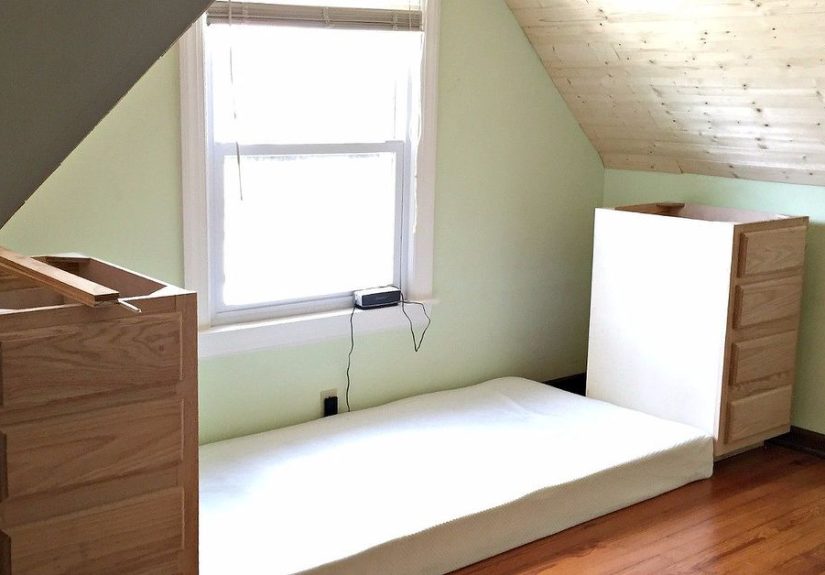
Pro tip: If the bed is going into an alcove or dormer nook, many successful builds use cabinets at the ends (like built-in nightstands)
plus a framed platform in the middle. You get structure, storage, and that “this was always meant to be here” look.
Step 2: Build a level base (plinth) so your cabinets start square
Floors slope. Walls bow. Nature is beautiful. Houses are… interpretive. A simple plinth (a ladder frame made from 2x lumber) lets you shim once
and give the cabinets a flat, level surface.
- Find the high spot on the floor where the cabinets will sit.
- Assemble a rectangular plinth to match your cabinet footprint.
- Set it in place, shim until level, and fasten it appropriately for your floor type.
Step 3: Set the cabinets, shim, clamp, and fasten
Treat cabinet installation like a team sport: you want every box aligned, plumb, and locked together.
- Mark stud locations on the wall.
- Place the first cabinet (start at a corner or an end), level it side-to-side and front-to-back with shims.
- Clamp the next cabinet to the first so face frames are flush.
- Fasten cabinets to each other (per manufacturer guidance) and secure to studs through appropriate mounting areas.
- Repeat until all cabinets are installed and aligned.
Step 4: Tie everything together with a “bed deck” frame
Cabinets are strong boxes, but your mattress needs continuous support. Build a deck frame that spreads load across cabinets and any open spans.
- Add 2x framing along the cabinet tops where needed for a flat plane.
- If your design includes an open span, install cross supports (like joists) at regular intervals.
- For alcove builds, a wall-mounted cleat/ledger (fastened into studs) can support the deck edge.
Step 5: Build the mattress platform (ventilation matters)
A solid sheet of plywood can trap moisture under some mattresses (especially foam). You have a few options:
- Slats: a classic approach for airflowspace them evenly and keep them consistent.
- Vented plywood: drill ventilation holes in a plywood deck if you prefer a solid top.
- Hybrid: plywood perimeter with slats through the center for both rigidity and airflow.
Secure the platform so it doesn’t squeak. (Squeaks are just your bed trying to tell jokes at 2 a.m.and nobody laughs.)
Step 6: Add under-platform storage (optional, but highly satisfying)
Want the “wow” factor? Many cabinet-bed builds include trundle-style drawers that roll out on casters, especially when the bed platform
spans between cabinet “ends.” This can be cheaper and simpler than heavy-duty slides for extra-wide drawers.
- Casters: great for big drawers; add a sturdy drawer box and a clean face panel.
- Heavy-duty slides: ideal for refined motion, but plan carefully for load rating and perfect alignment.
- Toe-kick drawers: sneaky storage for flat items; more fussy to build but very cool.
Step 7: Make it look built-in (scribes, fillers, and trim)
This is where “stock cabinets” become “custom built-ins.” Your goal is to hide gaps, make lines intentional, and create symmetry.
- Fillers/scribes: use filler strips where cabinets meet walls; scribe to uneven drywall for a tight fit.
- Face frame: add a continuous face frame or trim “stiles” so everything reads as one unit.
- Baseboard integration: return baseboard into the build so the bed feels anchored to the room.
- Caulk strategically: small gaps disappear; big gaps become “modern shadow lines” only if you meant it.
Step 8: Finish strong (paint, hardware, lighting, and little luxuries)
Prime and paint for a durable finish. Add hardware that matches the room. Consider:
- Plug-in sconces or reading lights
- USB/charging outlets nearby
- Soft-close hinges or drawer upgrades (optional, but delightful)
- A feature wall (wood slats, paneling, or wallpaper) to frame the bed visually
Two proven layout ideas (with real-world logic)
Layout A: Alcove/daybed with end cabinets + trundle drawers
This classic approach uses two stock cabinets at the ends (like built-in nightstands), a framed platform between them, and
rolling drawers underneath for extra storage. It’s especially good for dormers, alcoves, and awkward nooks because the cabinets “cap” the bed
and make the whole structure feel intentional.
Layout B: Built-in platform bed with cabinet storage facing the room
If your bed is set into a wall-to-wall nook, you can place cabinets along the exposed side so drawers/doors open into the room.
Top everything with a framed deck and finish with trim panels so it reads as furniture, not kitchen leftovers (no offense to kitchens).
Common mistakes (and how to avoid them)
- Skipping the level base: one out-of-level cabinet becomes a whole out-of-level bed.
- Forgetting mattress ventilation: airflow prevents funk and extends mattress life.
- Not accounting for baseboards: either remove them or notch/scribe so cabinets sit flush.
- Under-supporting spans: if the deck spans open space, frame it like you mean it.
- Buying cabinets before planning height: storage is great, but so is climbing into bed without a running start.
FAQ: Quick answers before you start cutting
Do I need a box spring?
Usually no. A properly built platform deck (slats or a vented surface) supports most modern mattresses. Always follow your mattress warranty requirements.
Can I use leftover cabinets?
Yesjust confirm they’re square, structurally sound, and not water-damaged. Reinforce where needed and plan your finish so mismatched cabinets still look cohesive.
What’s the fastest way to make it look custom?
Continuous trim lines, scribed fillers, matching hardware, and a unified paint finish. The “custom look” is mostly about hiding transitions.
Conclusion
A built-in bed using stock kitchen cabinets is one of the highest-impact DIY upgrades for small bedrooms and awkward nooks.
Plan your height, anchor everything securely, frame a solid (and breathable) mattress deck, then take your time with trim and finish.
Do it right and you’ll get a bed that looks built-in, stores like a closet, and makes your room feel like it got a professional makeoverwithout the invoice.
Field Notes: Real-World Experiences DIYers Keep Mentioning (So You Don’t Have to Learn the Hard Way)
If you read enough build logs and project recaps on cabinet-based beds, you’ll start noticing the same “why didn’t someone warn me?” moments.
Here are the most common lessons people share after tackling a DIY built in bed with kitchen cabinetspackaged into one friendly
heads-up list, because your future self deserves nice things.
First: the floor is never level. Even in newer homes, the “flat” floor usually has a high spot and a gentle slope. DIYers who skip
the leveling step often end up with drawers that drift open, cabinet doors that swing like haunted-house props, and a mattress platform that creaks
because it’s fighting gravity. The win is building a simple plinth and shimming it carefully. People routinely say it feels slow in the moment, but it
prevents a long chain of tiny annoyances later. Level once, relax forever.
Second: bed height sneaks up on you. Cabinets look normal in a store. Add a base, add a deck, add a mattress… and suddenly your bed is
tall enough to qualify as a sightseeing destination. A common workaround is to choose shorter cabinets where possible (especially for daybeds),
reduce plinth height, and avoid an overly thick mattress if the space has low ceilings or sloped dormer walls. DIYers also recommend mocking up height
with stacked boxes or scrap lumber before committing. It’s the cheapest “test build” you’ll ever do.
Third: access beats capacity. Huge deep cabinets under a bed sound amazinguntil you realize you’re crawling around to reach the stuff in back.
Many builders end up happier with drawers (even smaller ones) because daily-use storage needs to be easy. The pattern is predictable: drawers for clothes,
sheets, and kid items; doors or deeper cubbies for bulky seasonal storage. When planning your cabinet mix, think about what you’ll actually grab weekly,
not what you might store once and forget until the next ice age.
Fourth: finishing is the project. The structure goes faster than expected; the trim and paint take longer than expected. People who love their
final result almost always mention scribing fillers to the wall, aligning reveals between drawers, and doing the unglamorous prep: sanding, priming, caulking,
and filling nail holes. The difference between “DIY” and “custom” is usually one extra evening of detail workand the willingness to redo a piece of trim
that’s “fine” but not great.
Finally: the little comforts make it feel intentional. A built-in bed becomes everyone’s favorite spot when you add practical extras:
a reading light, a small ledge for a phone and water glass, a soft-close hinge upgrade, or a feature wall that frames the alcove. DIYers also mention that
quiet mattersfelt pads where wood meets wood, solid fastening to eliminate micro-movement, and a platform deck that’s secured well enough to avoid squeaks.
When all those small choices stack up, the bed stops feeling like “cabinets with a mattress on top” and starts feeling like a designed piece of the room.







 Close
Close