
Table of Contents >> Show >> Hide
- Materials You Need Before You Start
- How to Draw a Water Bottle: 11 Steps
- Step 1: Study the Bottle Shape First
- Step 2: Draw a Light Vertical Center Line
- Step 3: Sketch the Main Bottle Body
- Step 4: Add the Top and Bottom Ellipses
- Step 5: Draw the Neck and Cap
- Step 6: Add the Label or Design Area
- Step 7: Mark the Water Line Inside the Bottle
- Step 8: Refine the Outline and Erase Extra Guides
- Step 9: Add Shadows to Create Volume
- Step 10: Draw Highlights and Reflections
- Step 11: Add Final Details and a Cast Shadow
- Beginner Tips for a Better Water Bottle Drawing
- Common Mistakes When Drawing a Water Bottle
- How to Draw Different Types of Water Bottles
- Experience Notes: What Drawing a Water Bottle Teaches You
- Conclusion
Learning how to draw a water bottle sounds suspiciously simpleuntil you sit down, sharpen your pencil, and realize the bottle has curves, transparent edges, a cap, a label, water reflections, and one tiny shadow that somehow makes the whole thing look either realistic or like a confused cucumber. The good news? A water bottle is one of the best everyday objects for practicing basic drawing skills because it combines simple shapes with just enough detail to keep your brain awake.
This guide breaks the process into 11 clear steps, moving from basic construction lines to shading, highlights, and finishing touches. Whether you want a cute cartoon water bottle, a clean school-project sketch, or a more realistic still-life drawing, the method is the same: start with structure, refine the shape, then build depth with light and shadow.
Grab a pencil, eraser, paper, and your favorite bottle as a reference. Clear plastic, stainless steel, sports bottle, reusable tumblerany style works. Just do not drink all the water before you finish drawing it. Hydration is important, but so is art.
Materials You Need Before You Start
You do not need a professional art studio to draw a water bottle. A simple pencil and paper are enough for a beginner sketch. However, a few extra tools can make your drawing cleaner and easier to control.
Recommended Drawing Supplies
- HB pencil for light sketching
- 2B or 4B pencil for darker shadows
- Kneaded eraser or soft white eraser
- Ruler for straight guide lines
- Blending stump, tissue, or cotton swab for smooth shading
- Colored pencils, markers, or watercolor if you want color
- White gel pen for bright highlights
- A real water bottle or reference photo
If you are a beginner, start with a front-view bottle. A straight-on view is easier because the left and right sides should match. Once you feel comfortable, try drawing the bottle from an angle. That is where ellipses, perspective, and “why does this cap look like a flying saucer?” enter the chat.
How to Draw a Water Bottle: 11 Steps
Step 1: Study the Bottle Shape First
Before your pencil touches the paper, look carefully at the bottle. Is it tall and slim? Short and wide? Does it have a narrow neck, a rounded shoulder, a screw cap, a label, ridges, or a curved base? Observing first helps you avoid drawing from memory, which usually creates a generic bottle-shaped blob.
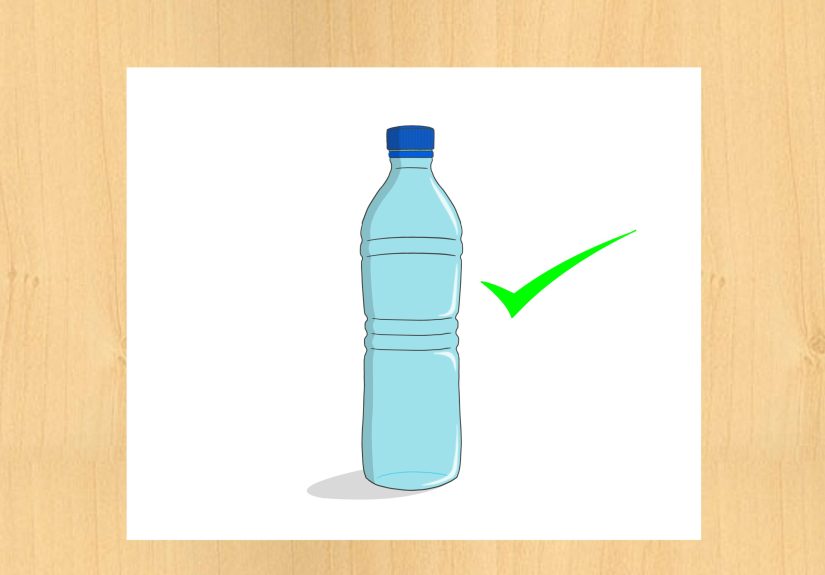
Think of the water bottle as a combination of basic forms. Most bottles are built from cylinders, ellipses, rectangles, and gentle curves. The body is usually a tall cylinder. The cap is a smaller cylinder. The top and bottom are ellipses. The label may be a curved rectangle wrapped around the surface. Once you see the hidden shapes, the drawing becomes much less intimidating.
Step 2: Draw a Light Vertical Center Line
Start by drawing a faint vertical line down the middle of your page. This is your symmetry guide. It keeps the bottle balanced so one side does not bulge out like it has been doing push-ups at the gym.
Keep this line light because you will erase it later. The center line should run from the top of the cap to the bottom of the bottle. If you are drawing a tilted bottle, angle the line slightly. For a front-view bottle, keep it straight.
This simple guide is especially helpful when drawing transparent bottles, reusable bottles, and sports bottles because small differences between the left and right sides become noticeable quickly.
Step 3: Sketch the Main Bottle Body
Using the center line as your anchor, lightly draw the main body of the bottle. For a basic plastic water bottle, sketch two long vertical sides. They can be perfectly straight for a simple bottle or slightly curved inward and outward for a more realistic shape.
At this stage, do not press hard. The first sketch is only a construction drawing. You are planning the shape, not signing a legal contract with your pencil. Leave room at the top for the neck and cap, and leave space at the bottom for the curved base.
If your bottle has a pinched waist or grip grooves, mark those areas lightly. Do not add details yet. Focus on proportion: height, width, and overall silhouette.
Step 4: Add the Top and Bottom Ellipses
A bottle is round, so its top and bottom edges should not look completely flat. Draw a shallow oval, also called an ellipse, at the bottom of the bottle. Then draw another small ellipse near the top where the neck or opening begins.
The bottom ellipse helps the bottle feel three-dimensional. The trick is to make both sides of the oval even. A lopsided ellipse can make the bottle look like it is melting, which is probably not the goal unless you are drawing a water bottle in a surrealist desert.
For a front-view drawing, the ellipses should be centered on your vertical guide line. The lower ellipse is often wider than the top ellipse because the base of the bottle is wider than the neck.
Step 5: Draw the Neck and Cap
Now add the bottle neck. From the upper body, draw two shorter lines rising toward the cap. Many water bottles have sloped shoulders that narrow into the neck. Sketch those shoulder curves gently, making sure they match on both sides.
Above the neck, draw the cap as a small cylinder. Start with a narrow rectangle shape, then add an ellipse on top and a curved line along the bottom. If the cap has ridges, do not draw every ridge yet. First make sure the cap sits straight on the neck.
For a sports bottle, the cap might include a flip-top lid, nozzle, or loop handle. For a reusable metal bottle, the cap may be wider and flatter. For a disposable plastic bottle, the cap usually has small vertical grooves around the sides.
Step 6: Add the Label or Design Area
Most water bottles have a label, logo, measurement marks, or decorative band. Draw the label as a curved rectangle around the middle of the bottle. The top and bottom edges of the label should curve slightly to follow the round surface.
This is a small detail that makes a big difference. If the label lines are perfectly straight, the bottle may look flat. Curving them tells the viewer, “Yes, this object is round. Please applaud quietly.”
You can leave the label blank, add simple text, draw a mountain logo, or create your own brand name. If you are practicing realism, keep the label simple. Too much tiny lettering can distract from the shape and shading.
Step 7: Mark the Water Line Inside the Bottle
If you are drawing a transparent plastic bottle, add a water line inside. The water line should also be slightly curved, not perfectly straight, because it follows the round form of the bottle.
Place the water line about halfway or two-thirds up the bottle. Then add a faint curved line near the back edge to show that the water continues around the inside. You can lightly shade the area below the water line to show that it is filled.
For a realistic effect, remember that water distorts what appears behind it. Lines seen through water may look slightly bent or softer. You do not need advanced physics herejust a few subtle changes can suggest transparency.
Step 8: Refine the Outline and Erase Extra Guides
Once the basic shape looks right, darken the clean outer contour of the bottle. Use smooth, confident lines. Then erase construction marks that are no longer needed, including the center line and extra sketchy strokes.
Be careful not to erase important inner details such as the label, water line, neck, cap, or base ellipse. If you accidentally erase something, do not panic. Every artist has erased a masterpiece at least once. That is why erasers exist: for mistakes, adjustments, and emotional support.
At this point, your water bottle drawing should be recognizable even without shading. The silhouette should feel balanced, the cap should align with the center, and the label should wrap naturally around the body.
Step 9: Add Shadows to Create Volume
Shading turns a flat outline into a three-dimensional object. Decide where your light source is coming from. For example, imagine the light is shining from the upper left. That means the right side and lower areas of the bottle will be darker.
Use light pencil pressure to shade along one side of the bottle. Build the tone gradually instead of pressing too hard right away. Add darker shading under the cap, beneath the label, around the base, and inside any grooves or ridges.
For a round object like a bottle, shadows should curve with the form. Use vertical strokes along the sides and soft horizontal curves near the base. Blend gently if you want a smooth look, but keep some crisp edges for reflections and details.
Step 10: Draw Highlights and Reflections
Highlights are the secret ingredient in a realistic water bottle drawing. Plastic, glass, and metal all reflect light, but they do it differently. A clear plastic bottle often has long white streaks along the sides. A metal bottle may have broader, smoother reflections. A glass bottle may show sharper highlights and darker contrast.
Leave thin white areas unshaded on the side facing the light. If you shaded too much, lift graphite with a kneaded eraser. You can also add bright highlights with a white gel pen after the drawing is finished.
Place highlights on the cap, shoulder, label edge, water surface, and curved side of the bottle. Do not cover the whole bottle with shiny marks. A few well-placed highlights look better than turning the bottle into a disco ball.
Step 11: Add Final Details and a Cast Shadow
Finish your drawing by adding small details: cap grooves, label folds, tiny bubbles, water ripples, recycling marks, measurement lines, or texture on the plastic. Keep the details lighter in areas that are farther from the viewer and darker near the main focal point.
Finally, draw a cast shadow under the bottle. This anchors it to the surface so it does not look like it is floating in space. The cast shadow should be darkest near the base and softer as it moves away. If your light source is on the left, the shadow should stretch slightly to the right.
Review the whole drawing. Are both sides balanced? Does the cap line up? Are the ellipses smooth? Is there enough contrast between light and dark? Make small corrections, then step back and admire your work. Congratulationsyou have drawn a water bottle, and it probably has more personality than the one sitting on your desk.
Beginner Tips for a Better Water Bottle Drawing
Use Light Lines First
Heavy lines are hard to erase and can make the drawing look stiff. Start lightly, especially when sketching the bottle body, cap, and label. Once the proportions are correct, darken only the final lines.
Make the Sides Match
Because most bottles are symmetrical, the left and right sides should mirror each other. Use the center line to compare distances. If one side curves outward more than the other, adjust it before shading.
Practice Ellipses Separately
Ellipses are one of the hardest parts of drawing bottles, cups, cans, and jars. Warm up by drawing rows of ovals before starting the final sketch. Try to make each ellipse smooth, even, and centered.
Do Not Overdo the Label
A label can add realism, but too much text or decoration can overwhelm the drawing. Use simple shapes, a few lines, and maybe one bold logo. The goal is to draw a convincing water bottle, not design an entire beverage empire before lunch.
Use Contrast Wisely
Realistic drawings need a range of values: light, medium, and dark. If everything is the same gray tone, the bottle will look flat. Add darker shadows under the cap, inside grooves, and near the base. Keep highlights bright and clean.
Common Mistakes When Drawing a Water Bottle
Mistake 1: Drawing the Bottle Too Flat
A water bottle is a cylinder, not a rectangle. Use curved lines, ellipses, and wrapping label edges to show roundness. Even a simple cartoon bottle should have some sense of volume.
Mistake 2: Forgetting the Light Source
Random shading makes the drawing confusing. Pick one light direction and stay consistent. If the left side is bright, the right side should usually be darker.
Mistake 3: Making the Cap Crooked
The cap is small, but it can ruin the whole drawing if it tilts accidentally. Align it with the center line and check that the top ellipse matches the bottle’s angle.
Mistake 4: Using Only Outlines
Outlines help define the object, but shadows and highlights make it believable. Add at least a simple shadow along one side and a cast shadow underneath.
Mistake 5: Ignoring Transparency
If the bottle is clear, show what makes it clear: water line, inner back edge, distorted label marks, highlights, and overlapping shapes. Transparency is not about drawing nothingit is about drawing the light and shapes that pass through the object.
How to Draw Different Types of Water Bottles
Plastic Water Bottle
A plastic bottle usually has a narrow neck, ribbed body, screw cap, and label. Add wrinkles or small dents for realism. Use sharp highlights and uneven reflections to show the flexible plastic surface.
Reusable Metal Bottle
A stainless steel bottle often has a smooth body and a wider cap. Use soft shading and broad highlights. Avoid drawing a visible water line unless the bottle is open or transparent.
Sports Water Bottle
A sports bottle may have a squeeze body, grip texture, nozzle, flip-top cap, or carrying loop. Exaggerate the shape slightly if you want a cartoon style. Add curved grip lines to make it look functional.
Glass Water Bottle
A glass bottle needs stronger contrast. Use darker edges, clear highlights, and subtle inner contours. Glass often looks more realistic when you draw the reflections rather than simply outlining the bottle.
Experience Notes: What Drawing a Water Bottle Teaches You
Drawing a water bottle may seem like a small exercise, but it teaches several core art skills at once. The first skill is observation. Many beginners draw what they think a bottle looks like instead of what is actually in front of them. When you slow down and observe, you notice that the cap is not just a rectangle, the label is not perfectly flat, and the water line does not behave like a ruler. These small discoveries improve every future still-life drawing you make.
The second lesson is patience with construction. A clean bottle drawing usually begins with messy light lines. That can feel disappointing at first because the early sketch may look rough. However, those construction lines are not mistakes; they are the scaffolding. Artists use guides because proportion is easier to fix early than after the drawing is fully shaded. In my experience, the drawings that start with careful structure often look better than drawings that begin with dramatic dark outlines.
The third lesson is learning to love ellipses, or at least learning to tolerate them politely. Ellipses appear in bottles, cups, bowls, plates, wheels, lamps, cans, and countless other objects. A water bottle gives you several chances to practice them: cap top, cap bottom, neck opening, label curve, water line, and base. The more you practice ellipses, the more natural cylindrical objects become.
The fourth lesson is understanding that realism is mostly about values, not tiny details. Beginners often spend too much time drawing label text and not enough time shading the form. A bottle with accurate light, shadow, and highlights will look convincing even with a simple blank label. A bottle with perfect label lettering but no shadows may still look flat. Start with large value areas, then add details only after the form works.
The fifth lesson is that transparent objects are not invisible. Clear plastic and glass still have edges, reflections, distortions, and shadows. When you draw a transparent bottle, focus on the reflections running along the side, the darker rim near the base, the water line inside, and the way the label or background appears slightly changed through the water. These clues tell the viewer what material the bottle is made of.
One helpful practice method is to draw the same bottle three times. First, draw it as a simple cartoon using only outline. Second, draw it as a shaded pencil sketch. Third, draw it in color with highlights. This comparison shows how each layer of information changes the final effect. The cartoon version teaches shape, the shaded version teaches form, and the colored version teaches material and mood.
Another useful experience is drawing from life instead of only using photos. A real bottle lets you move your head, see reflections shift, and understand the roundness better. Place the bottle near a window or desk lamp. Turn it slightly and notice how the highlight moves. Add a piece of paper behind it to make the edges easier to see. This simple setup can teach more than copying a flat image because you are studying the object directly.
Finally, remember that a water bottle drawing does not need to be perfect to be successful. If the first attempt looks wobbly, that is normal. If the cap is crooked, redraw it. If the shading gets muddy, simplify it. Every sketch gives you information. The humble water bottle is basically a tiny art teacher sitting on your table, silently saying, “Try again, but maybe fix that ellipse.” Listen to it. Your next drawing will be better.
Conclusion
Learning how to draw a water bottle is a practical way to build confidence with basic shapes, symmetry, ellipses, shading, transparency, and reflections. The process begins with a simple center line and body shape, then grows step by step into a complete drawing with a cap, label, water line, highlights, and cast shadow. Whether you are sketching for school, practicing still life, designing a product concept, or just doodling during a quiet afternoon, this everyday object offers a surprisingly rich drawing lesson.
The key is to work from big shapes to small details. Do not rush the outline. Keep your first lines light, check your proportions, curve the label around the bottle, and build shadows gradually. Once you understand the structure, you can draw plastic bottles, glass bottles, metal bottles, sports bottles, and creative cartoon versions with much more control.
Note: This article is written for web publication and synthesizes real drawing principles commonly used in still-life sketching, product drawing, cylinder construction, ellipse practice, shading, and transparent-object illustration.





 Close
Close