
Table of Contents >> Show >> Hide
- It Starts Long Before Spooky Season
- Every House Begins With Story, Not Screaming
- The Blueprint Is More Than a Floor Plan
- Why the Sets Feel So Cinematic
- Original Houses vs. IP Houses: Same Goal, Different Challenge
- Costumes, Masks, and Makeup Do More Than Decorate
- Scares Are Engineered, Not Random
- The Scareactors Are the Lifeblood of the Event
- The Most Overlooked Trick: The Nightly Transformation
- What the Experience Feels Like When All the Pieces Click
- Conclusion
At first glance, Halloween Horror Nights at Universal Orlando looks like pure chaos: fog everywhere, monsters in your personal space, chainsaws revving like they have a grudge, and guests speed-walking as if cardio could somehow defeat evil. But behind all that panic is a wildly disciplined machine. HHN is not thrown together with fake blood and a dream. It is planned, written, designed, engineered, rehearsed, painted, wired, costumed, lit, soundtracked, and timed with the precision of live theater and the scale of a movie production.
That is what makes the event so fascinating. When people ask how Halloween Horror Nights is built, the answer is not “very carefully,” although that would be fair. The real answer is that Universal Orlando builds it like an immersive horror world with multiple departments working in lockstep. Story comes first. Then scenic design. Then costumes and masks. Then sound, smell, timing, operations, and performer training. By the time guests scream their way through a haunted house, they are walking through a finished product that has been shaped by months of creative development and a truly ridiculous amount of detail.
So let’s pull back the blood-splattered curtain and look at how Halloween Horror Nights at Universal Orlando actually comes to life.
It Starts Long Before Spooky Season
One of the biggest misconceptions about HHN is that it is mainly a seasonal overlay. In reality, it behaves more like a year-round production pipeline. Universal has spent decades refining the event, and the modern version is built with a long lead time because there is simply too much to do. Original haunted houses need fresh concepts. Licensed houses need approvals. Scenic teams need plans. Wardrobe needs character direction. Show teams need rehearsal time. Operations needs to figure out how guests will move, queue, enter, exit, and occasionally forget how feet work when scared.
That early start matters because HHN is not just one attraction. It is an entire after-dark transformation of Universal Studios Florida. On event nights, the park shifts from daytime theme park to horror environment with haunted houses, scare zones, live entertainment, themed food, merchandise, and atmosphere woven together into one big screaming ecosystem. You are not entering a single maze. You are entering a full-scale production.
And because the event changes every year, Universal cannot lean on autopilot. Fans return specifically to see what is new. That means the creative team has to top itself again and again, which is a thrilling challenge and probably why coffee deserves its own employee badge.
Every House Begins With Story, Not Screaming
If a haunted house works, it feels like a nightmare with structure. You may not notice the structure in the moment because your brain is busy filing a complaint, but it is there. Universal’s process starts with story development: what the house is about, what guests are meant to feel, how scenes connect, where the tension rises, and what visual or emotional payoff closes the experience.
For original houses, this means inventing a horror concept strong enough to support room after room of visual storytelling. Universal has built a devoted following for these originals because they are not filler. They are where the team can experiment, expand lore, and test ideas that do not come from a movie or TV franchise. In many ways, the originals are creative playgrounds with sharper teeth.
For intellectual property houses, the job is slightly different. The team has to translate an existing world into a walk-through experience that feels familiar but still surprising. A film or series can jump locations with a cut. A haunted house cannot. It has to compress story into physical space, preserve iconic moments, and still create the unpredictability guests expect from HHN. In other words, the creatives are not just retelling a story. They are editing it into a live, spatial, sensory version of itself.
The Blueprint Is More Than a Floor Plan
Once the broad concept is locked, the house moves into detailed planning. This is where horror becomes architecture. Each scene is mapped for story beats, performer positions, visual reveals, and environmental transitions. The result is a structure that looks spontaneous to guests but is actually tightly controlled.
Think of the layout as a choreography of dread. A narrow hallway can create compression. A tall reveal can reset scale. A turn can hide a performer. A false focal point can pull your attention one way while the real scare fires from another. Even pacing matters. If every moment is full-volume panic, guests get numb. Great haunted-house design builds rhythm: anticipation, release, distraction, impact, recovery, then another unpleasant surprise waiting around the next corner like it pays rent there.
Universal’s scenic teams then translate those story beats into drawings, models, and buildable environments. That is the secret sauce many guests underestimate. HHN houses are not just dark rooms with props tossed in for vibes. They are layered scenic spaces with texture, depth, dressing, and practical effects designed to hold up under close scrutiny. That is why lights-on tours are so eye-opening. Without fog and adrenaline, you can see the craftsmanship doing the heavy lifting.
Why the Sets Feel So Cinematic
One reason Halloween Horror Nights stands out in the haunt world is that the sets often feel less like temporary decoration and more like film environments you can walk through. Universal comes from a studio tradition, and that DNA shows. Walls are treated, aged, distressed, and dressed to suggest history. Props are chosen to sell narrative, not just clutter space. Background elements support foreground action. Every room is trying to tell you something before any monster lunges into your tax bracket.
That commitment to environment is especially important in original houses, where the set itself has to do a lot of storytelling. If guests do not know the backstory before entering, the house still needs to communicate tone, place, and threat in seconds. A rotting manor, a cursed carnival, a deranged dollhouse, an isolated village, a grotesque underworld: these settings have to announce themselves immediately. Scenic design is doing plot delivery at 100 beats per minute.
And then there is scale. HHN is very good at making guests feel small. High ceilings, oversized facades, forced perspective, looming creatures, and massive scenic pieces can all create the sense that the world is swallowing you whole. It is one thing to be startled. It is another to feel physically absorbed into the horror.
Original Houses vs. IP Houses: Same Goal, Different Challenge
Universal Orlando’s original houses and licensed houses are built for the same result, but they get there differently.
Original Houses
Originals give the team freedom to create mythology from scratch. They can build a whole emotional and visual language around one central idea, then push it as far as the format allows. This is why longtime fans often love the originals so fiercely. They are weird, ambitious, and proudly specific. They do not have to answer to anyone but the event’s own logic and the audience’s appetite for fresh nightmares.
Licensed Houses
Licensed houses live under a different pressure: authenticity. Guests come in with expectations. They know the characters, the rooms, the costumes, the creatures, and in some cases the exact shot composition of iconic scenes. Universal has to honor those details while still building a house that works operationally. That means recreating recognizable locations, matching costumes and creature designs as closely as possible, and choosing moments that translate well into live horror. The goal is not just accuracy. It is recognition plus escalation. Fans want to think, “I know this scene,” and then immediately, “I regret being here.”
When the balance works, the result is powerful. Guests feel like they have stepped into the property instead of merely walking past references to it. That sense of immersion is a huge part of HHN’s appeal.
Costumes, Masks, and Makeup Do More Than Decorate
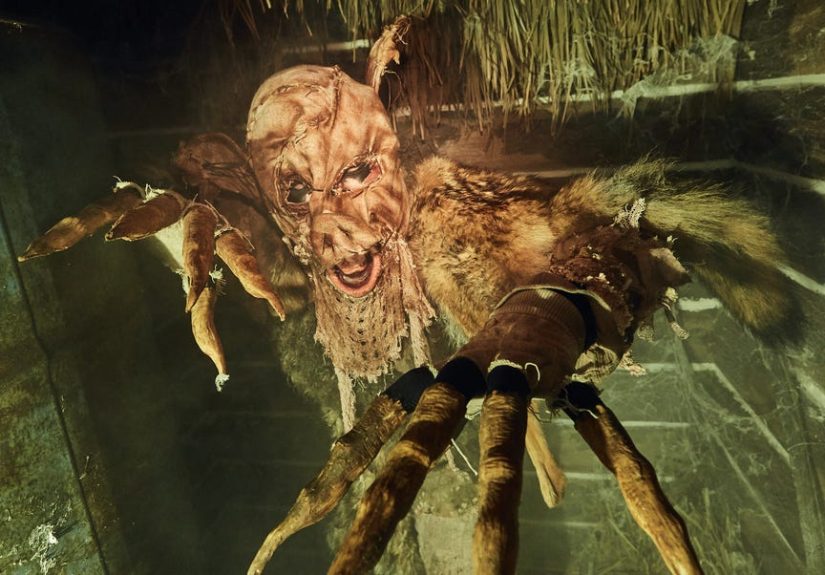
You can build a gorgeous house, but if the monsters inside look half-finished, the illusion collapses fast. That is why wardrobe, mask, and makeup design are central to how Halloween Horror Nights is built. These are not accessory departments. They are storytelling departments.
Costume design starts with character logic. What would this creature wear? How does that clothing support movement, silhouette, and immediate readability in low light? If a house draws from folklore or a specific culture, the design team has to dig into the source material instead of making everything generically “spooky,” which is how you end up with a vampire who looks like he lost a bet at a party store.
Makeup and prosthetics take over from there. Some looks are quick, others take real prep time, especially when full-face work or complex prosthetics are involved. The point is not just to make a performer look gross, though HHN certainly respects the art of looking gross. The point is to create a character that reads instantly under event conditions and holds up through multiple performances across the night.
That is part of why guests often underestimate the labor happening backstage. By the time the event opens, teams have already transformed a huge cast of performers into slashers, spirits, creatures, maniacs, monsters, and assorted things your therapist would call “concerning.”
Scares Are Engineered, Not Random
The best HHN houses feel chaotic, but the scares are carefully engineered. Universal knows where guests look, how they move, what draws attention, and how sound can control perception. A burst of audio can direct your eyes upward. A flicker can prime you for movement. A smell can make a room feel more real before you even process what you are seeing. Water, heat, strobe, fog, vibration, and directional sound all help build the illusion.
This is where HHN becomes more than scenic design. It becomes multi-sensory storytelling. Sound design is especially important because horror is often about anticipation. The audience hears before it sees. A footstep, whisper, scrape, metallic bang, or creature growl can set up the body for fear before the visual scare lands.
Scent is another powerful tool. Universal has increasingly leaned into smell as part of immersive design, using it not just for atmosphere but for storytelling. That may sound glamorous until you remember horror smells are not typically bakery-adjacent. The goal is not comfort. The goal is conviction.
And then there is performer timing. A scare that is too early misses. Too late, and the guest has already clocked the actor. Great haunted-house timing is a little like comedy, except the punchline is panic.
The Scareactors Are the Lifeblood of the Event
Universal creatives have said it plainly over the years: the scareactors are the lifeblood of Halloween Horror Nights. They are not there to fill empty corners. They are there to animate the entire machine.
That animation requires training. Performers need to understand the story of the house, the physicality of the character, the rhythm of their scare, the reset between guest groups, and the safety rules that keep the experience intense without turning it into chaos in the legal sense. Some performers are hidden in boo holes or scenic pockets, others roam scare zones where improvisation matters more, but all of them have to sell the world consistently.
Scare zones are especially performer-driven because they turn public pathways into active theater. The environment matters, but the zone only truly comes alive when characters own it. A good scare zone feels like you wandered into somebody else’s bad decision and now you are part of the scene whether you consented or not.
That live-theater energy is one reason HHN feels so addictive. Unlike passive horror media, this event reacts back. The guests fuel the atmosphere, and the performers respond in real time. That feedback loop is hard to fake and even harder to forget.
The Most Overlooked Trick: The Nightly Transformation
Maybe the wildest part of Halloween Horror Nights is not any single house. It is the nightly park transformation. Universal Studios Florida functions as a daytime park, then pivots into an after-hours horror event on select nights. That requires logistics as impressive as the creative work itself.
Pathways change purpose. Scenic elements take over public space. Lighting shifts. Soundscapes activate. Staff roles change. Guest flow has to be managed. Attractions operating during the event must coexist with haunted experiences without breaking the illusion. That kind of transition is not glamorous, but it is essential. Without operations, HHN would just be beautiful mayhem with a queue problem.
And yet, when it works, the flip feels magical in the darkest possible way. One minute you are in a theme park. The next minute the fog rolls in and the place seems to have developed trust issues.
What the Experience Feels Like When All the Pieces Click
Here is the part that explains why fans keep coming back: once all the planning disappears behind the performance, Halloween Horror Nights does not feel “built.” It feels unleashed.
Imagine entering Universal Orlando after sunset. The air already feels different. Music pulses somewhere ahead, fog drifts through the streets, and every pool of shadow looks like it has opinions. You are technically standing in a theme park, but emotionally you are standing in a horror movie lobby waiting to be assigned a problem.
As you approach a haunted house, the exterior does its job first. It frames the experience, teases the story, and quietly warns you that your dignity may not survive the next four minutes. Inside, the transition happens fast. The outside world falls away. Scenic detail crowds your vision. Audio wraps around you. A smell hits before your brain names it. Then the first scare lands, and suddenly your group dynamic changes forever. The brave friend is no longer brave. The skeptic is now speed-walking. The one person who said, “These things never get me,” is inventing a new dance move out of pure alarm.
That is what HHN is really selling: not just horror imagery, but participation. You are not watching a set. You are moving through it. You are not admiring a costume from a distance. It is breathing next to you. You are not hearing a soundtrack in the background. It is guiding your nerves like a conductor with a very mean sense of humor.
And the variety matters. One house may feel cinematic and grand, another claustrophobic and filthy, another surreal and dreamlike, another aggressive and sensory-heavy. Step back outside and scare zones keep the tension alive. There is no clean emotional reset. You leave one nightmare and walk directly into another one loitering in the street under theatrical lighting.
That layered experience is why a single HHN visit can feel both exhausting and electric. Guests are being asked to process story, design, movement, noise, surprise, and social chaos all at once. It is overstimulation, yes, but expertly curated overstimulation. The event understands that fear and delight are close cousins. People scream, then laugh. They flinch, then immediately start describing the room they just ran through. They say they hated that one hallway and then spend 10 minutes praising it.
In the end, that is the magic trick. Universal builds Halloween Horror Nights with the seriousness of a major production, but the guest experience feels gloriously unhinged. The seams are hidden. The labor is invisible. The engineering dissolves into adrenaline. What remains is the sensation that something impossible has taken over the park for the night.
And maybe that is the highest compliment you can give HHN. When it is at its best, you do not think about blueprints, approvals, performer call times, scenic drawings, or makeup chairs. You just believe, for a few loud and ridiculous minutes, that the monsters won.
Conclusion
Halloween Horror Nights at Universal Orlando is built like a hybrid of film production, live theater, haunted attraction design, and theme park operations. That mix is what gives the event its staying power. Story development shapes the houses. Scenic teams make them tangible. Costume and makeup turn performers into living nightmares. Sound, scent, and timing sharpen every scare. Operations pull off the huge nightly switch from day park to horror event without making the whole thing collapse into a puddle of fake blood and scheduling conflicts.
So yes, HHN is built with monsters. But more importantly, it is built with planning, artistry, and a startling amount of craft. Which is comforting, in a way. If you are going to be chased through a haunted house by something horrifying, it is nice to know the wallpaper was thoughtfully chosen.





 Close
Close