
Table of Contents >> Show >> Hide
- Short Answer: Yes, Wash Most Produce
- Why Washing Produce Matters
- What Washing Can and Can’t Do
- How to Wash Fruits and Vegetables Correctly
- Quick Produce Washing Guide by Type
- What You Should Never Use on Produce
- Do You Need to Wash Organic Produce?
- Should You Wash “Pre-Washed” or “Ready-to-Eat” Greens Again?
- Common Myths (and What Actually Helps)
- Special Caution for Higher-Risk Groups
- A 60-Second Produce Safety Routine You’ll Actually Use
- Final Verdict
- Experience Corner: from Real Kitchens
Let’s settle this kitchen debate once and for all: yes, you should wash fruits and vegetables.
Even if they look clean. Even if they’re organic. Even if they came from a fancy store where mist
hits the kale every 12 minutes like a spa treatment.
Fresh produce is one of the healthiest things you can eat, but it can carry dirt, bacteria, and
residues from handling, transport, and storage. The good news? Proper washing is simple, fast,
and genuinely reduces risk. The not-so-good news? A lot of popular “hacks” (soap baths, bleach
dips, random internet potions) are unnecessary or unsafe.
This guide gives you the practical, no-drama version: what to wash, how to wash it, what to avoid,
and how to keep your kitchen from turning into a cross-contamination relay race.
Short Answer: Yes, Wash Most Produce
You should wash almost all fresh fruits and vegetables before eating, cutting, or cooking them.
That includes produce you plan to peel, such as oranges, melons, bananas, avocados, and cucumbers.
Why? Because your knife can drag contaminants from the surface into the part you actually eat.
The only common exception is produce clearly labeled pre-washed, triple-washed, or
ready-to-eat. In most cases, rewashing those products is unnecessary and may even increase
contamination risk if your sink or tools are not clean.
Why Washing Produce Matters
1) Produce is handled by many people before it reaches your plate
From farm to packing line to transport to store shelves to your shopping cart, produce has a long
journey. Along the way, it can pick up soil, microbes, and residue from repeated contact. Washing
helps reduce what’s left on the surface.
2) Produce is often eaten raw
Cooking can kill many harmful germs. But salads, berries, herbs, apples, and snack veggies are
frequently eaten uncooked. That makes your washing routine your first and best defense.
3) Outbreaks linked to produce still happen
Public health advisories continue to report outbreaks tied to items like leafy greens, cucumbers,
onions, melons, basil, and other produce categories. Washing can’t eliminate every risk, but
skipping it definitely doesn’t help.
4) Washing is about both germs and grime
Rinsing under running water physically removes dirt and helps reduce bacteria and traces of chemical
residues on the surface. It is not magic, but it is meaningful.
What Washing Can and Can’t Do
What washing can do
- Remove visible dirt and debris.
- Reduce some bacteria on the produce surface.
- Lower some surface pesticide traces.
- Reduce transfer risk from peel/rind to edible portions during cutting.
What washing cannot do
- It cannot sterilize produce.
- It cannot reliably remove contamination that has penetrated tissues.
- It cannot replace refrigeration, clean tools, or safe storage practices.
- It cannot “fix” spoiled or rotten produce.
Translation: washing is necessary, but it is one part of a full food safety system that includes
clean hands, clean tools, separation of raw proteins from produce, and correct chilling.
How to Wash Fruits and Vegetables Correctly
Step 1: Wash your hands first
Scrub with soap and water for at least 20 seconds before and after handling produce. If your hands
are dirty, your produce will become an unwilling participant in that situation.
Step 2: Clean your sink, colander, knife, and cutting board
If you’re about to clean produce in a dirty sink, you’re basically giving it a mud spa. Use clean
tools and surfaces to avoid recontamination.
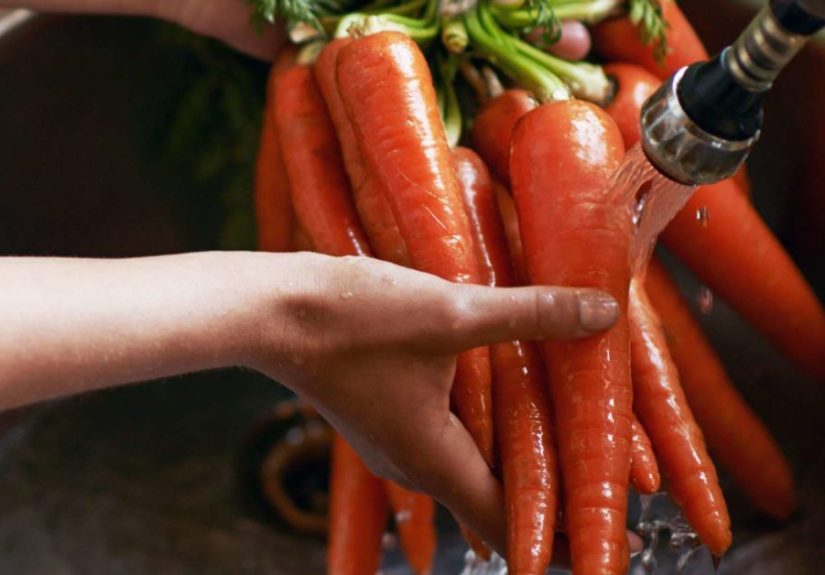
Step 3: Rinse under cool running water
Running water provides friction and flow that soaking alone does not. Hold produce under the stream
and gently rub with your hands.
Step 4: Use a produce brush for firm items
Melons, cucumbers, potatoes, carrots, and similar produce benefit from a clean brush to loosen dirt
in rough skin and crevices.
Step 5: Dry with a clean towel or paper towel
Drying can remove additional surface bacteria and moisture, and it helps produce last longer after
prep.
Step 6: Trim damaged spots and refrigerate when needed
Cut away bruised or damaged areas. Refrigerate cut or peeled produce promptly (ideally at 40°F/4°C
or below). Keep perishable items out at room temperature for as little time as possible.
Quick Produce Washing Guide by Type
| Produce Type | Best Method | Avoid |
|---|---|---|
| Berries | Rinse gently under running water right before use; pat dry carefully. | Long soaking (can damage texture and speed spoilage). |
| Leafy greens | Rinse leaves thoroughly; spin or pat dry. Wash just before eating. | Washing too early, then storing wet. |
| Firm produce (melons, cucumbers, potatoes) | Rinse and scrub with a clean produce brush. | Skipping wash because you plan to peel. |
| Herbs | Rinse quickly in cool water; dry gently with towel or spinner. | Leaving wet bunches in warm kitchen air. |
| Apples, pears, peaches | Rinse and rub under running water; dry before storage or serving. | Using soap or detergent. |
| Pre-washed salad mixes | Use directly if labeled ready-to-eat and package is intact. | Rewashing in a dirty sink. |
What You Should Never Use on Produce
- Dish soap or hand soap: not designed for ingestion and may leave residues.
- Bleach: unsafe for direct food washing in home use.
- Detergents: same problem as soap, plus no food-use benefit.
- Most commercial produce washes: major food-safety guidance does not recommend them for routine use.
Plain running water and friction are usually enough for home produce cleaning.
Do You Need to Wash Organic Produce?
Yes. Organic does not mean “germ-free” or “never touched by human hands.” Organic standards regulate
farming practices, not magical immunity from dust, handling, and contamination. Treat organic and
conventional produce the same way in your kitchen: wash before use.
Should You Wash “Pre-Washed” or “Ready-to-Eat” Greens Again?
Usually, no. If the package says pre-washed or ready-to-eat, you typically do not
need to wash it again. Rewashing can reintroduce bacteria from your sink, faucet, board, colander,
or hands. If packaging is damaged, expired, or visibly questionable, skip it and use a fresh package.
Common Myths (and What Actually Helps)
Myth 1: “If it looks clean, it is clean.”
Not true. Microbes are invisible, and many risks come from surfaces that look perfectly fine.
Myth 2: “Soap cleans better, so it must be safer.”
Also not true for produce. Soap residues are not intended for consumption and can irritate your GI
tract. For produce, use water and friction.
Myth 3: “A vinegar soak solves everything.”
Vinegar may reduce some surface microbes in specific setups, but it is not a complete food safety
strategy and may affect taste/texture. It should never replace the basics: running water, clean
hands, clean tools, and safe storage.
Myth 4: “I can wash all my produce for the week at once.”
Not ideal for many items. Washing some produce too early, then storing it damp, can increase spoilage.
For best quality and safety, wash many items right before use.
Special Caution for Higher-Risk Groups
Young children, older adults, pregnant people, and anyone with weakened immunity should be especially
careful with raw produce handling. Consider cooking higher-risk items like sprouts. Keep refrigeration
strict, and avoid leaving cut produce out for long periods.
A 60-Second Produce Safety Routine You’ll Actually Use
- Wash hands (20 seconds).
- Rinse produce under cool running water.
- Rub gently; brush firm skins.
- Dry with clean towel/paper towel.
- Use clean knife and board.
- Chill cut produce promptly.
That’s it. No chemistry set. No weird sprays. Just solid kitchen habits.
Final Verdict
So, do you need to wash fruits and vegetables? Yesalmost always. It’s a low-effort, high-value
step that reduces dirt, lowers some microbial and residue risk, and helps prevent avoidable food
safety issues at home.
If you remember only three rules, make them these:
wash produce under running water, skip soap/bleach, and keep your prep area clean.
Add smart storage and refrigeration, and you’ve got a practical system that works in real life.
Experience Corner: from Real Kitchens
Over the years, one pattern shows up again and again: people don’t skip produce washing because they
don’t care. They skip it because life is busy. Dinner is late, kids are hungry, and someone is already
asking why carrots can’t just “come in french fry format.” The trick is not perfection; the trick is
building a routine that survives chaos.
In one family kitchen, the turning point was a simple prep station: a clean colander next to the sink,
a small produce brush hanging on a hook, and paper towels within reach. Suddenly, washing apples and
cucumbers became automatic. Before that, the process felt like a mini project. After that, it felt like
muscle memory.
Another common situation: the giant clamshell of berries. People rinse everything at once, stash it wet,
and wonder why it collapses into berry soup two days later. A better approach is to rinse only what you
plan to eat now. Dry gently. Refrigerate the rest dry. This one habit alone can cut waste and keep fruit
tasting better through the week.
Leafy greens are their own adventure. Many home cooks assume “triple-washed” means “wash three more times
for luck.” But rewashing ready-to-eat greens can introduce contamination from sink surfaces. A safer move:
trust sealed, intact ready-to-eat packaging, and focus your effort on everything else. If greens are not
labeled ready-to-eat, rinse thoroughly right before eating, then spin dry.
Melons teach another important lesson. People often skip scrubbing because they don’t eat the rind. But
when the knife goes through that rind, surface contamination can move inward. A quick scrub under running
water before slicing is one of those “tiny effort, big payoff” habits that actually matters.
Home gardeners often assume backyard produce is automatically cleaner. It can be fresher, absolutelybut
it still needs washing. Soil splash, insects, hands, baskets, and garden tools all add exposure points.
Garden tomatoes and grocery tomatoes deserve the same rinse.
Then there’s the “soap debate.” Many people learned in childhood that soap equals cleanliness, period.
But produce isn’t a plate or a pan, and soap residues can end up in your food. Once people switch to
running water plus gentle rubbing (and brushing for firm skins), they usually realize the process is
easier than expected and doesn’t leave odd flavors behind.
Finally, the biggest real-world insight: consistency beats intensity. You don’t need a 15-step ritual.
You need a repeatable one-minute habit. Clean hands. Running water. Gentle friction. Clean tools.
Prompt chilling for cut produce. Do that most days, and you’ll dramatically improve your kitchen safety
without turning every snack into a laboratory protocol.






 Close
Close