
Table of Contents >> Show >> Hide
- Who Is David Zinn?
- Why David Zinn’s Chalk Art Feels So Different
- The Characters That Make David Zinn’s World So Memorable
- The Craft Behind the Charm
- Why People Connect With His Sidewalk Stories
- The Beauty of Temporary Street Art
- Chalk-Drawn Adventures and the Legacy of David Zinn
- Experiences Inspired by David Zinn’s Chalk-Drawn World
- Conclusion
Some artists chase giant canvases, museum walls, and dramatic spotlights. David Zinn, meanwhile, has built a beloved artistic universe by crouching near sidewalk cracks and asking a very important question: “What if that stain were actually a mouse with ambition?” That playful instinct is exactly why his work feels so memorable. Zinn’s chalk-drawn adventures do not arrive with velvet ropes or intimidating plaques. They pop up where people least expect themon city sidewalks, near weeds, around manhole covers, beside steps, and in the kinds of places most of us would normally ignore on our way to coffee.
The result is a body of work that feels both tiny and enormous. Tiny, because many of Zinn’s creatures are small enough to miss if you are glued to your phone. Enormous, because they transform how people see public space. One minute, a cracked piece of pavement is just a cracked piece of pavement. The next, it is the entrance to a cartoon underworld where a bright green monster, a flying pig, or a brave little mouse is clearly in the middle of a very serious mission. This is the magic of David Zinn: he makes ordinary places feel secretly alive.
His art is also refreshingly unpretentious. It is funny, approachable, and deeply skillful without ever acting smug about it. In a creative world that sometimes mistakes seriousness for importance, Zinn’s work argues the opposite. Delight matters. Surprise matters. Making strangers smile on a Tuesday afternoon absolutely counts as art. And in Zinn’s hands, sidewalk chalk becomes less like a children’s toy and more like a passport to a parallel universe hiding in plain sight.
Who Is David Zinn?
David Zinn is an Ann Arbor, Michigan artist who has been making original artwork in and around the city since the late 1980s. Before becoming widely known for his chalk creatures, he spent years working as a freelance commercial artist, creating everything from posters and logos to practical illustrations for local clients. That background matters because it helps explain the unusual balance in his work: it is whimsical, yes, but also technically sharp, compositionally clever, and instantly readable.
Zinn did not set out with some grand master plan to become “the chalk guy.” By his own account in interviews, sidewalk drawing emerged later, after years of other art jobs, when a box of chalk and a beautiful day created the perfect excuse to go outside and make something. That origin story feels wonderfully on-brand. Of course David Zinn’s career pivot began with curiosity, mild procrastination, and a willingness to follow a ridiculous idea until it became a vocation. Many people talk about finding their true calling. Zinn seems to have tripped over hispossibly while staring at a crack in the pavement.
Today, he is known internationally for temporary street drawings made from chalk, charcoal, and found objects. Most of the work still appears in Michigan, especially around Ann Arbor, but his creations have also shown up far beyond home turf. That mix of local identity and global appeal is part of his charm. He is unmistakably rooted in one place, yet the emotional language of his arthumor, wonder, surprise, tendernesstravels extremely well.
Why David Zinn’s Chalk Art Feels So Different
He collaborates with the sidewalk
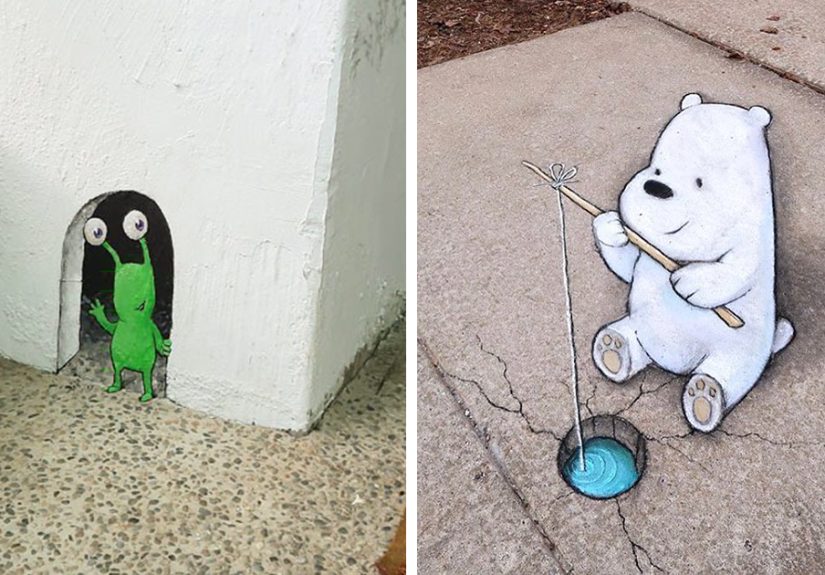
Plenty of artists put images onto surfaces. Zinn does something more interesting: he lets the surface help write the story. A weed becomes hair. A crack becomes a ladder. A drain becomes a portal. A missing chunk of concrete turns into a cave, a pond, or a cliff edge. His drawings do not fight the environment; they partner with it. That site-specific approach gives each piece a handmade sense of inevitability, as if the artwork had been hiding there all along, waiting for someone to notice.
He uses pareidolia like a superpower
Zinn has spoken about the idea of pareidoliathe human tendency to see patterns, faces, and figures in random shapes. Most of us do this casually when clouds look like rabbits or a lamp in the dark starts feeling suspiciously haunted. Zinn turns that mental quirk into a creative engine. He looks at spots most people would dismiss as urban clutter and sees characters with moods, motives, and excellent comedic timing. In that sense, his work is not only about drawing; it is about noticing.
He makes impermanence feel meaningful
Here is the twist that makes Zinn’s work more powerful, not less: it is temporary. Rain washes it away. Foot traffic scuffs it. Time wins. But that fragility is part of the point. Because the art is not permanent, it feels spontaneous and generous. It exists to brighten a moment, not dominate a space forever. That changes the relationship between artist and audience. Instead of saying, “Look at what I have installed,” the work says, “Look what happened here for a little while.”
The Characters That Make David Zinn’s World So Memorable
Zinn’s chalk universe is filled with recurring creatures, and they are a huge part of why his work sticks in people’s minds long after the chalk itself has vanished. These characters are not generic mascots. They feel like neighbors from a hidden neighborhood under the curb.
Sluggo
Sluggo is perhaps Zinn’s most recognizable creation: a bright green creature with stalk eyes, elastic energy, and a face that suggests equal parts mischief and confusion. Sluggo looks like the sort of being who would absolutely get into trouble, then somehow become more lovable because of it. He is weird in the best possible waycartoon oddity refined into a genuine personality.
Philomena
Philomena, the flying pig, adds a soft, deadpan sweetness to Zinn’s world. The humor in her design is immediate, but so is the grace. She is whimsical without becoming sugary. Zinn understands that good character art needs more than novelty; it needs emotional texture. Philomena is funny, but she is also oddly serene, as if levitating over the chaos of daily life is simply her version of emotional regulation.
Nadine
Nadine, often described as an adventurous mouse, brings heart to the menagerie. If Sluggo is comic chaos and Philomena is airy charm, Nadine feels like the brave little explorer of the group. Zinn’s art often suggests a narrative in progress, and Nadine fits that perfectly. She looks like someone who has places to go, mysteries to solve, and exactly zero interest in being underestimated.
Together, these recurring figures give Zinn’s work continuity. Even though each piece is temporary and location-specific, the characters create a familiar universe that viewers can return to again and again. That is not easy to pull off in ephemeral art. Zinn manages it with the instincts of both an illustrator and a storyteller.
The Craft Behind the Charm
It is easy to look at David Zinn’s work and think, “Well, that’s adorable.” That is true, but also hilariously incomplete. Beneath the charm is serious technical ability. His drawings often use perspective and optical illusion to create the impression that creatures are climbing out of holes, dangling from ledges, or interacting with three-dimensional parts of the street. He understands how viewers move through space and where they are likely to stand. In other words, he is not just drawing characters; he is directing an encounter.
His use of charcoal alongside chalk adds depth and shadow, which helps the figures feel more grounded in the physical world around them. This is especially important in work that depends on illusion. A sloppy shadow can ruin the trick. Zinn’s shadows, contours, and highlights do the opposite: they sell the impossible with a straight face.
There is also remarkable restraint in his compositions. He does not overcrowd the scene. He chooses one oddity in the environment and builds outward with precision. That economy makes the work feel natural instead of forced. The pavement stays visible. The crack stays a crack. The weed stays a weed. Yet somehow, after Zinn is done, the whole place has changed character.
Why People Connect With His Sidewalk Stories
David Zinn’s appeal goes far beyond chalk technique. His art resonates because it changes the emotional temperature of a place. A city sidewalk can be practical, anonymous, and easy to ignore. Zinn interrupts that routine with a tiny act of wonder. He gives people a reason to stop, laugh, point, and maybe show someone else. In that sense, his work is social, even when the drawings themselves are quiet.
It also helps that his art is deeply accessible. You do not need art theory to enjoy it. You do not need an admission ticket. You do not need to pretend you understand some aggressively mysterious curatorial statement. You just need eyes, a few spare seconds, and ideally the willingness to believe that a mouse might be spelunking through the curb. Zinn’s work welcomes everybody, which is one reason families, tourists, local residents, and online audiences all respond so strongly to it.
There is another layer, too: his drawings encourage people to pay attention to their surroundings. In a culture trained to scroll upward and move faster, Zinn’s work asks us to look down and linger. That small shift is surprisingly powerful. Public art often aims to reshape how we inhabit space. Zinn does exactly that, only with more jokes and fewer bronze plaques.
The Beauty of Temporary Street Art
One of the most thoughtful aspects of Zinn’s practice is his embrace of impermanence. He has explained that the temporary nature of chalk is not a sad compromise; it is part of what makes the process freeing. Permanent murals involve permissions, planning, and a different kind of pressure. Chalk, by contrast, can be finished in an afternoon and washed away without drama. That freedom makes the art feel alive.
Temporary art also creates a special kind of memory. If you saw one of Zinn’s creatures in person, you know the feeling: it becomes a small private treasure. You happened to be there. You caught it before the rain. You witnessed a joke the city was telling for one brief stretch of time. Photos preserve some of that magic, but not all of it. The real thrill is discovery.
That is why Zinn’s work often feels more intimate than giant public installations. It does not tower over viewers. It meets them where they already arewalking to lunch, heading to work, wrangling children, killing time, probably trying not to spill coffee. Then, suddenly, there is art underfoot, and the day becomes slightly less ordinary.
Chalk-Drawn Adventures and the Legacy of David Zinn
David Zinn matters because he proves that public art does not have to be monumental to be meaningful. It can be small, funny, temporary, and still leave a lasting impression. In fact, those qualities may be exactly why his work lands so effectively. It is not trying to intimidate anyone. It is trying to invite them in.
His legacy is not only the drawings themselves, but the mindset behind them. He models a way of moving through the world that is observant, playful, and open to surprise. He also reminds people that creativity does not always begin with a blank canvas. Sometimes it begins with a weird shadow, a chipped curb, or a patch of concrete that looks like it might secretly be a stage.
That lesson has real staying power. Whether you are an artist, a parent, a traveler, or just someone trying to survive another week of adult responsibilities, Zinn’s work makes a persuasive case for whimsy. It suggests that beauty does not always announce itself loudly. Sometimes it is crouched near a storm drain, drawn in chalk, making a face at the world, and waiting for you to notice.
Experiences Inspired by David Zinn’s Chalk-Drawn World
Part of what makes David Zinn’s work so beloved is the experience surrounding it. His art does not live only in the drawing itself; it lives in the moment of discovery. Imagine walking through Ann Arbor on an ordinary afternoon. You are not on an art tour. You are not “seeking a cultural experience.” You are just moving through your day, probably thinking about errands, dinner, emails, or why every bag of groceries now feels like an upper-body workout. Then you glance down and see a tiny green creature peeking out from a crack in the sidewalk as if it has been there all along. That moment of surprise is the real masterpiece.
For children, the experience can feel like stumbling into a secret storybook. Zinn’s creatures invite imagination immediately. Kids do not need anyone to explain the joke. They understand instinctively that the street has become a stage and the stage has become a playground. For adults, the reaction is slightly different but no less meaningful. His work can snap people out of autopilot. It creates a pause in the middle of a routine day and reminds them that public space can still hold mystery, humor, and handmade joy.
There is also a communal side to the experience. When people find Zinn’s art in the wild, they rarely keep it to themselves. They point. They laugh. They call someone over. They take photos. Strangers who might otherwise pass each other without a word end up sharing a moment of delight over a chalk mouse or a pig with wings. That is a quietly powerful thing. In an era when so many experiences are individualized and screen-mediated, Zinn’s work creates tiny public gatherings around shared surprise.
Then there is the bittersweet pleasure of knowing the art will disappear. Seeing one of Zinn’s pieces can feel a little like finding a perfect sandcastle before the tide comes in. The temporary quality makes the moment feel more vivid. You notice it differently because you know it is fleeting. A rainy forecast becomes part of the drama. A scuff mark from a passing shoe suddenly feels like time doing what time does best: moving along, whether we are ready or not. Oddly, that makes the experience sweeter rather than sadder.
Zinn’s workshops, demonstrations, and community appearances add another dimension to these experiences. They show that his art is not built on mystique or gatekeeping. He wants people to make things. He wants them to stop overthinking and start drawing. That generosity is woven into the work itself. His chalk creatures may be skillfully rendered, but they never feel like they are mocking the viewer from some elite artistic mountaintop. They feel like an invitation.
Ultimately, the experience of David Zinn’s art is about permission: permission to look closer, permission to laugh, permission to imagine, permission to make pointless beauty just because the day could use some. That may sound small, but it is not. In fact, it is one of the most generous things public art can do. Zinn does not just decorate sidewalks. He temporarily changes the emotional weather around them. And for anyone lucky enough to encounter one of those chalk-drawn adventures in person, the city never looks quite the same afterward.
Conclusion
David Zinn has built an extraordinary artistic career from humble materials, sharp observation, and a refusal to underestimate the power of whimsy. His chalk-drawn adventures prove that a sidewalk can be more than a route from one place to another. In the right hands, it becomes a theater, a portal, a punch line, and a tiny miracle all at once.
That is why his work continues to resonate so strongly. It is playful without being shallow, skillful without being showy, and temporary without feeling disposable. Zinn transforms cracks, stains, weeds, and overlooked corners into living stories, then leaves people with a simple but lasting challenge: look more closely. There may be more wonder under your feet than you think.





 Close
Close