
Table of Contents >> Show >> Hide
- Why This Bike Radar Project Turned Heads
- What Synthetic-Aperture Radar Actually Does
- How the Bike Radar Made Real Images
- Why SAR Still Matters in the Real World
- From Satellites and Aircraft to Cars, Drones, and Bikes
- The Limits Nobody Should Ignore
- Why This Project Is a Big Deal for Makers and Engineers
- Experiences Related to Bike-Mounted Synthetic-Aperture Radar Makes Detailed Images
- Conclusion
A bicycle is not usually the first vehicle that comes to mind when people talk about high-resolution imaging. Usually, a bike gives you wind in your face, sore calves, and maybe a smug sense of cardio superiority. In this case, though, it also becomes part of a radar imaging system that can build surprisingly detailed pictures of the world using radio waves instead of visible light.
That is what makes the idea behind a bike-mounted synthetic-aperture radar, or SAR, so irresistible. It sounds like a garage-project punchline, but it points to something very real: if you move a radar in a controlled way and process the returning signals cleverly enough, you can create images with far more detail than a small physical antenna should normally allow. In plain English, motion becomes part of the lens.
That is why the phrase bike-mounted synthetic-aperture radar is more than a fun headline. It captures a serious engineering story about low-cost radar, smart signal processing, and the growing possibility that advanced imaging tools once associated with satellites, spy planes, and research labs can now be explored on far smaller, scrappier platforms.
Why This Bike Radar Project Turned Heads
The project that inspired the buzz centered on a homemade radar system mounted to a bicycle and used to create images of real outdoor scenes. Instead of snapping photos with a camera, the system transmitted radio signals, collected the reflections, and then reconstructed the scene computationally. That alone is impressive. The fact that the radar was mounted on the rear rack of a bicycle makes it memorable.
The builder used the bike as a moving measurement platform, riding in a straight line at a steady pace while the radar pointed sideways at the scene. That sideways-looking setup matters. It is part of the classic SAR geometry: as the radar moves, each object in the scene is sampled from slightly different positions. Those tiny differences are gold. With the right math, they let the system synthesize a much larger virtual antenna than the one physically attached to the bike.
In other words, the bicycle is not just transportation. It is part of the imaging system. The pedals provide motion, the path provides geometry, and the data processing turns all that movement into detail. It is a beautiful example of engineering thrift: use motion you already have, then let software do the heavy lifting.
What Synthetic-Aperture Radar Actually Does
To understand why this works, it helps to translate the jargon into something friendlier. A normal radar sends out energy and listens for echoes. A synthetic-aperture radar does that too, but while the radar is moving. Because the radar collects many echoes from many positions, software can combine them into a sharper image than a single snapshot would provide.
The magic word is synthetic. The system is not carrying a giant antenna the size of a parking lot. It is faking one by moving a smaller antenna through space and combining the measurements afterward. The motion creates a “virtual” aperture. That virtual aperture gives you better cross-range detail, which is why SAR is so useful when engineers want crisp images from compact hardware.
This is also why SAR has become so important in airborne and spaceborne remote sensing. Radar is an active sensor, so it does not need sunlight. It can operate day or night, and it is valuable in conditions where optical imaging struggles, such as cloud cover, smoke, haze, or darkness. That does not mean it is a magic X-ray wand for every situation, but it does mean radar often keeps working when cameras start complaining.
Why a Bicycle Can Be Good Enough
A bicycle sounds delightfully low-rent for such a sophisticated job, but it makes more sense than you might think. SAR imaging needs motion, and a bike provides a controllable, repeatable path on the cheap. The catch is that the motion has to be consistent. Really consistent. We are not talking “close enough for jazz.” We are talking phase-sensitive radar measurements where tiny path errors can blur the image.
That is exactly why the bike-mounted setup is so compelling from an engineering standpoint. It highlights the trade-off at the heart of SAR: the hardware can be relatively compact, but the motion control and the processing demands become intense. A cheap platform can work, but only if you respect the physics and clean up the mess in software.
Bandwidth, Frequency, and Resolution Without the Headache
The homemade radar behind this project used frequency-modulated continuous-wave technology, commonly called FMCW radar. In systems like this, bandwidth strongly affects range resolution. More bandwidth generally means the radar can separate objects that are closer together in distance. That is one reason compact experimental radars can still produce surprisingly informative images when they are designed well.
In the bike-mounted work, the radar operated around 6 GHz, and the imaging path stretched on the order of hundreds of meters. That sounds roomy until you realize the motion accuracy needed for good focus is measured in tiny fractions of a wavelength. Suddenly, a smooth bike ride is no longer just pleasant; it is part of the signal chain.
How the Bike Radar Made Real Images
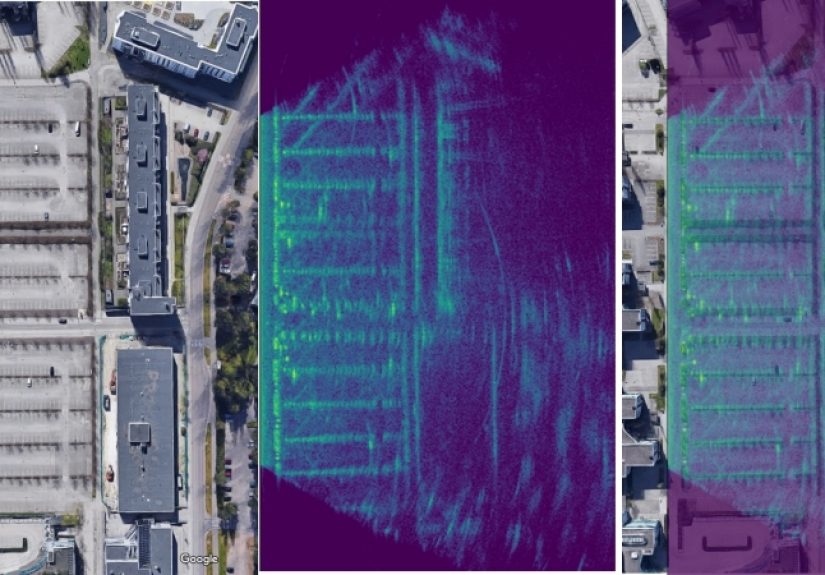
The project was not just theoretical. It produced actual images of outdoor scenes, including a parking lot and a nearby park. That matters because engineering demos can sometimes live forever in the “cool concept” phase. Here, the system moved beyond concept and into evidence.
In one scene, the radar data was compared with satellite imagery of the same area and matched up remarkably well. Pole-like objects showed clearly, major scene features lined up, and even surface differences such as grass versus asphalt appeared in ways that made sense for radar reflectivity. That is the moment where the idea stops being a novelty and starts looking like a real imaging tool.
Even better, the project showed what radar sees differently from a camera. Sharp edges, reflective structures, curbs, poles, street signs, and other man-made features can light up strongly in radar imagery. A scene that might look ordinary to the eye can become a high-contrast playground for microwave reflections. Radar has its own visual language, and once you learn to read it, you realize it is telling a different story than optical images do.
The Processing Was the Secret Sauce
If the bike supplied the motion, the software supplied the wizardry. The image formation pipeline used SAR processing methods that converted raw radar returns into focused images. The project also leaned on GPU acceleration, which dramatically reduced computation time. That is a big deal because SAR is not just a sensing problem; it is a math problem wearing an RF costume.
The builder also used autofocus methods to compensate for motion errors introduced by real bicycle travel. This is where the project becomes especially interesting for engineers and makers. The ride did not have to be perfect because the processing could correct at least some imperfections afterward. That is not a free pass to wobble around like a shopping cart with one bad wheel, but it shows how modern computation expands what small platforms can do.
Put differently, the bike-mounted SAR succeeded because it combined three ingredients: decent radar hardware, a carefully controlled measurement path, and fast enough processing to rescue focus from real-world motion errors. Leave out any one of those, and the image quality suffers fast.
Why SAR Still Matters in the Real World
The bicycle story is charming, but the bigger point is serious. Synthetic-aperture radar imaging is already used in Earth observation, disaster response, terrain analysis, environmental monitoring, and change detection. Airborne and spaceborne SAR systems can detect flooding, measure ground deformation, track landscape changes, and collect data in low-visibility conditions where normal photography can struggle.
That is why NASA and other research organizations keep investing in SAR missions and airborne platforms. Radar can reveal structural and surface information that is difficult to capture any other way. Some systems can also detect small shifts in the ground surface over time, which is useful for studying earthquakes, volcanoes, landslides, subsidence, and infrastructure stability. When the Earth decides to move, radar is one of the best witnesses in the room.
There are also specialized radar systems designed for subsurface or sub-canopy work, topographic mapping, and repeat-pass measurements. The wavelengths and system design determine what kind of scene information is emphasized. That means SAR is not one tool but a family of tools, ranging from giant scientific platforms to experimental systems that fit on vehicles, drones, or, yes, bicycles.
Emergency Response and Practical Mapping
One of the clearest examples of SAR’s usefulness is emergency response. When disasters strike, responders need fast situational awareness, and radar can help because it works in conditions that are inconvenient, dangerous, or downright rude to optical sensors. Wildfires, storms, smoke, darkness, and cloud cover do not politely wait for ideal imaging conditions.
That broader context makes the bike project more than a clever hack. It points toward a future where mobile radar mapping platforms become more common, more affordable, and more tailored to niche tasks. A bike is not replacing a NASA aircraft anytime soon, but the principles scale in intriguing ways. Low-cost SAR experiments help broaden the talent pool, test algorithms, and inspire new platform ideas.
From Satellites and Aircraft to Cars, Drones, and Bikes
The core SAR concept has spread far beyond traditional aircraft. Researchers and engineers are exploring vehicle-mounted SAR, drone-based SAR, and other mobile platforms that can collect images while in motion. In some cases, the goal is mapping. In others, it is localization, environmental sensing, or object recognition.
That shift matters because smaller platforms change the economics of radar imaging. If useful SAR data can be collected from systems that are cheaper, lighter, and easier to deploy, then experimentation speeds up. Suddenly, students, startups, and independent engineers can join a field that once felt guarded by billion-dollar doors and a polite cough from national labs.
There is even a nice historical rhyme here. MIT’s radar education efforts have long demonstrated that small, low-cost radar platforms can teach real SAR principles. Hobbyist and educational systems do not rival major operational platforms, but they prove something important: the knowledge is portable. The bike-mounted build takes that idea and gives it wheels.
The Limits Nobody Should Ignore
Now for the less glamorous part: SAR is unforgiving. The phrase “just mount it on a bike” leaves out a small mountain of technical pain. The platform path has to be known accurately. Motion errors cause defocus. Vibration matters. Antenna orientation matters. Timing matters. Calibration matters. Signal processing matters. This is not a hot-glue-and-hope kind of project.
Moving targets can also complicate the scene, because SAR generally relies on combining measurements under assumptions about how the world behaves during collection. If objects are shifting around unpredictably, the image can smear or create artifacts. Large reflective structures can saturate the receiver. Occlusions can hide useful details. In short, the world is a noisy place and radar notices.
That is part of the charm, though. Bike-mounted SAR is a reminder that modern imaging is often a negotiation between messy reality and disciplined computation. The raw data may look unintelligible at first glance. Then the algorithms go to work, the image sharpens, and suddenly a parking lot begins to emerge from what looked like electronic soup.
Why This Project Is a Big Deal for Makers and Engineers
What makes this story genuinely exciting is not just that someone strapped radar hardware to a bicycle. It is that the project demonstrates how far accessible engineering has come. You can now see a path, however steep, from hobbyist-grade experimentation to meaningful radar imaging. That path runs through open documentation, modern software libraries, fast GPUs, cheaper RF components, and a stubborn refusal to accept that only giant institutions get to have all the fun.
For SEO purposes, people searching for terms like bike-mounted synthetic-aperture radar, homemade SAR imaging, mobile radar mapping, or FMCW radar imaging project are really looking for the same answer: can advanced radar imaging be made smaller, smarter, and more personal? This project suggests the answer is yes, with an asterisk the size of a graduate thesis.
That asterisk, of course, reads: “Bring math, patience, and probably snacks.”
Experiences Related to Bike-Mounted Synthetic-Aperture Radar Makes Detailed Images
The most fascinating part of a project like this is the experience it creates around the engineering. A bike-mounted SAR setup turns an ordinary ride into something halfway between fieldwork, signal-processing art, and a trust exercise with physics. You are no longer simply traveling through a place; you are measuring it, sampling it, and asking the microwave reflections to reveal its structure one echo at a time.
Imagine rolling down a long, flat path with the radar secured behind you. Suddenly, the sidewalk, fence lines, curbs, poles, parked cars, and tree edges stop being background scenery and start becoming signal sources. The ride becomes strangely intentional. You care about holding a straight line, keeping speed steady, and avoiding unnecessary wobble. A tiny bump in the pavement is no longer just annoying; it is a possible image-quality villain.
That changes how you experience the environment. You start noticing which surfaces are smooth, which corners are reflective, which objects probably have strong radar returns, and which areas might create clutter. A parking lot full of poles and signs becomes interesting in the same way a dramatic skyline is interesting to a photographer. Only here, you are not chasing color or light. You are chasing geometry, reflectivity, and phase stability. It is nerdy, yes, but gloriously so.
Then comes the second experience: the uncomfortable gap between collecting data and seeing whether you actually succeeded. With a normal camera, you know immediately if the image is blurry. With SAR, the raw measurements can look cryptic and unimpressive. The scene is buried inside calculations, frequency sweeps, motion assumptions, and image-formation algorithms. This creates a unique emotional rhythm. First there is the physical task of gathering data. Then there is the suspense of processing it. Then comes the payoff, or the humbling lesson.
When the reconstruction works, the feeling is deeply satisfying. Features begin to appear where chaos once lived. Reflective poles snap into place. Street boundaries emerge. Broad surfaces separate into meaningful regions. If the result lines up with a map or a known scene, it feels a bit like translating a secret language. You are not just looking at an image; you are looking at proof that the motion, the timing, the hardware, and the math all agreed to cooperate for one glorious moment.
When it does not work, the experience is educational in a less cinematic way. Blurring, ghosting, clutter, and weak focus become teachers. They force you to ask whether the path was straight enough, whether the sweep was linear enough, whether the calibration drifted, or whether the scene itself was harder to interpret than expected. It is a project that teaches humility quickly. Microwave imaging has no interest in protecting anyone’s ego.
There is also something oddly human about using a bicycle for a radar experiment. It makes advanced sensing feel less distant. Instead of imagining radar only as a tool of satellites, defense platforms, or large institutional labs, you experience it as something that can coexist with handlebars, bike racks, and a local footpath. That shift in scale is powerful. It turns radar from a mysterious black box into a hands-on system with visible trade-offs and understandable constraints.
In the end, the experience of bike-mounted SAR is not only about making detailed images. It is about learning to see motion, space, and measurement differently. You stop thinking of the ride as travel and start thinking of it as aperture. You stop thinking of the scene as scenery and start thinking of it as data. And once that mental switch flips, even an ordinary bike path can feel like a rolling laboratory with a very nerdy sense of adventure.
Conclusion
Bike-mounted synthetic-aperture radar sounds like the kind of phrase invented by a very ambitious crossword puzzle. In reality, it is a brilliant demonstration of how motion, radar, and computation can work together to produce detailed images from compact hardware. The project shows that SAR is not just a satellite technology or a defense-world acronym. It is a flexible imaging concept that can scale down, get weird, and still stay scientifically meaningful.
More importantly, it shows where radar is headed. As processing gets faster and hardware becomes more accessible, we will likely see more experiments that put SAR on unusual platforms and aim it at new problems. Some will be practical. Some will be educational. Some will just be beautifully nerdy. All of them will help expand the conversation around what radar imaging can be.
And honestly, any technology that can turn a bicycle ride into a microwave mapping mission deserves at least one respectful slow clap.







 Close
Close