
Table of Contents >> Show >> Hide
- The 9 Nose Piercings at a Glance
- Before You Get Pierced: Safety, Setup, and “Please Don’t DIY This”
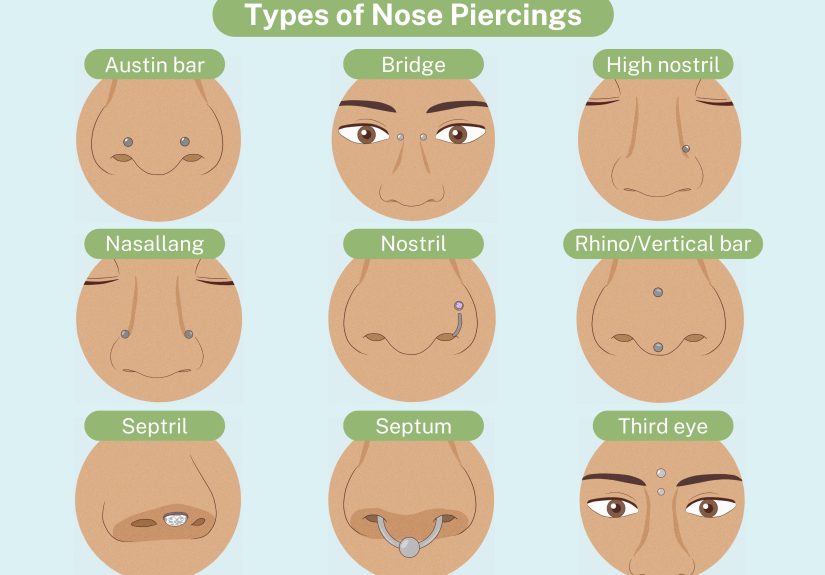
- The 9 Types of Nose Piercings, Up Close
- Aftercare That Actually Works (and Doesn’t Start a War With Your Nose)
- Common Problems (and When to Get Help)
- How to Choose the Right Nose Piercing for You
- Real-Life Experiences: What People Say It’s Like (500+ Words)
- Parting Advice (Because Your Nose Deserves Nice Things)
Nose piercings are the rare fashion choice that can look equally perfect with a black-tie gown, a band tee, or
a hoodie you “borrowed” in 2019 and never gave back. But “nose piercing” is basically a whole menuranging from
classic and subtle to “wow, your piercer definitely owns a ruler and a steady hand.”
This guide breaks down nine popular (and not-so-common) nose piercing types with a realistic look at placement,
jewelry, healing, pain, aftercare, and who should maybe not get one right before allergy season.
Expect specifics, a little humor, and advice that won’t treat your nose like a DIY craft project.
The 9 Nose Piercings at a Glance
Healing times vary wildly based on anatomy, jewelry quality, lifestyle (glasses! masks! toddlers!), and whether
your nose is currently starring in a daily sneeze marathon. Think of these ranges as “typical,” not a guarantee.
| Type | Where It Goes | Common Starter Jewelry | Typical Healing Range | Skill Level |
|---|---|---|---|---|
| Nostril | Side of the nostril, usually in/near the crease | Flat-back labret stud | ~4–9 months | Beginner-friendly |
| High Nostril | Higher up above the nostril crease (denser cartilage) | Flat-back labret stud | ~9–12+ months (can be longer) | Intermediate |
| Septum | Soft tissue “sweet spot” under the septal cartilage | Circular barbell or retainer | ~2–3 months | Beginner-friendly (with a skilled piercer) |
| Bridge (Erl) | Surface piercing across the bridge of the nose | Curved barbell (surface-friendly) | ~2–3 months for outer healing; longer to fully settle | Intermediate/advanced |
| Mantis (Forward-Facing Nostrils) | Paired piercings on the front of the nose tip | Threadless studs (paired) | Similar to nostrils; often months | Advanced (anatomy-dependent) |
| Rhino (Vertical Nasal Tip) | Vertical through the tip tissue (two visible ends) | Curved barbell | ~6–9 months | Advanced |
| Austin Bar (Horizontal Tip) | Horizontal through the nose tip (no septum pass-through) | Straight barbell | Often months; varies | Advanced |
| Nasallang | Single bar through both nostrils + septum | Straight barbell | Often months; can be finicky | Expert-only |
| Septril | At the bottom tip area, using an existing stretched septum | Flat-back labret stud | ~6–9 months (after the stretch journey) | Expert-only |
Before You Get Pierced: Safety, Setup, and “Please Don’t DIY This”
The best-looking nose piercing is the one that heals well. That means you’re choosing a professional piercer,
not your brave friend with a YouTube tutorial and “good vibes.”
A quick safety checklist
- Pick a professional studio: clean environment, sterile technique, single-use needles (not “piercing guns”).
- Start with body-safe materials: implant-grade titanium is a common go-to if you’re sensitive to metals.
- Plan for swelling: initial jewelry should allow room; downsizing later is often part of healing.
- Respect anatomy: some piercings (mantis, high nostrils, rhino, nasallang) simply won’t work on every nose.
- Schedule around life: if you have a big event in 2 weeks, that’s adorable. Your piercing does not care.
Jewelry materials that make healing easier
Fresh piercings are picky. The safest bet is high-quality, smooth-finished jewelry made from materials known for
biocompatibilitythink implant-certified titanium, quality gold that’s truly appropriate for initial wear, and
other studio-approved options. If you’ve ever had “mystery metal” jewelry turn your skin into an itchy complaint
form, you already understand why this matters.
The 9 Types of Nose Piercings, Up Close
1) Nostril Piercing
The nostril piercing is the classic for a reason: it’s versatile, easy to style, and works with almost any vibeminimal,
glam, edgy, or “I just want one tiny sparkly dot and I want it yesterday.”
- Placement: typically on the curve/crease area of the nostril.
- Starter jewelry: a flat-back labret stud tends to heal more predictably than starting with a hoop.
- Pain feel: quick pinch + watery eyes (your nose is dramatic; it’s fine).
- Healing reality: months, not weeks. Snags from towels, shirts, and glasses are the usual villains.
Style note: Once fully healed, you can switch to a hoop, but early hoop swaps are a common “why is my piercing mad at me”
origin story.
2) High Nostril Piercing
A high nostril sits above the usual nostril creasehigher placement, denser cartilage, and a bigger personality.
It looks sleek and elevated (like the nostril piercing got a promotion), but it’s also more demanding.
- Placement: above the nostril crease, sometimes significantly higher depending on anatomy.
- Starter jewelry: flat-back labret studs are standard because they sit comfortably in tighter internal space.
- Why it’s tougher: thicker cartilage + narrower internal passages can mean more swelling and a longer “downsize dance.”
- Healing reality: expect a long haul; full stability may take many months and sometimes longer than a year.
Practical tip: If you wear glasses or a mask daily, tell your piercer. Friction patterns matter here.
3) Septum Piercing
The septum is the chameleon piercing: it can be a tiny clicker, a bold ring, or completely hidden with a retainer.
When done correctly, it goes through a softer “sweet spot” of tissue rather than hard cartilage.
- Placement: the thin tissue under the septal cartilage (a skilled piercer will find it).
- Starter jewelry: circular barbell, captive bead ring, or retainer.
- Pain feel: often sharp but fastfollowed by “why am I sneezing like a cartoon?” for a day.
- Healing reality: many people heal relatively quickly compared with other nose piercings, but it still needs gentle care.
Bonus: If you need to look “unpierced” for work or family events, a retainer can keep the peace.
4) Bridge Piercing (Erl)
A bridge piercing sits across the bridge of the nose between the eyes. It’s a surface piercing, which means it’s
naturally more prone to migration and rejection than piercings that sit deeper in stable tissue.
- Placement: surface tissue across the bridge (not through bone).
- Starter jewelry: curved barbell designed for surface wear.
- Pain feel: pressure + pinch; bruising and swelling can happen.
- Healing reality: the outside may settle in a couple of months, but true “hands-off comfort” can take longer.
Reality check: If you love wearing sunglasses daily, this piercing will require extra planningand patience.
5) Mantis Piercings (Forward-Facing Nostrils)
Mantis piercings are paired forward-facing nostrils placed on the front of the nose tip. They’re adorable, bold,
and deceptively complex. They can snag easily (front-and-center piercings love drama), and placement is highly anatomy-dependent.
- Placement: a pair on the front of the nose tip, oriented forward.
- Starter jewelry: low-profile, threadless studs are common for comfort in tight nasal space.
- Biggest challenge: snagging and potential migrationespecially if you go too big or too tiny with decorative ends.
- Healing reality: often similar to nostrils, but expect more follow-ups for sizing and alignment.
Best for: people who enjoy a statement piercing and don’t mind check-ins for downsizing and tweaks.
6) Rhino Piercing (Vertical Nasal Tip)
The rhino piercing goes vertically through the tip of the nose, leaving two visible ends (one near the top of the tip,
one near the underside area). It looks strikingbut it’s not a casual commitment.
- Placement: vertical through nose tip tissue.
- Starter jewelry: commonly a curved barbell for stability and shape.
- Pain feel: many people report it feels more intense than a standard nostril due to the sensitive area.
- Healing reality: expect a longer timeline and stricter “don’t mess with it” rules.
Lifestyle warning: If you have frequent allergies, blow your nose often, or wear tight masks all day, talk through the practicality
before you commit.
7) Austin Bar (Horizontal Nasal Tip)
The Austin bar is a horizontal piercing through the nose tip (not passing through the septum), typically worn with a straight barbell.
It’s one of those piercings that looks simple in photos and complicated in real life.
- Placement: horizontal through tip tissue.
- Starter jewelry: straight barbell.
- Pain feel: can feel spicy because the tip is sensitive and exposed.
- Healing reality: varies; the location is high-traffic and easy to bump, which can extend healing.
Who should consider it: experienced piercing folks who can commit to being extra careful with towels, shirts, and face-washing.
8) Nasallang Piercing
The nasallang is essentially the “boss level” of nose piercings: a single barbell that goes through one nostril,
across the septum, and out the other nostril. It can look like symmetrical nostril piercings, but it’s one continuous piece of jewelry.
- Placement: nostril → septum → nostril (in a straight line).
- Starter jewelry: straight barbell.
- Pain feel: more intense for many people because multiple areas are involved.
- Healing reality: it can be finicky; swelling and alignment matter, and an experienced piercer is non-negotiable.
Best for: people who already know how their body heals piercings and want something rare and technical.
9) Septril Piercing
A septril is an advanced modification that uses an existing stretched septum to place a piercing through the tip/bottom-front area.
Translation: you can’t walk in off the street and get a septril as your first nose piercing. It’s a journey.
- Placement: advanced placement achieved through a stretched septum channel.
- Starter jewelry: commonly a flat-back labret.
- Pain feel: can be higher on the nose-piercing spectrum because thicker tissue/cartilage may be involved.
- Healing reality: longer and more involved; it also assumes you’ve already healed and stretched a septum over time.
Big takeaway: if you love the look, plan for a long-term process with a highly experienced professional.
Aftercare That Actually Works (and Doesn’t Start a War With Your Nose)
Your goal is clean, calm, and boring. “Boring” is healing’s love language.
Do this
- Wash hands before touching. Your phone is not a medical device.
- Use sterile saline wound wash. Look for 0.9% sodium chloride as the key ingredient.
- Pat dry with clean, disposable materials. Avoid towels that snag and carry bacteria.
- Leave the jewelry alone. No twisting, spinning, or “checking if it still moves.”
- Downsize when advised. Once swelling reduces, oversized jewelry can snag and irritate.
Avoid this
- Mixing your own salt solution. Homemade mixes often end up too strong and drying.
- Alcohol, hydrogen peroxide, and harsh cleansers. They can irritate tissue and slow healing.
- Removing jewelry early. Nose piercings can shrink or close faster than you’d expect.
- Makeup and skincare directly on the piercing. Keep products off the hole while it’s healing.
Common Problems (and When to Get Help)
Mild swelling, tenderness, and some crusties can be normal early on. But your nose will also send up flares when something’s off.
Don’t “power through” serious symptoms just because you really like the jewelry.
Watch for infection signs
Redness that’s spreading, increasing pain, heat, significant swelling, or thick discharge that looks like pus are reasons to
contact a healthcare professional. If you feel feverish or unwell, don’t wait it out.
“Piercing bumps” and irritation
Bumps are common, especially with nostrils and high nostrils. The usual causes are irritation (snags, pressure from masks/glasses,
sleeping on it), inappropriate jewelry, or over-cleaning with harsh products. Calm, consistent aftercare and reducing friction is often the fix
not nuclear-level cleaning.
Allergies and metal sensitivity
If you’ve reacted to jewelry before, start with high-quality, body-safe materials and avoid mystery metals. Nickel sensitivity is a common culprit
in jewelry reactions.
How to Choose the Right Nose Piercing for You
Instead of asking “Which one looks coolest?” (valid), also ask:
- How patient am I? Some piercings are a months-long relationship, not a weekend fling.
- Do I wear glasses or a mask daily? Friction and pressure change the game.
- Do I have allergies? Frequent nose blowing can irritate fresh piercingsespecially tip piercings.
- Am I okay with follow-up visits? Downsizing and check-ins are part of successful healing.
- Do I want subtle or statement? Septum and nostril can go either way; rhino/nasallang/septril are naturally bold.
If you’re brand new to piercings, nostril or septum is usually the easiest entry point. If you’re experienced and want something rare,
look toward mantis, rhino, or nasallangbut only with a piercer who has a strong portfolio for that exact placement.
Real-Life Experiences: What People Say It’s Like (500+ Words)
The internet will tell you “it doesn’t hurt at all” and “it hurt so much I saw my ancestors.” The truth lives somewhere in the middle, and it’s
heavily influenced by your anatomy, your piercer’s technique, and the tiny daily moments you forget to plan forlike pulling a sweater over your
head with the grace of a raccoon.
A common first-week theme is surprise sensitivity. People often expect the needle moment to be the whole story, but the next 48 hours
can include swelling, a warm throbbing sensation, and watery eyes whenever you yawn. Septum wearers sometimes describe a “tickly” feeling at first,
especially when the jewelry moves. Nostril wearers often discover that their face-washing routine was… ambitious. That foaming cleanser you love?
It suddenly wants to migrate directly into your piercing like it’s paying rent there.
Then come the snags, the unofficial rite of passage. Towels are the biggest offendersespecially the fluffy ones that feel like clouds
but behave like Velcro. Shirts can catch, too, and so can phone screens if you’re the type to take “just one more selfie” to admire your new jewelry.
People who wear glasses often mention a learning curve: you start adjusting frames carefully, and you become hyper-aware of every little bump on the bridge
of your nose. This is where low-profile starter jewelry earns its paycheck.
High nostril and forward-facing (mantis) wearers commonly talk about the “maintenance era.” It’s not necessarily painful every day, but it is
attention-requiring. They describe periods of calm followed by random irritation after sleeping wrong, wearing a mask for a long shift, or catching
the jewelry while changing clothes. Many say the most helpful mindset is treating healing like training a houseplant: consistent care, minimal meddling,
and acceptance that sometimes it looks worse before it looks better.
Tip piercingsrhino and Austin barget described as “high reward, higher responsibility.” People love the look because it’s unusual and symmetrical,
but they also mention needing to change habits: blowing their nose gently, patting rather than rubbing, and being cautious with anything that presses
the nose tip. A surprising number of folks report that the hardest part isn’t the piercingit’s remembering the piercing exists during fast, unconscious
movements like wiping sweat or diving into bed face-first.
For advanced piercings like nasallang and septril, the shared experience is simple: planning and patience. People who love them usually
already know how their body reacts to piercings, and they’re prepared for multiple check-ins. Septril wearers, especially, talk about the long runway:
healing and stretching a septum, waiting, upsizing carefully over time, then finally earning the “piercing within a piercing.” The pride is real.
The timeline is also very real.
Across all types, one consistent “wish I knew” is that healing isn’t linear. You can have a perfect month and then a random week where
your piercing acts like it’s auditioning for a drama series. That’s why experienced piercers emphasize proper jewelry, gentle saline cleaning, and avoiding
harsh products or constant touching. People who have the smoothest healing stories tend to share the same secret: they got professional work, chose safe
materials, and resisted the urge to “help” the piercing by doing too much.
The happiest ending usually looks like this: after months of consistency, the piercing becomes a normal part of your face. You stop thinking about it.
You swap jewelry confidently (when it’s truly ready). And every once in a while, you catch your reflection and think, “Yep. That was worth the towel trauma.”






 Close
Close