
Table of Contents >> Show >> Hide
- What Is A-Z West?
- Andrea Zittel and the Art of Everyday Systems
- Why “Investigative Living” Matters
- The High Desert Setting: More Than a Pretty Backdrop
- Key Spaces and Projects at A-Z West
- High Desert Test Sites and the Next Life of A-Z West
- Design Lessons From A-Z West
- Why A-Z West Still Feels Relevant
- Visiting A-Z West: What to Expect
- Experiences Related to A-Z West: Living With the Questions
- Conclusion: A-Z West as a Map for Intentional Living
- SEO Tags
A-Z West is not the kind of California destination where you simply admire the view, take a few tasteful photos, and go home pretending you have become “more minimalist.” Located in the high desert near Joshua Tree National Park, Andrea Zittel’s A-Z West asks a bigger, funnier, more uncomfortable question: How do we actually want to live?
Part artwork, part homestead, part design laboratory, part philosophical obstacle course, A-Z West turns ordinary life into a field study. Chairs, clothing, cabins, food, sleep, work, solitude, social rituals, storage, and even boredom become raw material. It is California desert living with a clipboard, a sense of humor, and a very good eye for form.
What Is A-Z West?
A-Z West is an expansive artwork and living compound created by American artist Andrea Zittel in Joshua Tree, California. Spread across more than 80 acres of high desert land, it sits near the borderlands of Joshua Tree National Park, where the landscape already feels like a collaboration between geology, wind, silence, and a slightly eccentric set designer.
But A-Z West is not merely a studio with a scenic address. Since its founding around 2000, it has functioned as an evolving testing ground for living. That phrase sounds elegant, but it is also wonderfully literal. Zittel has used the site to test how people inhabit space, how objects shape behavior, how routines create meaning, and how restrictions can sometimes produce more freedom than endless choice.
The project grew from Zittel’s larger A-Z enterprise, a body of work that treats everyday necessities as sites of investigation. Home, furniture, clothing, food, shelter, and social habits are not background details here. They are the main event. At A-Z West, the coffee mug is not innocent. The bed is making an argument. The chair has opinions.
Andrea Zittel and the Art of Everyday Systems
Andrea Zittel was born in Escondido, California, in 1965 and studied at San Diego State University before earning an MFA in sculpture from the Rhode Island School of Design. Her work moves across art, architecture, design, textiles, installation, and social practice. That range matters because A-Z West refuses to stay in one professional lane. It is not only art about living; it is living arranged as art.
Before A-Z West, Zittel developed A-Z East in Brooklyn, where she used small spaces and domestic systems to explore how people organize their lives. The move from dense New York to the open California desert changed the scale of her thinking. The contained unit became the compound. The apartment became a landscape. The domestic experiment suddenly had room to stretch, sweat, and cast a long shadow.
Zittel is often associated with self-imposed rules: uniforms, modular furniture, compact living units, escape vehicles, desert shelters, and carefully structured daily practices. The point is not austerity for its own sake. Her work suggests that a life with limits can be more revealing than a life of unlimited options. Anyone who has spent 45 minutes choosing a streaming show and then gone to bed annoyed may understand the argument immediately.
Why “Investigative Living” Matters
The phrase investigative living captures the heart of A-Z West. It means treating daily life as something worth examining rather than sleepwalking through. Instead of asking only what looks good, A-Z West asks what works, what is necessary, what is excessive, what feels free, what feels controlled, and why we confuse one for the other.
Most homes hide their systems. A-Z West exposes them. It draws attention to the way a sleeping area shapes rest, how a kitchen chore becomes a ritual, how storage encourages accumulation, and how clothing can either express identity or trap a person in constant decision-making. In Zittel’s world, the line between useful object and conceptual artwork is intentionally slippery. A blanket can be practical, beautiful, and philosophical all at once. Overachieving blanket? Absolutely.
This approach is especially powerful in the California high desert. Desert life makes comfort less automatic. Heat, wind, distance, water, shade, and light all become design partners. A-Z West does not pretend humans float above the environment. It shows that living is always negotiated with place.
The High Desert Setting: More Than a Pretty Backdrop
Joshua Tree has become famous for its surreal boulders, spiky yuccas, clear skies, midcentury rentals, vintage shops, and people wearing very good hats while holding iced coffee. But underneath the lifestyle imagery is a serious and demanding environment. Joshua Tree National Park is where two desert ecosystems, the Mojave and the Colorado, meet. The land is shaped by wind, limited water, dramatic temperatures, dark skies, and long histories of Indigenous presence, homesteading, military activity, art-making, and tourism.
A-Z West belongs to this environment rather than simply decorating it. Its cabins, studios, outdoor installations, and living systems respond to the desert’s scale and severity. The project’s visual languagelow structures, practical materials, compact shelters, pale surfaces, outdoor rooms, experimental furniturefeels inseparable from the terrain.
That setting also keeps the project honest. In a city gallery, a compact living unit might seem like a stylish theoretical proposal. In the desert, the same structure has to negotiate sun, wind, dust, insects, isolation, and the small drama of needing a place to put your toothbrush. The desert is a tough critic. It does not care about your artist statement.
Key Spaces and Projects at A-Z West
The A-Z West House
The A-Z West House, formerly Andrea Zittel’s home, is one of the clearest expressions of the project’s central idea: every object and room can participate in a larger investigation of modern living. The house includes artist-designed interiors, sculptural furniture, custom objects, and spaces meant to slow down ordinary habits. It is a place where staying overnight can feel less like booking lodging and more like entering a living essay.
The house’s current role has evolved. Today, High Desert Test Sites stewards A-Z West, and the former home can be experienced through organized stays. Guests encounter a space that has been carefully shaped around intentional living rather than passive consumption. There is no need for a television when the walls, furniture, outdoor areas, and silence are already doing plenty of talking.
The Wagon Station Encampment
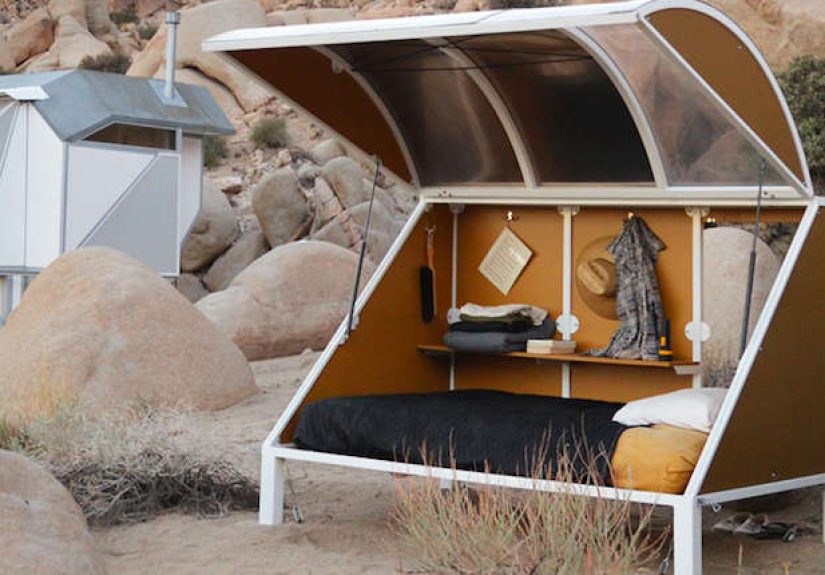
One of A-Z West’s most recognizable elements is the Wagon Station Encampment, a collection of small futuristic sleeping pods that look somewhere between a desert trailer, a space capsule, and the dream of a very disciplined turtle. These compact units explore shelter at a reduced scale. They offer privacy, simplicity, and a direct relationship with the desert environment.
The Wagon Stations are not luxury tiny homes stuffed with decorative pillows and suspiciously perfect lemons. They are more like propositions: What does a person truly need to sleep, think, and exist comfortably? How small can shelter become before it stops supporting life and starts arguing with it? What happens when a temporary home makes you more aware of your body, your belongings, and the horizon?
The Studio, Weaving, and Ceramics
A-Z West also includes studio spaces connected to making, research, and production. The site has supported ceramics, textiles, weaving, and artist-designed objects. These are not separate from the philosophical project; they are part of it. A woven textile, ceramic vessel, or storage object becomes a way to think through usefulness, beauty, labor, repetition, and value.
The presence of craft at A-Z West is important because it resists the idea that ideas live only in language. Here, ideas have weight, texture, seams, handles, and sometimes dust on them. They are made, used, repaired, reconsidered, and placed back into circulation.
Planar Pavilions and Desert Installations
A-Z West includes outdoor works and architectural experiments such as Planar Pavilions and other site-responsive structures. These projects use simple forms to frame space, guide movement, and create temporary zones of attention. In the desert, a wall does not need to be elaborate to become dramatic. A plane, a shadow, and a horizon can do the job with excellent posture.
The installations encourage visitors to notice how little architecture sometimes needs in order to influence experience. A plane of color can become a threshold. A low structure can become a room without fully enclosing anything. A path can become a thought process.
High Desert Test Sites and the Next Life of A-Z West
In January 2022, High Desert Test Sites formally began stewarding A-Z West, managing day-to-day operations, residencies, programs, tours, and public-facing experiences. This shift matters because it moves the site from being primarily associated with Zittel’s personal live/work practice into a broader nonprofit cultural platform.
High Desert Test Sites brings together artists, writers, thinkers, and community members through residencies, workshops, exhibitions, public programs, and desert-based projects. Its mission fits naturally with A-Z West because both are interested in art that does not remain sealed inside a white cube. The desert becomes a classroom, studio, stage, and testing ground.
In this sense, A-Z West is not frozen as a monument to one artist’s past. It continues to change. That is part of its integrity. A project about living cannot behave like a taxidermied antelope. It has to adapt, metabolize new uses, and keep asking questions that are inconvenient enough to be useful.
Design Lessons From A-Z West
1. Limits Can Create Freedom
A-Z West repeatedly suggests that constraints are not always enemies. A small shelter can focus attention. A uniform can reduce decision fatigue. A limited palette can sharpen perception. A structured daily routine can create space for creativity. The project does not romanticize deprivation; it studies how chosen boundaries can make life feel more intentional.
2. Objects Are Never Just Objects
At A-Z West, furniture, clothing, ceramics, and textiles are not accessories. They are tools that shape behavior. A storage system can encourage collecting or editing. A chair can formalize rest. A garment can turn identity into a daily practice. This is one reason the site appeals to artists, architects, designers, minimalists, and anyone who has ever looked at a junk drawer and wondered who, exactly, is in charge here.
3. Sustainability Starts With Desire
A-Z West is often discussed in relation to small-space living, desert adaptation, and reduced consumption. But its most interesting sustainability lesson may be psychological. People rarely change habits only because they are told to own less. They change when a different way of living feels meaningful, beautiful, challenging, or liberating. Zittel’s work makes restraint visually and intellectually compelling.
4. Place Should Shape Design
The high desert is not a neutral site. It demands shade, durability, flexibility, and respect. A-Z West shows how design can emerge from environmental pressures rather than ignoring them. In an age of copy-paste interiors and homes that look identical from Brooklyn to Boise, that lesson feels especially fresh.
Why A-Z West Still Feels Relevant
A-Z West feels remarkably current because the questions it raises have only become louder. How much space do we need? How many objects make life richer, and how many simply become unpaid interns for our anxiety? Can a home be more than a container for stuff? Can design help us live with more attention and less automatic consumption?
These questions matter in a culture shaped by remote work, housing pressure, climate awareness, digital overload, and endless lifestyle marketing. A-Z West does not offer a neat solution. It is not a 10-step plan to become a better person by buying a more expensive linen robe. Instead, it offers a method: observe your life, test alternatives, accept contradictions, and notice what your surroundings are teaching you.
That may be the project’s strongest contribution. It does not tell everyone to live in the desert, wear a uniform, sleep in a pod, or become an artist. It asks people to investigate their own systems. What routines are inherited? What comforts are actually necessary? What choices create freedom, and which ones simply create more shopping tabs?
Visiting A-Z West: What to Expect
Today, A-Z West can be experienced through High Desert Test Sites programming, including tours and stays. Visitors should approach it less like a conventional museum and more like a living cultural landscape. The experience may include artist-designed interiors, outdoor installations, desert views, studio areas, and stories about how the site has evolved over time.
Because A-Z West is located in the high desert, practical preparation matters. Bring water, sun protection, comfortable shoes, and an openness to dust. The desert is not a theme park, and it will not apologize for being hot, bright, windy, or extremely committed to texture. The best visits are slow visits. A-Z West rewards attention rather than speed.
For travelers already exploring Joshua Tree, A-Z West offers a different kind of landmark. It is not only about scenery; it is about systems. It adds intellectual architecture to the desert itinerary. After hiking among boulders or watching the sun turn the land gold, visitors can encounter a project that asks how landscape changes the way people define comfort, work, privacy, and community.
Experiences Related to A-Z West: Living With the Questions
The most memorable way to understand A-Z West is not to treat it as a collection of objects but as an experience of attention. Imagine arriving in Joshua Tree after the visual noise of a city: billboards, brake lights, grocery aisles, browser tabs, that one notification you keep ignoring because it looks official and therefore threatening. Then the desert opens. The road gets quieter. The sky becomes enormous. Suddenly, a chair is not just a chair. It is a decision about how to sit in the world.
A visit to A-Z West can feel like stepping into a practical thought experiment. The first impression is often visual: clean geometric forms, compact shelters, pale surfaces, handcrafted details, and the dry drama of the desert around them. But the deeper experience is behavioral. You begin noticing what you carry, where you place your body, how much privacy you expect, how quickly you reach for a screen, and how strongly your sense of comfort depends on habit.
Spending time around the Wagon Stations, for example, can make ordinary bedrooms seem extravagant. The pods are small, direct, and intentionally limited. They do not perform luxury in the usual way. Their luxury is concentration. They make rest feel deliberate. They also reveal how little is required for shelter to become emotionally charged: a surface, a roof, a threshold, a view, and the knowledge that the desert is very much still outside.
The A-Z West House offers a different experience. It shows how a domestic interior can become a composed environment without losing its usefulness. The furniture is not merely decorative. The arrangement of rooms, objects, books, surfaces, and outdoor areas encourages slower attention. It is the opposite of the generic rental-house feeling where everything is pleasant, beige, and spiritually laminated. Here, details feel authored. The space asks you to participate.
One of the strongest experiences connected to A-Z West is the tension between freedom and structure. Many people imagine desert living as pure freedom: open land, big sky, no neighbors peering over the fence to judge your recycling bin. But A-Z West complicates that fantasy. It suggests that freedom may depend on systems: where water comes from, how shade is made, how work is organized, how guests share space, how objects are maintained, and how much choice one person can handle before choice becomes noise.
There is also a social experience. A-Z West is associated with residencies, workshops, tours, and High Desert Test Sites programs, so the project is not only about solitude. It explores community through shared curiosity. Artists, writers, students, visitors, and desert residents encounter one another through a place designed to make familiar assumptions feel slightly strange. That strangeness is productive. It opens conversation.
Finally, A-Z West changes how visitors see their own homes. After engaging with Zittel’s world, a kitchen cabinet may look less innocent. A closet may resemble a biography. A sofa may appear to be managing the household more than anyone realized. That is the lasting experience of investigative living: the desert experiment follows you back into daily life. You may not move to Joshua Tree or build a sleeping pod in the yard. But you might ask better questions about what you own, what you repeat, and what kind of life your surroundings quietly encourage.
Conclusion: A-Z West as a Map for Intentional Living
A-Z West is one of California’s most compelling examples of art expanding beyond the gallery into the structure of everyday life. Andrea Zittel’s high desert project turns living into a form of research and design into a philosophical tool. It is beautiful, rigorous, odd, practical, and occasionally funny in the way only serious experiments can be.
Its importance lies not only in its architecture or objects, but in its questions. How do we live? What gives life meaning? How do freedom and limitation shape one another? How can a home, a garment, a shelter, or a daily routine become a site of awareness rather than autopilot?
In a culture that often sells lifestyle as decoration, A-Z West offers something more durable: lifestyle as inquiry. It does not ask visitors to copy Andrea Zittel’s life. It asks them to investigate their own. And that may be the most useful design lesson of all.






 Close
Close