
Table of Contents >> Show >> Hide
- What Was the Pearl Harbor Attack?
- Why Did Japan Attack Pearl Harbor?
- How the Attack Unfolded on December 7, 1941
- Damage, Casualties, and Ships Hit
- Why Pearl Harbor Was Such a Shock
- The U.S. Response and Why It Changed the War
- Pearl Harbor’s Long Shadow
- Experiences Related to the Pearl Harbor Attack
- Conclusion
- SEO Tags
The Pearl Harbor attack was one of those history-shaking moments that turned an ordinary Sunday morning into a global turning point. On December 7, 1941, Japanese forces launched a surprise assault on the U.S. naval base at Pearl Harbor on Oahu, Hawaii. In less than two hours, ships were burning, aircraft were wrecked, and the United States was no longer watching World War II from the sidelines. It had been shoved onto the stage.
Even now, the phrase Pearl Harbor attack carries enormous weight. It is not just a military story. It is a story about strategy, intelligence failures, human courage, grief, memory, and the way one morning can alter the course of the twentieth century. For anyone trying to understand World War II, American history, or the Pacific conflict, Pearl Harbor is not optional reading. It is chapter one of America’s wartime transformation.
What Was the Pearl Harbor Attack?
The attack on Pearl Harbor was a surprise military strike carried out by the Imperial Japanese Navy against the United States Pacific Fleet. The target was the naval base at Pearl Harbor, a major American stronghold in the Pacific. Japan’s goal was not random destruction for its own sake. The attack was designed to weaken U.S. naval power so Japan could expand across Southeast Asia and the Pacific without immediate American interference.
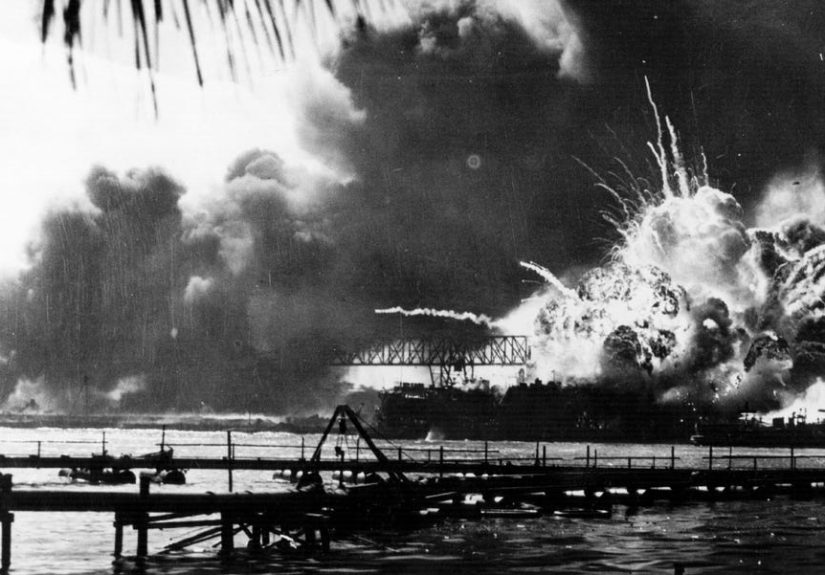
The strike came in two waves. Japanese aircraft launched from six aircraft carriers and hit battleships, airfields, and military facilities across Oahu. The raid began just before 8:00 a.m. local time and lasted under two hours, but the damage was devastating. The image most people remember is Battleship Row in flames, yet the attack also crippled aircraft on the ground and threw multiple branches of the U.S. military into chaos.
That is what makes the Pearl Harbor attack so historically important: it was tactically sharp, emotionally shocking, and politically explosive. By the next day, President Franklin D. Roosevelt had delivered his famous “Day of Infamy” speech, and Congress declared war on Japan. A few days later, Germany and Italy declared war on the United States. The war had become fully American, whether the country liked it or not.
Why Did Japan Attack Pearl Harbor?
To understand why Japan attacked Pearl Harbor, you have to zoom out a bit. By 1941, relations between Japan and the United States had deteriorated badly. Japan had already expanded aggressively into China and French Indochina, and the United States responded with economic pressure, including restrictions on oil and other materials. For Japan, which depended heavily on imported resources, that pressure was a serious threat.
Japanese leaders believed that war with the United States might become unavoidable. Their answer was a grim gamble: strike first, hit hard, and knock the U.S. Pacific Fleet out of the picture long enough to secure strategic territory rich in oil and raw materials. In other words, Japan hoped Pearl Harbor would buy time. It was supposed to deliver a clean, stunning blow that would leave the United States too weakened or too discouraged to respond effectively in the Pacific.
That calculation was bold, but it also rested on a dangerous assumption. Japan underestimated America’s industrial power, military recovery, and public anger. The attack succeeded in shocking the United States, but it failed to break American resolve. If anything, it did the opposite. Pearl Harbor unified the country faster than almost any speech ever could.
How the Attack Unfolded on December 7, 1941
The First Wave
The first wave of Japanese aircraft struck just before 8:00 a.m. on a clear Sunday morning. That timing mattered. Many service members were at breakfast, preparing for religious services, or easing into what they expected to be a relatively quiet day. Instead, torpedo bombers and dive bombers came roaring in. At first, some Americans thought it might be a drill. It was not. History had not come to rehearse.
The first wave targeted battleships moored at Pearl Harbor as well as airfields such as Hickam, Wheeler, Bellows, Ewa, Ford Island, and Kaneohe. The Japanese understood that aircraft could threaten their operation, so destroying planes on the ground was part of the plan. Many American aircraft had been lined up wingtip-to-wingtip as a precaution against sabotage, which unfortunately made them easier targets from the air.
Among the most catastrophic blows was the hit on the USS Arizona. A bomb penetrated the ship and ignited its forward magazine, causing a massive explosion. The loss of life aboard the Arizona alone became one of the defining tragedies of the day.
The Second Wave
After a brief lull, the second wave arrived. This group focused heavily on continuing the destruction inside the harbor and hitting additional military targets. By then, American forces were firing back more effectively, and the first shock had begun to wear off. But confusion, smoke, damaged communications, and the speed of the assault still left defenders at a serious disadvantage.
The Japanese attack force included 353 aircraft launched from six carriers. Their assault damaged or destroyed battleships, cruisers, destroyers, and other vessels, while also wrecking aircraft and military infrastructure. The raid did not last very long, but that is part of what made it so terrifying. In under two hours, the entire strategic picture in the Pacific had changed.
Damage, Casualties, and Ships Hit
The human toll of the Pearl Harbor attack was staggering. More than 2,400 Americans were killed, including service members and civilians, and 1,178 were wounded. Nearly half of the deaths occurred on the USS Arizona, where 1,177 sailors and Marines were lost. The battleship USS Oklahoma capsized, the USS Utah was also lost, and many additional vessels were sunk, beached, or badly damaged.
Aircraft losses were severe too. American planes were destroyed or damaged in huge numbers, especially because so many were caught on the ground. The result was not just immediate destruction but a temporary collapse of local air defense. Pearl Harbor became a case study in how surprise, speed, and concentration of force can overwhelm even a powerful military base.
Still, the attack was not a total strategic victory for Japan. Several crucial American assets escaped destruction. Most notably, U.S. aircraft carriers were not in port that day. Repair facilities, oil storage tanks, and some other base infrastructure also survived. That mattered more than it might have seemed in the moment. The United States recovered faster than Japan expected, and those surviving assets helped fuel the American war effort in the Pacific.
Why Pearl Harbor Was Such a Shock
Part of the power of Pearl Harbor lies in the fact that it was a surprise attack, but the phrase “surprise attack” is almost too neat for what actually happened. The reality was messier. There were warning signs, intelligence traffic, and even a radar detection of incoming aircraft on the morning of December 7. But information was delayed, misread, or not acted upon in time. A warning message reached Honolulu too late to matter. That failure has been studied ever since.
The attack also shattered assumptions about distance and safety. Hawaii felt remote from the battlefields of Europe and Asia, and many Americans believed the Pacific Fleet was a strong deterrent. Pearl Harbor proved that modern warfare could arrive suddenly, from far away, and with terrifying precision. It was not just a military blow. It was a psychological earthquake.
That shock is one reason Pearl Harbor remains so deeply embedded in American memory. It was a moment when geography failed, intelligence stumbled, and ordinary routine collapsed in minutes. Sunday uniforms and breakfast trays gave way to smoke, gunfire, and rescue efforts. If history sometimes feels dusty in textbooks, Pearl Harbor stubbornly refuses to stay dusty.
The U.S. Response and Why It Changed the War
On December 8, 1941, Roosevelt addressed Congress and called December 7 “a date which will live in infamy.” The line became immortal because it captured the public mood perfectly. Americans were shocked, angry, and suddenly unified. Congress moved quickly to declare war on Japan, and the United States formally entered World War II.
The effect reached far beyond Pearl Harbor. The attack triggered a chain of events that brought the United States fully into the global conflict. America’s industrial capacity, manpower, and naval rebuilding would become decisive factors in the Allied victory. So while Pearl Harbor was a terrible defeat in the short term, it also became the spark for a massive military and economic mobilization.
In that sense, the attack was both a tactical success and a strategic failure for Japan. It damaged the Pacific Fleet, but it did not destroy the American ability to fight. More importantly, it transformed U.S. public opinion overnight. Before Pearl Harbor, debate over America’s role in the war was still alive. After Pearl Harbor, that debate was effectively over.
Pearl Harbor’s Long Shadow
The legacy of Pearl Harbor did not end with the war. The site became sacred ground, especially around the wreck of the USS Arizona, which remains the final resting place for many of its crew. The USS Arizona Memorial, dedicated in 1962, turned the harbor into a place not only of mourning but also of reflection and education. Today, the Pearl Harbor National Memorial preserves the stories of the attack, the people who lived through it, and the broader path from war to remembrance.
That long shadow matters because Pearl Harbor is not only about destruction. It is also about memory. It is about how nations remember trauma, how families remember loss, and how visitors encounter history in places where it actually happened. The memorials at Pearl Harbor honor not just strategy and sacrifice, but the deeply personal cost of war.
For students, travelers, history buffs, and anyone trying to understand the Pacific War, Pearl Harbor remains one of the clearest examples of how a single attack can reshape politics, military planning, and national identity. It is a reminder that the past does not just sit quietly behind glass. Sometimes it still leaks oil, echoes in speeches, and changes how a country sees itself.
Experiences Related to the Pearl Harbor Attack
One of the most powerful ways to understand the Pearl Harbor attack is to think about what it felt like to live through it. For the sailors on Battleship Row, the day began with routine. Then came the sound of engines, explosions, shouted orders, and the sick realization that this was not training. Men ran to battle stations through smoke and fire. Some were trapped below deck. Others dove into burning water. Many survivors later described confusion first, then instinct. There was no time for grand speeches. There was only the next task: fight the fire, carry the wounded, free the trapped, stay alive.
For Army personnel and airmen on Oahu, the experience was just as chaotic. Airfields were hit fast, and aircraft that might have defended the island were smashed before they could get airborne. Mechanics, pilots, guards, and medics were thrown into combat almost instantly. Some tried to return fire with whatever weapons they could reach. Others helped drag injured people away from wreckage. The attack did not politely stay in one corner of the island. It spread fear and violence across multiple bases in a matter of minutes.
Civilians in Hawaii experienced something different but equally terrifying. They saw black smoke over the harbor, heard gunfire, and realized the war had arrived at their doorstep. Some were killed during the attack. Others spent the day in fear of invasion, rumor, and more bombing. For families waiting for news, the uncertainty was brutal. In wartime history, we often focus on admirals and presidents, but Pearl Harbor was also lived minute by minute by wives, children, nurses, teachers, and workers who had no warning that their Sunday would become historic.
Then there is the experience of memory. Decades later, veterans returned to Pearl Harbor for ceremonies and reunions. Many spoke not only about the attack itself, but about the faces they never forgot. Visitors today often describe the USS Arizona Memorial as unusually quiet, the kind of quiet that makes people lower their voices without being told. Standing above the wreck, reading the names, and knowing many remains are still entombed below creates a feeling that is hard to fake and harder to forget.
That emotional journey is part of why the Pearl Harbor attack still matters. It is not only a subject for timelines and casualty counts. It is a human experience of shock, courage, grief, survival, and remembrance. The facts explain what happened. The experiences explain why it still reaches people so deeply. And together, they make Pearl Harbor more than a history lesson. They make it a warning about complacency, a tribute to resilience, and a place where the past still feels very close.
Conclusion
The Pearl Harbor attack was far more than a dramatic military raid. It was the event that pushed the United States into World War II, exposed serious intelligence and preparedness failures, and reshaped the balance of power in the Pacific. It also left behind stories of sacrifice that continue to define how Americans remember war, loss, and national resolve.
More than eight decades later, Pearl Harbor still matters because it combines strategy with human drama in a way few historical events can. It is a story of geopolitical tension, of devastating surprise, and of how quickly a nation can be transformed. Most of all, it reminds us that history is not just dates and ships and speeches. It is people caught in moments they did not choose, whose lives changed forever before breakfast was even over.






 Close
Close