
Table of Contents >> Show >> Hide
- Quick-Use Liquid Measurement Conversion Chart
- The “Ounces” Problem: Fluid Ounces vs. Weight Ounces
- Kitchen Equivalents You’ll Use Every Week
- How to Measure Liquids Accurately (Without Becoming a Perfectionist)
- Metric vs. U.S. Cups: Why the Numbers Don’t Always Match
- Recipe Scaling: Halving and Doubling Without Regret
- Common Recipe Questions (Answered Like a Friend, Not a Robot)
- Printable Mini Chart (Cabinet-Door Approved)
- Conclusion: Your Recipes Don’t Need Perfect MathJust Consistent Measuring
- Real-Life Kitchen Moments: Where Conversion Charts Save the Day
Ever stare at a recipe that calls for 1/3 cup, but your measuring cup set jumps from
1/4 to 1/2 like it’s avoiding commitment? Or maybe your favorite American cookie recipe
meets a European kitchen scale and suddenly everyone’s speaking milliliters.
This guide is your no-drama, real-world liquid measurement conversion chart for everyday cooking:
cups, tablespoons, teaspoons, fluid ounces, pints, quarts, gallons, milliliters, and litersplus
the “wait… ounces are WHAT?” explanation nobody teaches you until it’s too late.
Bookmark it, print it, tape it inside a cabinet, or memorize it to impress friends at brunch. (Yes, that’s a thing.
No, I don’t know why it works, but it does.)
Quick-Use Liquid Measurement Conversion Chart
Here are the conversions you’ll reach for constantlyespecially when scaling recipes or switching between U.S. and metric.
Values are shown in practical kitchen-friendly form. (Nobody needs a PhD in decimals to make soup.)
U.S. Volume to Metric (mL/L)
| U.S. Measure | Equivalent (Approx.) | Metric |
|---|---|---|
| 1 teaspoon (tsp) | ≈ 0.17 fl oz | ≈ 4.93 mL |
| 1 tablespoon (tbsp) | ≈ 0.5 fl oz | ≈ 14.79 mL |
| 1 fluid ounce (fl oz) | 2 tbsp | ≈ 29.57 mL |
| 1/4 cup | 4 tbsp | ≈ 59 mL |
| 1/3 cup | 5 tbsp + 1 tsp | ≈ 79 mL |
| 1/2 cup | 8 tbsp | ≈ 118 mL |
| 2/3 cup | 10 tbsp + 2 tsp | ≈ 158 mL |
| 3/4 cup | 12 tbsp | ≈ 177 mL |
| 1 cup | 16 tbsp / 8 fl oz | ≈ 237 mL |
| 1 pint (pt) | 2 cups | ≈ 473 mL |
| 1 quart (qt) | 2 pt / 4 cups | ≈ 946 mL |
| 1 gallon (gal) | 4 qt / 16 cups | ≈ 3.785 L |
Tip: In many recipes, rounding to the nearest whole milliliter is perfectly fine.
Baking is fussier than cooking, but even baking usually won’t collapse into chaos because you rounded
118.29 mL to 118 mL. (If it does, your oven is probably the real villain.)
The “Ounces” Problem: Fluid Ounces vs. Weight Ounces
Let’s fix one of the most common kitchen misunderstandings:
fluid ounces measure volume, while ounces (oz) usually measure weight.
They’re not interchangeableexcept when the ingredient happens to behave like water, and even then, it’s a shortcut.
Why the confusion happens
- “fl oz” = a volume measure (how much space a liquid takes up).
- “oz” = a weight measure (how heavy something is).
- Water is the sneaky ingredient that makes people think they’re the same, because roughly 8 fl oz of water weighs about 8 oz.
- But ingredients like honey, syrup, and oil have different densitiesso volume and weight drift apart fast.
If a recipe lists liquids in fluid ounces, use a liquid measuring cup or a scale set to a volume-friendly mode.
If a recipe lists ingredients by weight ounces (common in professional baking), use a kitchen scale.
Kitchen Equivalents You’ll Use Every Week
These are the “mental math” conversions that save you from stopping mid-recipe to google
“how many tablespoons in a cup” with sticky hands.
Small-to-medium liquid equivalents
| Measure | Equals |
|---|---|
| 3 tsp | 1 tbsp |
| 2 tbsp | 1 fl oz |
| 16 tbsp | 1 cup |
| 1 cup | 8 fl oz |
| 2 cups | 1 pint |
| 2 pints | 1 quart |
| 4 quarts | 1 gallon |
Fractional cup cheat sheet (the “my measuring cup is missing” edition)
This is where life gets better. If you’re missing a 1/3 cup, you can still win.
| Fraction | Tablespoons | Fluid Ounces |
|---|---|---|
| 1/8 cup | 2 tbsp | 1 fl oz |
| 1/4 cup | 4 tbsp | 2 fl oz |
| 1/3 cup | 5 tbsp + 1 tsp | ≈ 2.65 fl oz |
| 3/8 cup | 6 tbsp | 3 fl oz |
| 1/2 cup | 8 tbsp | 4 fl oz |
| 5/8 cup | 10 tbsp | 5 fl oz |
| 2/3 cup | 10 tbsp + 2 tsp | ≈ 5.3 fl oz |
| 3/4 cup | 12 tbsp | 6 fl oz |
| 7/8 cup | 14 tbsp | 7 fl oz |
| 1 cup | 16 tbsp | 8 fl oz |
How to Measure Liquids Accurately (Without Becoming a Perfectionist)
Measuring liquids sounds simple until you realize you’ve been holding the cup in the air like a trophy and
squinting at the lines from a 45-degree angle. Accuracy comes down to a few habits.
Use the right measuring tool
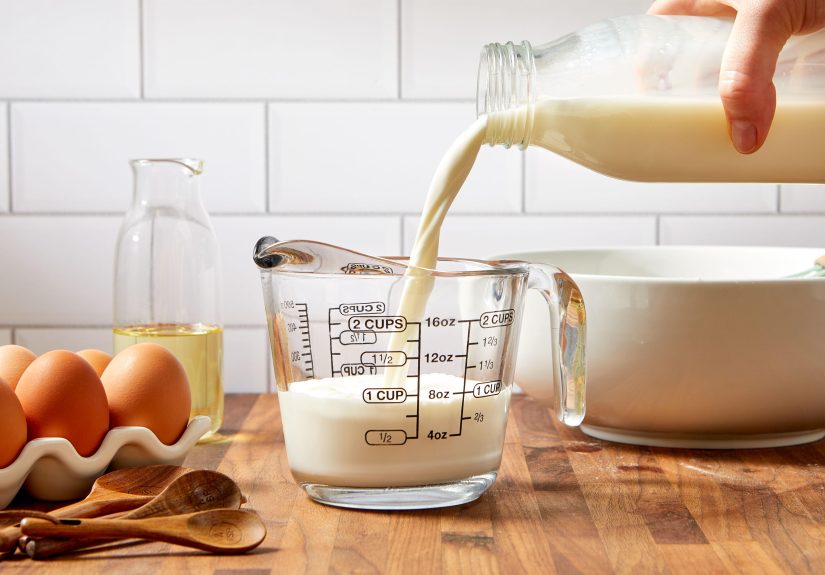
- Liquid measuring cups have a spout and measurement linesideal for water, milk, broth, vinegar, oil.
- Measuring spoons are best for small amountsvanilla extract, lemon juice, soy sauce, hot sauce (aka culinary courage).
- Dry measuring cups are better for dry ingredients, but they’re also handy for thick liquids when you plan to level them.
Read at eye level (yes, really)
Place the cup on a flat surface, get your eyes level with the marking, and read the measurement where the liquid surface settles.
Many liquids form a slight curve at the top (a “meniscus”), and reading at eye level helps you avoid over- or under-pouring.
Thick liquids need a different approach
Honey, molasses, and syrup don’t pourthey negotiate. Use a spoon or spatula to coax them out, and consider lightly oiling the spoon or cup
when the recipe allows. For these ingredients, consistency matters more than speed.
Metric vs. U.S. Cups: Why the Numbers Don’t Always Match
If you’ve ever seen a recipe claim “1 cup = 250 mL,” you’re not hallucinating.
Different systems define “cup” differently around the world.
The practical takeaway
- U.S. customary cup is about 237 mL in most cooking conversions.
- Nutrition labeling in the U.S. often rounds to 240 mL per cup.
- Metric cup is commonly 250 mL in some countries and recipe systems.
For everyday cooking, a 10–13 mL difference usually won’t matter. For delicate baking or scaled-up batches,
try to stick to one system throughout the recipe (or use a scale).
Recipe Scaling: Halving and Doubling Without Regret
Scaling recipes is where conversion charts earn their keep. You can absolutely halve pancake batter or double a soup recipe,
as long as you scale liquids thoughtfully.
Fast scaling table for common liquid amounts
| Original | Half | Double |
|---|---|---|
| 1 cup | 1/2 cup | 2 cups (1 pint) |
| 3/4 cup | 6 tbsp | 1 1/2 cups |
| 2/3 cup | 1/3 cup | 1 1/3 cups |
| 1/2 cup | 1/4 cup | 1 cup |
| 1/3 cup | 2 tbsp + 2 tsp | 2/3 cup |
| 1/4 cup | 2 tbsp | 1/2 cup |
| 1 tbsp | 1 1/2 tsp | 2 tbsp |
| 1 tsp | 1/2 tsp | 2 tsp |
Example: Turning a vinaigrette into a smaller batch
Say your dressing calls for 1/3 cup olive oil and 3 tbsp vinegar, but you only need half.
Half of 1/3 cup becomes 2 tbsp + 2 tsp. Half of 3 tbsp becomes 1 tbsp + 1 1/2 tsp.
Suddenly you’re not guessingyou’re just cooking.
Example: Doubling soup without watery sadness
If a soup uses 4 cups broth (1 quart), doubling gives you 8 cups (2 quarts, or 1/2 gallon).
Those bigger units (quarts/gallons) make scaling feel less like math class and more like common sense.
Common Recipe Questions (Answered Like a Friend, Not a Robot)
How many fluid ounces are in a cup?
1 cup = 8 fluid ounces. If you remember one fact forever, make it this one.
How many tablespoons are in a cup?
1 cup = 16 tablespoons. Your measuring spoons are officially a measuring cup now. Congratulations.
How many teaspoons are in a tablespoon?
1 tablespoon = 3 teaspoons. This is also the secret handshake of people who bake regularly.
Is 1 mL the same as 1 gram?
Only for water (approximately). For oils, syrups, dairy, and anything that sounds delicious, the weight changes because density changes.
When accuracy matters, weigh ingredients in grams using a kitchen scale.
Printable Mini Chart (Cabinet-Door Approved)
If you want a quick reference without scrolling, here’s a simple list format you can copy, print, or screenshot:
- 1 tbsp = 3 tsp = 1/2 fl oz ≈ 15 mL
- 1 fl oz = 2 tbsp ≈ 30 mL
- 1/4 cup = 4 tbsp = 2 fl oz ≈ 60 mL
- 1/3 cup = 5 tbsp + 1 tsp ≈ 80 mL
- 1/2 cup = 8 tbsp = 4 fl oz ≈ 120 mL
- 1 cup = 16 tbsp = 8 fl oz ≈ 240 mL
- 1 pint = 2 cups = 16 fl oz ≈ 475 mL
- 1 quart = 2 pints = 4 cups ≈ 1 liter
- 1 gallon = 4 quarts = 16 cups ≈ 3.8 liters
These are friendly rounded numbers for everyday use. When you need precision (especially in baking),
use the fuller chart earlier in this guide.
Conclusion: Your Recipes Don’t Need Perfect MathJust Consistent Measuring
A solid liquid measurement conversion chart does two things: it saves time and it prevents “mystery outcomes.”
(You knowlike when your cake looks fine but tastes like you forgot an ingredient. Because you did. Because you eyeballed 1/3 cup.)
Keep these conversions close, measure liquids at eye level, use the right tools, and don’t let the words “fluid ounce” bully you.
With a few reliable equivalents, you can cook from nearly any recipeAmerican, metric, or written by someone’s great-aunt who measures with vibes.
: experiences related to the topic (added for length)
Real-Life Kitchen Moments: Where Conversion Charts Save the Day
Conversions sound like a boring “reference page” thinguntil the exact moment you need them. And that moment usually happens
when you’re mid-recipe, slightly hungry, and your brain refuses to do fractions because it has switched into
“I smell garlic, therefore I deserve food now” mode.
The missing measuring cup situation
Picture this: you’re making a sauce that calls for 1/3 cup of broth. You open your drawer and find exactly
one measuring cup1/4 cup. The rest of the set has apparently joined a traveling circus.
This is where the chart becomes a superhero in very unglamorous clothing.
Instead of guessing, you use the workaround: 1/3 cup = 5 tbsp + 1 tsp. It’s not just “math,” it’s control.
Your sauce tastes the same every time because you’re repeating a real measurement, not a hopeful pour.
Consistency is the difference between “Wow, this is amazing!” and “It’s fine, I guess…”
which is the culinary version of being left on read.
The “ounces” misunderstanding
Another classic: someone reads “8 oz” and assumes it means 8 fl oz. Sometimes that’s okay, sometimes that’s chaos.
Water is forgiving, but try that with honey or maple syrup and you’ll learn a valuable lesson:
volume and weight are not twinsthey’re more like cousins who only show up to the same family events.
This is why a chart (and the tiny “fl” in “fl oz”) matters. Once you get the hang of it, you stop feeling tricked by recipes
and start feeling like you can adapt them. That’s the real win: flexibility without sacrificing results.
Scaling recipes for real people
Most recipes are written for an imaginary household where everyone eats exactly the same amount and leftovers always fit in one container.
Real life is messier. Sometimes you need half a recipe because it’s a Tuesday and you’re not trying to bathe in soup.
Sometimes you need double because suddenly everyone is home and hungry, and your kitchen has become a tiny restaurant with no warning.
Conversions make scaling feel safe. Doubling 4 cups into 2 quarts is easy.
Halving 1/3 cup into 2 tbsp + 2 tsp is also easyas long as you have the chart.
Without it, people “eyeball” and end up with soup that’s too salty, dressing that’s too sharp, or pancake batter that’s so thin it
should be paying rent as a beverage.
The quiet confidence effect
A conversion chart does something sneaky: it makes you calmer. When you know you can convert what you need, you don’t panic if a recipe
is written in a different system. You don’t have to abandon a great recipe just because it says “milliliters” or “pints.”
You can translate it into your kitchen’s language and keep cooking.
And honestly? That’s the point. Cooking should feel like a skill you can build, not a pop quiz you didn’t study for.
Keep the chart handy, use it when you need it, and let your future self enjoy the benefitspreferably with something delicious.






 Close
Close