
Table of Contents >> Show >> Hide
- Why Make Homemade Beef Jerky?
- Best Cuts of Beef for Jerky
- Essential Tools for Homemade Beef Jerky
- Homemade Beef Jerky Recipe (Oven or Dehydrator)
- How to Tell When Beef Jerky Is Done
- Storing Homemade Beef Jerky
- Flavor Variations to Try
- Pro Tips for Perfect Homemade Beef Jerky
- of Real-Life Homemade Beef Jerky Experience
If you’ve ever stared at a tiny bag of gas station beef jerky and thought, “That’s it? For that price?” welcome to the club. The good news: homemade beef jerky is surprisingly easy, tastes way better, and lets you control everything from the cut of meat to how spicy, smoky, or low-sodium you want it.
This homemade beef jerky recipe walks you through picking the right cut, building a flavor-packed marinade, drying it safely in your oven or dehydrator, and storing it so it actually lasts more than a day (assuming everyone in your house doesn’t devour it on sight).
Why Make Homemade Beef Jerky?
Store-bought beef jerky is convenient, but it often comes with a long list of additives, lots of sugar, and enough sodium to season a small ocean. When you make jerky at home, you can:
- Choose lean, quality beef instead of mystery meat.
- Control the sodium with low-sodium soy sauce or salt substitutes.
- Customize flavors smoky, sweet, spicy, or all of the above.
- Save money by buying larger cuts of meat and slicing them yourself.
- Make high-protein snacks that work for hiking, road trips, lunch boxes, or just stress-snacking in front of the fridge.
Best Cuts of Beef for Jerky
The secret to great jerky is choosing a lean cut of beef. Fat doesn’t dehydrate well and can cause jerky to spoil faster, so most jerky pros recommend trimming off as much visible fat as possible.
Great cuts for homemade beef jerky
- Top round – Lean, affordable, and widely available. A classic jerky cut.
- Bottom round – Similar to top round, slightly different grain, also great for jerky.
- Eye of round – Very lean and uniform in shape, which makes slicing easier.
- Sirloin tip – A bit pricier but offers robust flavor and tender jerky.
- Flank or skirt steak – Lean with bold flavor; slice carefully for your preferred texture.
Whatever cut you choose, look for:
- Minimal marbling: Less fat = longer shelf life.
- Freshness: Avoid meat that looks dull or has an off smell.
- Uniform thickness: Slices that are roughly the same thickness dry more evenly.
Essential Tools for Homemade Beef Jerky
You don’t need fancy equipment to make beef jerky at home, but a few tools make life easier:
- Sharp knife: For thin, even slices.
- Cutting board: Large enough to work comfortably.
- Oven with low-temperature setting (around 170–200°F) and baking sheets with wire racks or a food dehydrator.
- Large resealable bags or shallow containers: For marinating.
- Instant-read thermometer: To ensure the jerky reaches a safe internal temperature.
Homemade Beef Jerky Recipe (Oven or Dehydrator)
Ingredients
This is a flexible, flavor-packed base recipe. Adjust heat and sweetness to your taste.
- 2 pounds lean beef (top round, eye of round, or sirloin tip), well-trimmed
- 3/4 cup low-sodium soy sauce
- 1/4 cup Worcestershire sauce
- 2 tablespoons honey or maple syrup
- 1 tablespoon apple cider vinegar or rice vinegar
- 2 teaspoons smoked paprika
- 2 teaspoons black pepper, freshly ground
- 1 teaspoon garlic powder
- 1 teaspoon onion powder
- 1 teaspoon liquid smoke (optional, for extra smokiness)
- 1/2–1 teaspoon red pepper flakes or hot sauce (optional, for heat)
Step 1: Slice the Beef
For easier slicing, place the beef in the freezer for about 30–45 minutes until it’s firm but not solid. This helps you get thin, even strips.
- Slice the beef into strips about 1/8–1/4 inch thick.
- For a chewier jerky, slice with the grain.
- For a more tender jerky, slice against the grain.
Step 2: Make the Marinade
In a large bowl, whisk together the soy sauce, Worcestershire, honey, vinegar, smoked paprika, black pepper, garlic powder, onion powder, liquid smoke (if using), and any hot sauce or red pepper flakes.
Add the beef strips to the bowl or to a large resealable bag. Toss or massage well so every piece is coated. Press out the air, seal, and refrigerate for at least 6 hours, preferably overnight. The longer it marinates, the deeper the flavor.
Step 3: Preheat and Prep for Food Safety
Food safety is important with jerky because it spends hours in the temperature “danger zone” if you’re not careful. To help keep things safe:
- Preheat your oven to 275°F (135°C).
- Line baking sheets with foil for easy cleanup; place wire racks on top.
- Remove the beef from the marinade and pat the strips dry with paper towels to remove excess liquid. This helps them dry faster and more evenly.
Arrange the strips in a single layer on the racks, making sure they don’t overlap.
Step 4: Initial Heating Step (Safety First!)
Bake the meat strips at 275°F for about 10 minutes, or until the thickest pieces reach an internal temperature of 160°F. This step helps reduce the risk of harmful bacteria while still allowing you to dry the jerky at lower temperatures afterward.
Step 5A: Drying in the Oven
After the initial heating step:
- Reduce the oven temperature to its lowest setting, usually around 170–180°F.
- Crack the oven door open slightly (you can use a wooden spoon to hold it open) to allow moisture to escape.
- Continue drying the beef for about 3–6 hours, rotating pans occasionally.
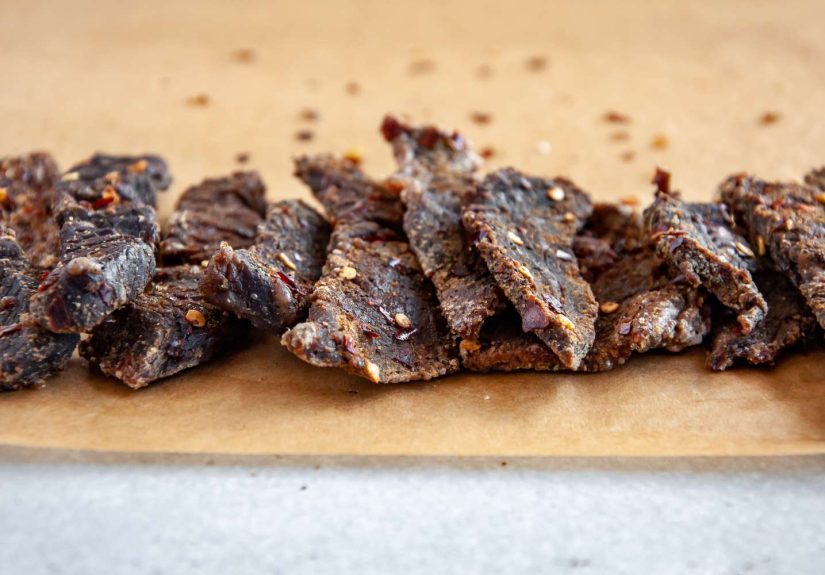
Your jerky is done when it bends and cracks slightly but doesn’t snap in half, and there are no visible moist spots.
Step 5B: Drying in a Dehydrator
If you have a food dehydrator:
- After the initial oven heating step, transfer the beef strips to dehydrator trays in a single layer.
- Set the dehydrator to 160–165°F, if available.
- Dry for about 4–8 hours, depending on thickness and your preferred texture.
Check periodically and rotate trays as needed. Again, you want the jerky to be dry but still flexible, not brittle.
How to Tell When Beef Jerky Is Done
The “bend test” is your best friend:
- Take a cooled piece of jerky and bend it.
- If it bends and cracks slightly but does not break cleanly in half, it’s ready.
- If it snaps, it’s likely over-dried; if it feels moist or squishy, it needs more time.
Always let a few pieces cool completely before deciding, since jerky firms up as it cools.
Storing Homemade Beef Jerky
Once the jerky is completely cool, blot off any residual surface oil with paper towels. Then store it properly to extend its life:
- Room temperature: In an airtight container or bag, homemade jerky usually keeps for about 1–2 weeks.
- Refrigerator: Store in an airtight container for up to 1 month.
- Freezer: For longer storage (2–3 months or more), freeze in airtight bags. Vacuum sealing works especially well.
Label your bags with the date. (Future you will thank present you when you find a mysterious stash of jerky in the back of the freezer.)
Flavor Variations to Try
Once you’ve nailed the basic homemade beef jerky recipe, you can remix it endlessly. A few ideas:
- Sweet & Smoky: Add extra honey or brown sugar and more smoked paprika.
- Spicy Sriracha: Stir in Sriracha or your favorite hot sauce plus extra red pepper flakes.
- Teriyaki Style: Swap some soy sauce for pineapple juice, add grated ginger, and go a bit heavier on the sweetness.
- Black Pepper Heavy: Use cracked black pepper generously and reduce sweetness for a more robust, savory jerky.
- Low-Sodium: Use low-sodium soy sauce, cut back on added salt, and lean on garlic, onion, and vinegar for flavor.
Pro Tips for Perfect Homemade Beef Jerky
- Slice consistently: Keep thickness uniform so pieces dry at the same rate.
- Don’t skip the pat-dry step: Too much surface marinade can slow drying and lead to uneven texture.
- Use racks, not flat pans: Airflow above and below the meat is key.
- Taste and tweak: Cook a small test strip if you’re experimenting with a new marinade and adjust seasoning next time.
- Write down what you did: When you create your “perfect” batch, you’ll want to remember exactly how you got there.
of Real-Life Homemade Beef Jerky Experience
On paper, homemade beef jerky looks like a science project: precise temperatures, food safety steps, drying times. In real life, it’s more like a personality test you learn a lot about yourself while babysitting meat for six hours.
The first time many people make jerky, they either go way too thick (“I like thick steak, so thick jerky will be amazing!”) or cut it so thin it turns into beef-flavored paper. The sweet spot really is that 1/8–1/4-inch thickness. A little time in the freezer before slicing helps tremendously. Once you experience the satisfaction of those smooth, even slices, you’ll never go back to hacking at a wobbly roast on the cutting board.
Another common “rookie move” is to forget about the food safety step. It’s tempting to think, “Eh, I’m drying it forever, that’s enough.” But getting the meat to 160°F at the start or end of the process is one of those non-negotiables. It doesn’t change the taste, but it does change how relaxed you feel handing a Ziploc bag of jerky to your friends, kids, or hiking buddies. Knowing you followed good safety practices means you can focus on whether they like the flavor instead of whether you accidentally served everyone a science experiment.
Speaking of friends: homemade jerky has a funny way of disappearing. You might imagine stocking your pantry with neat, labeled jars of jerky to pull out whenever you need a protein boost. In reality, jerky tends to vanish in “just one more piece” increments. Someone opens the container, takes a strip, then another, then suddenly your carefully portioned snack supply is just crumbs and memories. If you really want jerky to last, consider making a double batch and maybe labeling one bag “Hands Off” (it won’t work, but you’ll feel better).
One of the best parts of getting comfortable with this recipe is experimenting with flavors. Maybe you start with a basic soy-and-Worcestershire situation and then discover you’re a “smoky chipotle and honey” kind of person. Or you realize a splash of pineapple juice and some ginger turns your jerky into something that tastes suspiciously close to vacation. Tweaks like swapping regular soy sauce for a low-sodium version or adding a dash of vinegar can make jerky more weeknight-friendly, especially if you’re watching your salt intake but still want big flavor.
Jerky also has serious “experience points” beyond taste. It’s the perfect project for a weekend afternoon where you want to feel productive but also don’t mind hanging around the house. You slice and marinate, maybe clean up the kitchen, then relax while the house slowly fills with the smell of seasoned beef. Every time you walk past the oven or dehydrator, you peek in like a kid checking on cookies, except this time you’re supervising a high-protein snack with a much longer payoff.
And then there’s the practical side: jerky is the unsung hero of travel. Toss a bag into your carry-on for flights, add it to your hiking pack, or keep some in the car for those moments when “grab a snack” turns into “we’re stuck in traffic and everyone is grumpy.” Unlike a lot of snacks, jerky actually makes you feel full and energized instead of sleepy and regretful.
Once you’ve made homemade beef jerky a couple of times, it stops feeling like a project and starts feeling like a life skill. You’ll know how to pick the right cut, how long to marinate to get the flavor you like, and exactly when to pull the strips from the oven or dehydrator so they’re perfectly chewy. And the next time you walk past that tiny, expensive bag of jerky at the store, you’ll smile, shake your head, and think, “I can do better at home.” Because now, you actually can.
SEO JSON






 Close
Close