
Table of Contents >> Show >> Hide
- 1. Hanging Out in a Suspended Tree Tent
- 2. Your Car Roof as a Loft: Rooftop Tent Camping
- 3. The Hammock Village in the Trees
- 4. Ultralight Bivy and Tarp “Stealth Suite”
- 5. Bikepacking Micro-Camp Using Your Bike as Furniture
- 6. Kayak or Canoe Sandbar Camp
- 7. Snow Trench and Winter Kitchen Camp
- 8. The “Outdoor Living Room” Car-Camp Setup
- 9. Modular Camp Kitchen Command Center
- 10. Backyard or Driveway “Prototype” Camps
- Extra: Real-World Experiences with Unusual Camps
Pitching a basic dome tent on a flat patch of dirt works just fine. It’s safe, classic, and… a little bit dull.
If you’ve been camping for a while, you’ve probably wondered, “Is this really the only way to sleep outside?”
The good news: absolutely not. Modern gear, creative setups, and a bit of imagination have turned camping into a
choose-your-own-adventure game.
From tree tents that float in the forest canopy to kayak camps that pop up on remote sandbars, there are
plenty of unusual ways to set up camp without ignoring safety or Leave No Trace principles. In this guide,
we’ll walk through ten creative camping setups, what makes them special, and how to try them without
wrecking your back, your gear, or the local ecosystem.
Whether you’re a car camper looking to upgrade your usual site, a bikepacking addict chasing the perfect
micro-camp, or a paddler who wants to turn a riverbank into a five-star bedroom, these ideas will help you
rethink what “home for the night” can look like.
1. Hanging Out in a Suspended Tree Tent
If a hammock and a tent had a very outdoorsy baby, you’d get the suspended tree tent. Instead of resting on
the ground, these tents stretch between sturdy trees, lifting you above rocks, roots, and curious critters.
Many tree tents have tensioned floors, bug nets, and rain flies, so you get full protection with a treehouse vibe.
Why it’s unusual
Traditional campsites focus on the flattest ground possible. Tree tents flip that logic: as long as you can
find strong, well-spaced trees, you can set up over slopes, muddy patches, or vegetation without flattening anything.
It’s a fresh perspective on the forestliterally.
How to try it safely
- Use only healthy, solid trees at least 6–8 inches in diameter.
- Follow the manufacturer’s instructions for tension and angle.
- Hang low: just high enough that, if something fails, you’d rather bruise your ego than your spine.
- Use wide tree straps to protect bark and follow Leave No Trace principles.
Suspended tree tents work best in wooded areas where you’re allowed to hang gear from trees and local rules
don’t prohibit this kind of setup.
2. Your Car Roof as a Loft: Rooftop Tent Camping
Rooftop tents turn your vehicle into a two-story apartment on wheels. The tent mounts to your car’s or truck’s
roof rack and usually pops open in a minute or two. You climb a ladder to get into a cozy sleeping platform,
often with a built-in mattress. It’s essentially a portable treehouse that goes wherever your car can.
Why it’s unusual
Instead of searching for a soft patch of dirt, your campsite is wherever you can safely park and are allowed
to camp. You sleep above mud, puddles, and many ground-dwelling critters, and you get elevated views of sunsets,
lakes, and trailheads. Overlanders and road-trippers love rooftop tents because camp setup becomes part of the vehicle.
Safety and setup tips
- Check your vehicle’s roof and rack weight ratings (dynamic and static) before buying a tent.
- Have the tent professionally mounted or follow torque specs carefully.
- Park on level ground and chock your wheels.
- Keep kids supervised on the ladder, and zip doors closed at night so no one accidentally steps out.
A rooftop tent isn’t the cheapest experiment, but if you love road trips and hate wrestling with poles in the
dark, it’s a game-changer.
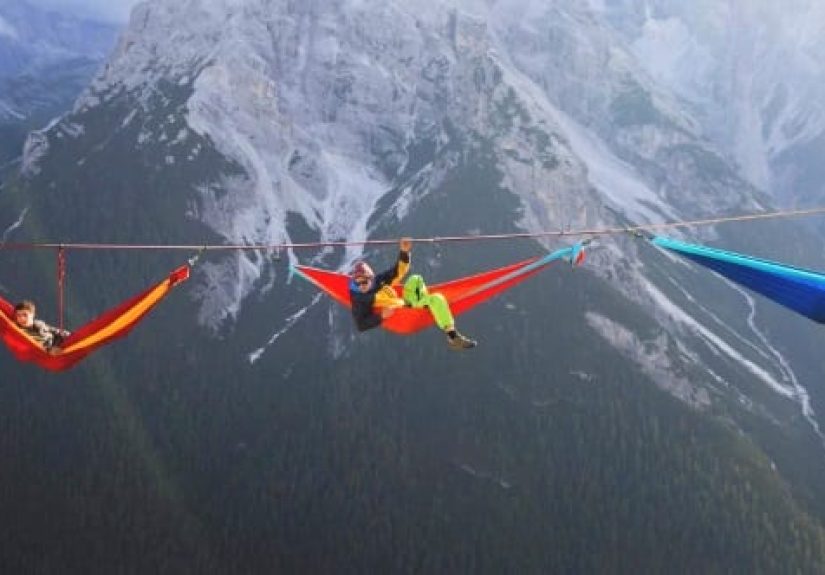
3. The Hammock Village in the Trees
Hammock camping by itself is already a twist on the usual tent routine. Now imagine stacking multiple hammocks
between a cluster of trees, layering a big tarp overhead, and turning the whole space into a swinging lounge.
That’s the hammock village: part campsite, part living room, all attitude.
Why it’s unusual
Instead of everyone disappearing into separate tents, you get a communal space where you can sit, nap, read,
and chat in a hanging “neighborhood.” It works especially well for social groups who like to relax more than
they like to log miles.
How to build it
- Choose several healthy trees and stagger hammock heights so they don’t collide.
- Add a large rectangular tarp or two for rain protection.
- Use underquilts or pads; you lose heat faster from below in hammocks.
- Keep at least some hammocks low enough that falling out means a soft landing.
This setup is ideal in warm climates or summer conditions where airflow matters more than four-season tent walls.
4. Ultralight Bivy and Tarp “Stealth Suite”
If you like to hike far and carry almost nothing, the bivy-and-tarp combo is the stealth fighter of the camping world.
You sleep inside a waterproof or water-resistant bivy sack, use a tiny inflatable pad under you, and pitch a small tarp
overhead as a roof. The whole shelter can weigh less than some sleeping bags.
Why it’s unusual
Most people think “camping” means a tent you can sit up in. Here, you’re basically a well-equipped burrito.
It’s minimalist, but it lets you camp in spots where a big tent footprint won’t fitbetween roots, on ledges, or
in tight forest pockets, as long as it’s legal and safe.
Best practices
- Check weather carefully; bivy camping in hot, buggy, or stormy conditions can be miserable without good ventilation.
- Practice pitching your tarp at home so you can adjust angles quickly in changing wind and rain.
- Use this style where camping is permitted and durable surfaces (rock, gravel, dry grass) are available.
It’s not glamping, but if you want a light pack and discrete footprint, it’s hard to beat.
5. Bikepacking Micro-Camp Using Your Bike as Furniture
Bikepacking blends backpacking with bikingyou carry your shelter and gear on your bike rather than in a big pack.
The unusual twist comes when your bicycle becomes part of the shelter: you can prop a tarp from your handlebars,
lean your bike as a windbreak, or use the frame as a gear rack.
Why it’s unusual
Instead of a sprawling campsite, you get a compact “micro-camp” that barely takes up more space than the bike itself.
You’re also more mobile: pack up, pedal, and you’re gone. It fits perfectly for overnight loops, rail trails, or mixed
dirt-pavement routes.
How to set it up
- Use bikepacking bags or dry bags strapped to frame, bars, and seatpost to keep weight stable.
- Pitch a small tent, tarp, or bivy right next to the bike for fast transitions.
- Hang wet clothes or lights from the bike at night so you can find camp in the dark.
- Choose established or legal campsites even if you’re traveling ultralight.
The result: a camp that looks more like a sci-fi landing pod than a classic family setup.
6. Kayak or Canoe Sandbar Camp
For paddlers, one of the coolest ways to camp is turning a mid-river sandbar or quiet shoreline into a temporary
island home. You load your gear into dry bags and hatches, paddle to a legal camping spot, and unload your entire
campsite directly onto the sand or gravel.
Why it’s unusual
Access: your campsite might be reachable only by boat. That instantly changes the moodfrom campground culture to
mini-expedition. The river becomes your main highway, and your tent door opens to water, not a parking lot.
Key safety and comfort tips
- Check river levels and flood forecasts; never camp where rising water could trap you.
- Pull boats well above the waterline and tie them off.
- Use a footprint or groundsheet so sand and moisture don’t invade your tent.
- Pack dry clothes in separate bags so one flip doesn’t ruin everything.
With good planning, a humble sandbar turns into a beach camp that feels far more exotic than it probably is.
7. Snow Trench and Winter Kitchen Camp
If you’re camping in snowy conditions with the right skills and gear, snow can be your building material, not
just a cold inconvenience. One unusual approach is the snow trench: you dig a narrow trench, line it with a
ground pad, cover it with a tarp or snow blocks, and create a surprisingly insulated sleeping space. Nearby,
you carve out a “winter kitchen” with benches and windbreak walls.
Why it’s unusual
Instead of fighting snow, you literally move into it. When built correctly, snow structures can buffer wind and
stabilize temperatures, making winter camping more comfortable than you’d expect.
Important cautions
- Snow shelters require knowledge of snowpack, ventilation, and collapse risks.
- Always camp with proper winter gear, including a four-season sleeping bag and pad.
- Learn techniques from qualified instructors or reputable winter-camping resources.
This one is definitely not for beginners, but for experienced winter campers it’s an unforgettable option.
8. The “Outdoor Living Room” Car-Camp Setup
Not every unusual camp has to be extreme. One of the most fun twists on regular car camping is turning your
site into an outdoor living room. Think awnings, throw rugs, camp chairs, fairy lights, and maybe even a small
folding coffee table. Your tent becomes the bedroom and the rest of camp is basically a cozy patio.
Why it’s unusual
Most campers stop at “tent + cooler + camp chair.” By layering a few small touches, you get something closer to
a pop-up cabin: comfortable seating, defined zones for cooking and chilling, and lighting that doesn’t feel like
an interrogation scene.
How to pull it off
- Use a simple pop-up canopy or vehicle awning for shade and rain protection.
- Bring a tough outdoor rug to cut down on dirt tracked into the tent.
- String up battery-powered or solar lanterns instead of relying on one harsh headlamp.
- Keep decor practical: items should pack small and handle dirt and moisture.
The result isn’t just prettyit encourages you to hang outside longer and actually enjoy camp instead of hiding in the tent.
9. Modular Camp Kitchen Command Center
Most people toss a random stove, cooler, and bag of food onto a picnic table and hope for the best. A modular
camp kitchen flips that chaos into a dedicated cooking “command center.” You build it from foldable tables, storage
bins, hanging organizers, and maybe a camp pantry that opens like a toolbox.
Why it’s unusual
Instead of cooking on the ground or hunched at a cluttered table, you’ve got a system: prep space, cooking zone,
dish station, and food storage all in clear, labeled spots. It feels like a tiny, open-air food truck.
Simple ways to build one
- Use clear bins: one for pantry items, one for cooking tools, one for cleaning gear.
- Hang utensils and mugs from a cord or collapsible rack so they don’t vanish into the dirt.
- Create a designated “clean” surface for food prep only.
- Store all scented items securely at night to avoid attracting wildlife.
Once you try a structured camp kitchen, you may never go back to the “where did we put the spatula?” lifestyle.
10. Backyard or Driveway “Prototype” Camps
The most underrated unusual campsite? Your own backyard or driveway. Setting up camp at home might sound boring,
but it’s an ideal way to test weird setupstree tents, hammock villages, new stoves, tarp configurationswithout
committing in the backcountry. Consider it your camping laboratory.
Why it’s unusual
We usually think of camping as “away from home,” but backyard or driveway camps let you iterate and experiment
before the real trip. You can dial in your rooftop tent ladder angle, adjust tarp pitches, or figure out which
hammock angle saves your shoulders.
How to make it worthwhile
- Do a full “mock trip” with only the gear you’d bring into the wild.
- Time how long it takes to set up and pack down each unusual configuration.
- Keep a small notebook or phone doc with tweaks you want to make.
- Get the whole family involved so everyone practices the routine.
When you finally hit the trail, your setup will feel dialed in instead of experimental.
Extra: Real-World Experiences with Unusual Camps
Reading about unusual camp setups is fun, but the real magic happens when people actually use them. While
experiences vary widely, certain patterns show up again and again among campers who experiment with tree tents,
rooftop tents, hammocks, bikepacking shelters, and river camps.
Many fans of tree tents describe a surprisingly calming effect from being lifted off the ground. The gentle sway
and elevated view can make even a familiar forest feel new. At the same time, newcomers often underestimate how
important careful tree selection and tensioning really are. A rushed setup may sag or tilt in the night, so
most experienced users recommend treating the first few outings as practice sessions rather than big once-a-year trips.
Rooftop-tent users often talk about how much more spontaneous their trips become. With the bed effectively pre-made
on the roof, they can drive until they find a legal, safe place to camp and be settled in minutes. Families with kids
appreciate the “treehouse” feel and the separation from dirt and mud. On the flip side, beginners sometimes forget
about added height and weight while driving. Over time, people learn to slow down on rough roads, watch clearance
signs, and treat the loaded vehicle more like a small RV than a normal car.
Hammock-village setups tend to shine on slower, social trips. Groups report that it’s easier to spend time together
when everyone lounges in the same general area rather than retreating to separate tents. The main lesson people learn
is temperature management: without insulation underneath, even mild nights can feel cold. Underquilts, sleeping pads,
and wind-blocking tarps quickly graduate from “nice extras” to “non-negotiable essentials.”
Bikepackers and paddlers who camp in micro-sites or sandbars often talk less about comfort and more about mood.
Pedaling or paddling into a tiny hidden cove, unpacking a minimalist shelter, and falling asleep with bikes or
boats just a few feet away can feel adventurous even when conditions are gentle. It’s common for people to start
with heavy loads and oversized gear, then gradually refine their setups as they learn what they actually use nightly
and what never leaves the bottom of the bag.
Backyard prototype camps get surprisingly high praise, especially from new campers or families. People often discover
small but important issueslike a ladder that feels wobbly for kids, a tarp that’s too short for their hammock angle,
or a kitchen bin system that collapses under real-world clutter. Fixing those problems at home means fewer stressful
surprises later. It also builds confidence; by the time you pitch your unusual camp miles away from the car, it feels
like a routine you’ve already rehearsed.
The big takeaway from all these experiences is simple: unusual camp setups work best when you treat them as systems,
not just cool gear. Think through how you’ll sleep, cook, move around, and stay safe in each configuration. Start with
easy locationsyour backyard, drive-in campgrounds, calm rivers, familiar trailsand expand to more remote spots only
when your skills and comfort catch up. When you do, “setting up camp” stops being a chore and becomes one of the most
memorable parts of the trip.
In the end, there is no single “right” way to sleep under the stars. Whether you’re hanging in the treetops, perched
on a car roof, tucked into a snow trench, or lounging in a forest of hammocks, the goal is the same: stay safe, respect
the land, and enjoy the kind of campsite that makes you smile every time you zip the door closed for the night.







 Close
Close