
Table of Contents >> Show >> Hide
- 1. Seven Earth-Size Worlds Found Around One Tiny Star
- 2. America Got a Total Solar Eclipse and Briefly Became One Giant Astronomy Club
- 3. Two Neutron Stars Collided and Basically Forged Cosmic Treasure
- 4. Scientists Edited a Disease-Causing Mutation in Human Embryos
- 5. An AI Beat Top Poker Pros at a Game Built on Bluffing
- 6. Cassini Took a Final Bow by Diving Into Saturn
- 7. An Object From Another Star System Visited Us
- 8. The FDA Approved a Gene-Altered Cell Therapy for Cancer
- 9. A Gene Therapy for Inherited Blindness Reached the U.S. Market
- 10. Antarctica Lost a Giant Iceberg the Size of Delaware
- Why 2017 Felt Like Science Fiction With Better Data
- What It Felt Like to Live Through These 2017 Science Stories
- Conclusion
Some years give us slow, sensible science news. Then there was 2017, a year that seemed to wake up every morning, stretch dramatically, and yell, “What if reality had a movie trailer voice?” Suddenly, astronomers were tracking an interstellar visitor with a name that sounded like it had its own soundtrack. Physicists were watching dead stars collide and spray out the ingredients for jewelry. Doctors were reprogramming immune cells like biological software updates. And NASA, never one to miss a chance to be cinematic, sent Cassini into Saturn like the most graceful spacecraft mic drop in history.
If you were following the biggest science stories of 2017, you probably had at least one moment where you stared at your screen and thought, “This is either a breakthrough or the plot of a very expensive streaming series.” The fun part is that it was both. These 2017 scientific breakthroughs did not just sound futuristic. Many of them changed how researchers think about life, space, medicine, and the future of technology.
Below are ten 2017 science stories that read like sci-fi taglines but were gloriously, stubbornly real. Some were cosmic. Some were microscopic. All of them made the year feel like humanity had accidentally wandered into the cool part of the timeline.
1. Seven Earth-Size Worlds Found Around One Tiny Star
Sci-fi tagline: “One star. Seven planets. Countless daydreams.”
In February 2017, the TRAPPIST-1 system exploded into public imagination. Astronomers announced that a small, ultracool dwarf star about 40 light-years away hosted seven Earth-size planets. That sentence alone sounds like it should be delivered by someone with a cape and a suspiciously deep voice.
What made the discovery so electrifying was not just the number of planets. It was the possibility that several of them orbited in or near the star’s habitable zone, where liquid water could potentially exist under the right conditions. That did not mean aliens were immediately filing property tax forms, but it did mean researchers had found a rare natural laboratory for studying rocky worlds beyond our solar system.
For years, exoplanet hunting had been gradually teaching us that planets are everywhere. TRAPPIST-1 turned that lesson into a fireworks show. It gave scientists a compact system where multiple Earth-size planets could be compared side by side, almost like a cosmic apartment building full of different climate experiments. As sci-fi science headlines go, “seven possible ocean worlds around a nearby star” is hard to beat.
2. America Got a Total Solar Eclipse and Briefly Became One Giant Astronomy Club
Sci-fi tagline: “The sky went dark at noon, and everyone looked up.”
On August 21, 2017, the Moon’s shadow sliced across the continental United States, and millions of people stepped outside to watch daytime turn into twilight. The total solar eclipse was the first visible across the contiguous U.S. in decades, and it was one of those rare scientific events that felt both deeply technical and wonderfully human.
Researchers treated it as a golden opportunity to study the Sun’s corona, atmospheric changes, and even animal behavior. Regular people treated it as a reminder that the universe does not need CGI. The temperature dropped. Light went weird. Birds got confused. Everyone wearing eclipse glasses looked like they had joined the nerdiest secret society on Earth.
The eclipse also mattered because it fused science communication with public excitement in a way that institutions dream about. This was not niche science tucked into a journal. It was front-yard science. Parking-lot science. “Hey, neighbor, is your cereal bowl shadow doing something strange?” science. Few science stories of 2017 captured wonder so perfectly.
3. Two Neutron Stars Collided and Basically Forged Cosmic Treasure
Sci-fi tagline: “When dead stars crash, the universe makes gold.”
October 2017 brought one of the most thrilling astronomy announcements in modern memory: scientists had detected colliding neutron stars through both gravitational waves and light. This event, known as GW170817, was a landmark in multi-messenger astronomy, meaning researchers could study the same cosmic event with different kinds of signals.
That alone was huge. But the drama did not stop there. The collision also helped confirm that some heavy elements, including gold and platinum, are forged in these violent mergers. In other words, one of the universe’s most glamorous manufacturing processes appears to involve two ultradense stellar corpses smashing together in spectacular fashion. Your ring just got a much darker backstory.
This discovery connected physics, astronomy, and chemistry in a way that felt almost unfairly elegant. Einstein’s ripples in spacetime met telescopes, data modeling, and elemental origin stories. The result was one of the year’s defining scientific breakthroughs of 2017, and it sounded like a line cut from a screenplay no studio executive would dare reject.
4. Scientists Edited a Disease-Causing Mutation in Human Embryos
Sci-fi tagline: “The code of life gets an early rewrite.”
Gene editing had already been a major topic before 2017, but that summer a U.S.-based team reported a high-profile advance using CRISPR to correct a mutation linked to hypertrophic cardiomyopathy in human embryos. The embryos were not intended for implantation, and the work immediately triggered scientific and ethical debate, as it should have.
Still, the reason this story felt so futuristic is obvious: humanity was no longer just reading genetic code. It was actively attempting to repair it at the earliest stages of development. That is not a minor upgrade. That is the kind of sentence that makes philosophers sit up straighter and science fiction writers reach for a notebook.
The story also revealed something important about real science: it is rarely just triumph or doom. It is usually both promise and caution, discovery and argument, possibility and limits. The 2017 embryo-editing research was fascinating not because it settled everything, but because it showed how close medicine was getting to decisions once confined to speculative fiction.
5. An AI Beat Top Poker Pros at a Game Built on Bluffing
Sci-fi tagline: “The machine doesn’t know your tell, but it knows you’re doomed.”
Chess had fallen. Go had fallen. In 2017, poker joined the club. Carnegie Mellon’s Libratus defeated elite human professionals in heads-up no-limit Texas Hold’em, a game famous for incomplete information, deception, and psychological pressure. This was not just about raw calculation. Poker requires navigating uncertainty, reading patterns, and making strategic decisions without perfect knowledge.
That made the victory especially important for artificial intelligence research. If a machine can master a game where bluffing matters and information is hidden, its methods may be useful far beyond casinos. The same kinds of strategic reasoning can matter in cybersecurity, negotiations, logistics, and defense planning. So yes, the poker table was exciting. But the real story was what the poker table represented.
Also, let us pause to appreciate how absurdly cinematic this sounds. A bot named Libratus sits down, metaphorically speaking, and outplays professionals at one of humanity’s favorite games of ego and risk. Somewhere, a screenplay agent whispered, “Call me.”
6. Cassini Took a Final Bow by Diving Into Saturn
Sci-fi tagline: “After years at Saturn, the explorer chooses the fire.”
Cassini’s Grand Finale was one of the most moving space stories of 2017. After years of transforming our understanding of Saturn, its rings, and its moons, the spacecraft made a series of daring dives between the planet and its rings before plunging into Saturn’s atmosphere on September 15.
The mission was not merely ending. It was ending scientifically. Those final maneuvers gathered valuable data, and the last plunge ensured Cassini would not accidentally contaminate moons like Enceladus or Titan, both of which are scientifically important in the search for habitable environments. In classic NASA fashion, the farewell was emotional, practical, and devastatingly cool.
Cassini’s ending worked on multiple levels. It was a feat of engineering. It was a lesson in planetary protection. And it was a strangely human story about finishing well. Few missions have combined technical excellence with narrative power so effectively. If 2017 had a space-opera goodbye scene, this was it.
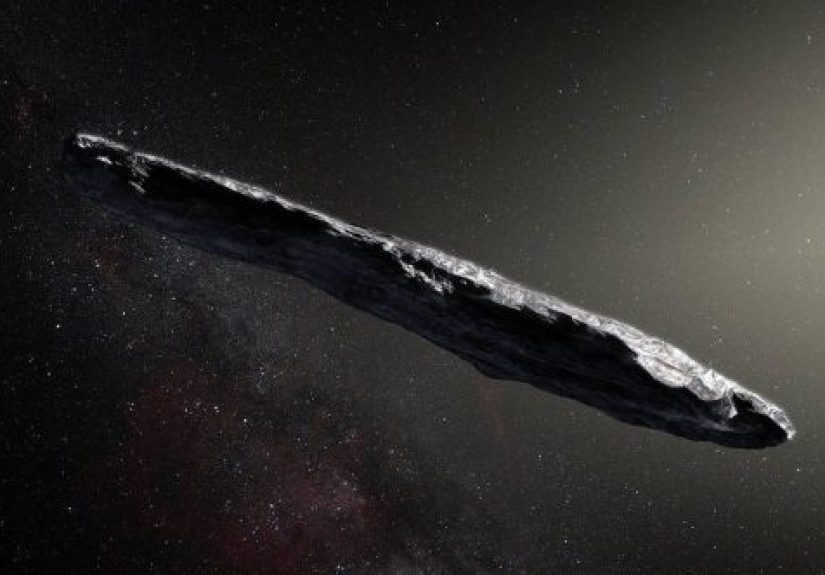
7. An Object From Another Star System Visited Us
Sci-fi tagline: “A messenger from interstellar space enters the frame.”
Late in 2017, astronomers announced the first known interstellar object ever observed passing through our solar system: ‘Oumuamua. Even the name sounded like a title card from a thoughtful, beautifully lit science-fiction film. The object moved on a trajectory showing it had come from outside our solar system, which immediately made it a scientific celebrity.
Researchers raced to study it before it vanished into the dark. Observations suggested an unusually elongated shape and behavior that sparked years of debate. Was it rocky? Icy? A strangely shaped natural object unlike the kinds we usually spot nearby? Science, being science, did not turn it into a spaceship. It turned it into a very good mystery.
That mystery was the point. ‘Oumuamua reminded scientists that our solar system is not sealed off from the rest of the galaxy. Stuff can wander in. Rarely, briefly, and inconveniently fast, but still. If any single 2017 science story deserved the phrase “cosmic cameo,” this was it.
8. The FDA Approved a Gene-Altered Cell Therapy for Cancer
Sci-fi tagline: “Doctors train your own cells to hunt the disease.”
In August 2017, the FDA approved Kymriah, a CAR-T cell therapy for certain patients with B-cell acute lymphoblastic leukemia. The basic idea is so futuristic it almost sounds rude: take a patient’s immune cells, genetically modify them to recognize cancer more effectively, grow them, and send them back in like highly motivated biological special forces.
CAR-T therapy did not arrive as a magic wand. It came with complexity, cost, and serious safety considerations. But it represented a turning point in cancer treatment and in the broader idea of personalized medicine. Instead of using one-size-fits-all treatment, researchers were moving toward therapies engineered around the patient’s own cells.
This was one of those moments when medicine stopped sounding vaguely futuristic and started sounding like it had kicked down the lab door wearing action boots. Among the biggest science stories of 2017, CAR-T stood out because it made the future feel clinical, immediate, and very real.
9. A Gene Therapy for Inherited Blindness Reached the U.S. Market
Sci-fi tagline: “A damaged visual signal gets a second chance.”
Later that same year, the FDA approved Luxturna for a rare inherited retinal disease caused by mutations in the RPE65 gene. This mattered because it was a landmark for gene therapy in the United States, showing that replacing or supplementing a faulty gene could move from bold concept to approved treatment.
What made this story so powerful was that it was not abstract. It was about vision, light, navigation, and daily life. It was about the possibility that a genetic disorder affecting sight might be addressed at its biological root rather than merely managed around the edges. That is the kind of advance that makes even dry regulatory language feel a little heroic.
Together, Kymriah and Luxturna made 2017 feel like a year when gene therapy stopped being a promise people kept mentioning at conferences and started becoming something patients could actually encounter. The future had moved from the whiteboard to the exam room.
10. Antarctica Lost a Giant Iceberg the Size of Delaware
Sci-fi tagline: “The frozen continent drops a colossal shard into the sea.”
In July 2017, a massive iceberg known as A-68 broke away from the Larsen C ice shelf in Antarctica. Satellite images made the event look almost unreal, as if Earth had begun shedding planetary armor plates. It was one of the year’s most visually dramatic science stories, and it instantly fed discussion about climate systems, ice dynamics, and the fragility of polar regions.
Scientists were careful to explain the nuance. Because the iceberg split from a floating ice shelf, the calving itself did not directly raise sea level the way land ice melt does. But the event still mattered enormously. It showed the scale of physical changes happening in polar environments and reminded the public that climate science often becomes most visible when the planet starts doing things large enough to appear on maps.
If your definition of sci-fi includes giant landscapes cracking apart in silence while satellites stare from orbit, then Larsen C absolutely qualifies. It was less laser battle, more frozen apocalypse trailer, but the effect was unforgettable.
Why 2017 Felt Like Science Fiction With Better Data
What ties these stories together is not just spectacle. It is the strange overlap between imagination and measurement. In 2017, scientists did not merely present interesting results. They delivered moments that sounded like genre fiction while resting on hard evidence, peer review, engineering, observation, and regulatory process.
That is what makes the best science stories of 2017 so memorable. They did not ask us to abandon reality for fantasy. They proved that reality was already dramatic enough. The universe had interstellar visitors. Medicine had editable instructions and programmable immune cells. Spacecraft died noble deaths. Dead stars made gold. If someone had pitched all ten stories as one film anthology, audiences would have said, “Tone it down.” Science responded by doing the opposite.
What It Felt Like to Live Through These 2017 Science Stories
Living through these headlines in real time felt a little like standing in the aisle of a grocery store and realizing the cereal boxes had started giving graduate seminars. One week you were reading about planets circling a dim red star, and the next week you were trying to explain to a friend why colliding neutron stars might be the reason wedding rings exist. It was the kind of year that turned ordinary conversations weird in the most delightful way.
There was also a specific emotional rhythm to 2017’s science coverage. Some stories created pure wonder, like the eclipse or the discovery of TRAPPIST-1. They made people feel small in a healthy way, the kind that reminds you the universe is huge and beautiful and not at all concerned with your unread emails. Other stories, especially the ones involving gene editing and gene therapy, felt more intimate. They were about bodies, illness, inheritance, and the possibility that medicine could begin fixing problems much closer to their source. That kind of progress lands differently. It is not just cosmic awe. It is personal hope.
Then there were the stories that mixed fascination with discomfort, which is often where the most important science lives. An AI beating poker pros was funny until you started thinking seriously about strategic decision-making in the real world. Editing embryos sounded thrilling until the ethics arrived, right on schedule, like the adult in the room carrying a clipboard. Even the iceberg story had that split-screen effect: astonishing images on one side, hard climate questions on the other.
For science fans, 2017 was exhausting in the best possible sense. Every few weeks, there seemed to be another headline that made you say, “Wait, that happened already?” It felt like the future was not arriving in one clean, dramatic scene. It was arriving in bursts: a telescope announcement here, an FDA approval there, a physics breakthrough in the middle, and a spacecraft funeral just to keep everyone emotionally unstable.
Looking back, the most lasting experience may have been the feeling that scientific progress had become easier for the public to picture. Not understand fully, because science is still gloriously complicated, but picture. You could picture shadow racing across the United States. You could picture Saturn swallowing Cassini. You could picture an interstellar object slipping through our neighborhood like a tourist who refused to stop for directions. That matters. When people can visualize science, they are more likely to care about it.
And maybe that is why these stories still linger. They were not just important discoveries. They were memorable experiences. They gave 2017 a rare quality: it was a year when reality consistently outperformed the special effects department.
Conclusion
The most unforgettable 2017 scientific breakthroughs were not memorable simply because they were big. They were memorable because they bent the imagination without breaking the facts. They reminded us that science is not a pile of jargon sitting in fluorescent rooms. It is a living, unfolding story about what the universe is, what life can become, and how much stranger reality is than our old assumptions.
If 2017 proved anything, it is that the line between science headlines and sci-fi taglines is thinner than most people think. The difference is that real science has peer review, error bars, and a deeply annoying habit of being even more interesting than fiction.







 Close
Close