
Table of Contents >> Show >> Hide
- What a Ferrofluid Clock Is (and Why It’s Weirdly Hypnotic)
- Why We Lose Time: The Modern World Is a Slip-n-Slide
- Turn the Ferrofluid Clock Into a Wasted-Time Tracker
- Practical Setups That Actually Work
- The Science-ish Magic: Why a Physical Clock Helps More Than Another App
- Care, Limitations, and the Not-So-Magical Reality Check
- of Experiences: Living With a Ferrofluid Clock as a Waste-Time Tracker
- Conclusion
There are two kinds of clocks in this world: the kind you glance at, and the kind that stares back.
A ferrofluid clock is firmly in the second category. It’s the timepiece equivalent of adopting a tiny,
well-dressed alien blob that politely reminds you, every minute, that time is doing what time does best:
leaving without saying goodbye.
And that’s exactly why it’s such a sneaky tool for tracking wasted time. Not because it’s “smart” (it’s not
trying to sell you a subscription), but because it’s physical, mesmerizing, and slightly unsettling in the way
only a magnetic liquid pretending to be a clock can be. When your time is literally sloshing around in front of you,
it becomes harder to pretend your “quick scroll” didn’t turn into a 47-minute documentary about a guy who restores
old toasters for fun.
What a Ferrofluid Clock Is (and Why It’s Weirdly Hypnotic)
Ferrofluid 101: the “liquid metal” that isn’t actually liquid metal
Ferrofluid looks like glossy black ink with an attitude. Technically, it’s a liquid filled with nanoscale magnetic
particles suspended in a carrier fluid, kept from clumping by a surfactant. When a magnetic field shows up, those tiny
particles alignso the fluid can stretch, curve, and even form spiky peaks (a dramatic effect called the Rosensweig or
“normal-field” instability). In plain English: it’s a liquid that behaves like it’s trying out for a sci-fi movie.
Ferrofluid was originally developed for space-related problemsspecifically, how to move propellant in weightless
environments using magnetic fields. Since then, it’s escaped the lab and found its way into very real, very unglamorous
jobs (like sealing rotating shafts in hard drives and helping cool speaker voice coils)… and also into mesmerizing desk art
that makes you forget why you opened your browser tab. (Yes, the irony is baked in.)
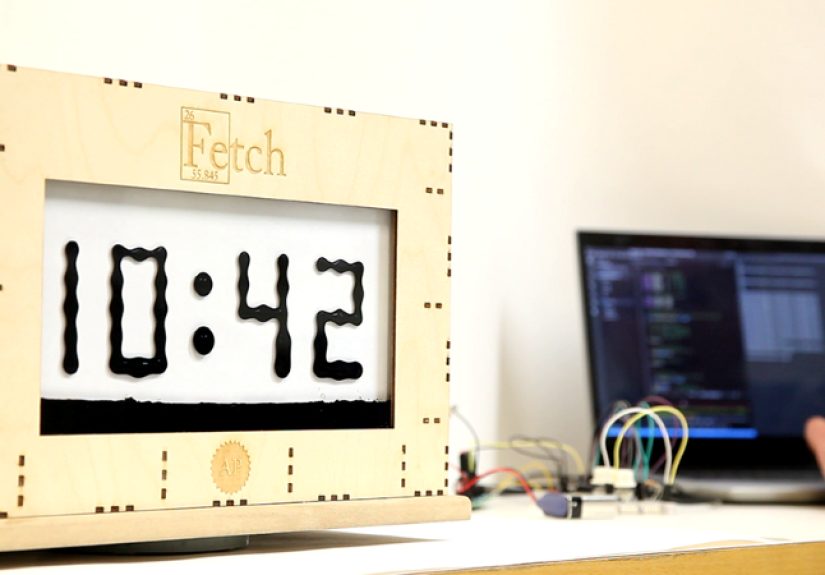
How a ferrofluid clock tells time
Most ferrofluid clocks work by trapping a thin layer of ferrofluid behind glass (or inside a sealed chamber) and then
using magnetsoften hidden behind the faceto pull the fluid into shapes that behave like hands or digits. Some designs
guide a “liquid hand” around a dial; others form digital numerals by moving the fluid into segmented patterns.
The result is time you can watch instead of time you can merely count. It’s like your clock is doing interpretive
dance to the concept of minutes. Which makes it perfect for a time-waste audit, because it creates a small moment of friction:
you notice the moment passing, not just the number.
Why We Lose Time: The Modern World Is a Slip-n-Slide
“Wasted time” isn’t always laziness. A lot of it is default behavior: frictionless apps, endless feeds, autoplay,
notifications that treat your brain like a doorbell they’re paid to ring. The biggest time leaks usually aren’t dramatic
choicesthey’re tiny ones that stack: “I’ll just check,” “I’ll just reply,” “I’ll just look up one thing,” followed by
“How is it suddenly dark outside?”
U.S. time-use data regularly shows that leisure is dominated by screen-based activities, with additional chunks going to
socializing, computer use for leisure, and other “small” slices that add up fast. Meanwhile, health and well-being reports
increasingly focus on heavy screen exposure and the side effects that come with itlike eye strain and fatiguebecause time
isn’t the only thing that gets spent.
A ferrofluid clock won’t rescue you from the attention economy. But it can become an honest mirrorone that looks cool enough
to keep on your deskso you can see the pattern of your day the way you’d see a pattern in that shifting magnetic liquid:
not as a moral failure, but as a shape you can change.
Turn the Ferrofluid Clock Into a Wasted-Time Tracker
Here’s the trick: don’t use the clock to shame yourself. Use it to measure. The goal isn’t “never waste time.”
The goal is “waste time on purpose, and stop wasting time by accident.”
Step 1: Define “wasted time” without guilt
Start by separating three categories:
- Rest: deliberate downtime that helps you recover (not waste).
- Joy: intentional fun (also not waste).
- Leakage: unplanned drifttime that disappears without paying rent.
Leakage is what you’re tracking. Not because you need to punish it, but because you can’t fix what you can’t see.
Step 2: Run a 7-day “time audit lite”
You don’t need a complicated app. In fact, apps are suspiciously good at becoming part of the problem. Use something
low-friction:
- a notes file
- a small notebook
- or a simple spreadsheet (if you’re feeling brave and caffeinated)
For one week, do quick check-ins at natural transition points:
when you sit down to work, after meals, when you switch tasks, and before bed.
Each check-in takes 10 seconds:
- Time (what the clock says)
- What I intended to do
- What I actually did
- Was it Rest/Joy/Leakage?
The ferrofluid clock matters here because it turns your check-in into a tiny ritual. You’re not “checking time.”
You’re watching time move. That physicality makes the moment stick.
Step 3: Use the clock as a “pattern interrupt”
Wasted time loves autopilot. So you need a cue that interrupts autopilot without yelling at you. A ferrofluid clock is perfect
because it’s visually loud while being emotionally quiet.
Try this rule: Whenever you catch yourself watching the ferrofluid for no reason, write down what you were about to do.
That’s it. No judgment. Just data.
Most people discover a hilarious (and slightly alarming) truth: the moments they “randomly” watch something are the same moments
they were about to flee a difficult task. The goo becomes a little therapist that only speaks in magnets.
Step 4: Add gentle guardrails (timeboxing + Pomodoro)
Once you’ve identified your biggest leaks, plug them with guardrails that don’t require superhuman willpower:
-
Timeboxing: Put tasks on your calendar as blocks. When the block ends, you stopor you consciously extend it.
This converts “infinite tasks” into “finite time,” which reduces drift. -
Pomodoro-style sprints: Work in a focused burst (often 25 minutes), then take a short break.
Your brain gets a finish line, not a treadmill.
Pair the method with the ferrofluid clock by making the clock your “start signal.” When you begin a timebox or sprint,
glance at the clock and say (out loud, if you want extra power): “This is where the goo goes on purpose.”
Step 5: Review the week like a scientist, not a judge
At the end of seven days, look for:
- Top 3 leakage triggers (boredom? stress? waiting? late-night fatigue?)
- Top 3 leakage locations (bed? couch? desk? “standing in the kitchen like a confused NPC”?)
- Top 3 leakage activities (scrolling, doom-news, “research,” video spirals, messaging loops)
Then choose one leak to fix first. One. Not twelve. Twelve is how you end up time-auditing your time audit.
Practical Setups That Actually Work
1) The Desk Setup: “Liquid Glance” Focus Checks
Place the ferrofluid clock just off-center from your main screenclose enough to notice, not so close it becomes your new hobby.
Every time you notice it, do a 3-question check:
- What am I doing right now?
- Is this what I planned to do?
- Is this Rest, Joy, or Leakage?
If it’s Leakage, don’t fight the universe. Use a simple pivot:
“Two-minute reset.” Close one tab, stand up, drink water, then restart with a 25-minute sprint.
2) The Living Room Setup: The “Streaming Tax”
If your biggest leak is couch time, put the clock where it’s visible from your usual spot. Set a rule:
Every episode requires a decision. Not “autoplay decides,” but you.
When an episode ends, glance at the clock and pick one:
- One more episode (Joy, intentional)
- Stop and do a 10-minute reset task (Rest with purpose)
- Switch to something you actually planned (Leakage plug)
The clock turns “I don’t know how I got here” into “I chose this.” That’s the whole point.
3) The Phone Setup: A “No-Scroll Buffer”
If your time leaks live on your phone, the ferrofluid clock can become your buffer. Before you pick up your phone, glance at
the clock and say what you’re doing:
- “Reply to Sam.”
- “Check directions.”
- “Pay bill.”
If you can’t name the reason, that’s usually your sign that it’s Leakage wearing a fake mustache.
The Science-ish Magic: Why a Physical Clock Helps More Than Another App
Digital time tools are useful, but they’re also the same ecosystem that leaks your attention. A physical object creates a different
mental loop: it’s a cue in your environment that doesn’t ping you, doesn’t vibrate, and doesn’t beg for engagement.
In productivity research and practice, time tracking works best when it creates awareness without becoming a second job.
That’s why “track your time for a while, learn the pattern, then simplify” is a common recommendation. A ferrofluid clock fits that
philosophy: it’s not collecting your datait’s just making time feel real again.
Care, Limitations, and the Not-So-Magical Reality Check
Ferrofluid is dramatic, but it’s not immortal
Real ferrofluids can degrade over time. The surfactant that keeps nanoparticles separated can break down, and the fluid can lose some
of its smooth behavior. That’s why ferrofluid clocks typically keep the fluid sealed away from air and contaminants.
Basic common-sense care:
- Keep it away from high heat and direct sunlight.
- Don’t park strong magnets next to it “for fun.”
- Handle it like a precision object, not a stress ball.
It won’t fix your lifeyour choices will
The clock is a cue. The method is the fix:
define leakage → measure lightly → change one trigger → repeat.
The ferrofluid just makes the cue hard to ignore… in a very stylish way.
of Experiences: Living With a Ferrofluid Clock as a Waste-Time Tracker
Imagine a normal Tuesday. You sit down to work, determined to be productive, and the ferrofluid clock is already doing its glossy,
slow-motion thinglike it’s warming up for a performance. At first, it’s pure novelty. You tell yourself you’ll only watch it for a
second. Ten seconds later, you realize you’ve been staring at it like it’s going to reveal the secrets of the universe. It won’t.
It will, however, reveal that you’re procrastinating. Rudely. Accurately.
The first week feels like living with a tiny honesty machine. You notice how often you reach for your phone “just to check something,”
and you catch yourself mid-reach because the clock is in your peripheral vision, quietly being a moving reminder that minutes have weight.
You start doing micro-confessions: “Okay, I was going to scroll. I admit it.” And the wild part is that the confession alone often breaks
the spell. You don’t have to fight your brain for an hour. You just have to notice it for two seconds.
By day three, you start recognizing your personal leakage patterns. For example: difficult email? You drift. Ambiguous task? You drift.
Mild anxiety? You drift harder, like you’re trying to escape gravity. The ferrofluid clock becomes a checkpoint at the border between
“I’m choosing this” and “I’m escaping that.” And once you can see the border, you can choose which side you want to live on.
The funniest discovery is how easily “research” becomes a costume for avoidance. You’ll think, “I need to look up one detail,” and
suddenly you’re reading an argument from 2014 about whether staplers have emotions. The clock doesn’t stop you, but it makes the drift
obvious sooner. You begin setting tiny rules: one tab at a time, one question at a time, and when you catch yourself watching the ferrofluid
for “no reason,” you write down what you were trying to avoid. The list gets uncomfortably insightful.
Eventually, the clock stops feeling like novelty and starts feeling like a ritual object. You use it to start focus sprints. You use it to
end them. You use it to make breaks real instead of accidental. And you still waste timebecause you’re humanbut it becomes intentional:
“I’m going to watch something for 30 minutes because I want to,” not “I fell into a content hole and woke up next Thursday.”
The biggest change isn’t that you become a productivity robot. It’s that time stops being invisible. You get better at spotting the moment
a decision is being made for youby autoplay, by notifications, by habitand you take the decision back. The ferrofluid clock doesn’t shame you.
It just keeps moving, patiently, like a liquid reminder that you can either spend your minutes or let them spill.
Conclusion
Tracking wasted time doesn’t require turning your life into a spreadsheet. It requires a little awareness, a simple audit, and one or two
changes that reduce drift. A ferrofluid clock is a surprisingly effective partner in that processnot because it’s magical, but because it’s
physical. It gives your day a visible heartbeat.
If you want a practical takeaway: run a 7-day audit, label Rest/Joy/Leakage, fix one trigger, and use the ferrofluid clock as your pattern
interrupt. Let the goo be your cue. Then go do something that’s worth your timebefore it oozes away.







 Close
Close