
Table of Contents >> Show >> Hide
- Understanding Combined Labor (Combined Work) Problems
- Method 1: Use the Work–Rate Equation
- Method 2: Think in Fractions of the Job
- Method 3: Use the Unitary (Per-Unit) Method
- Common Mistakes in Combined Labor Problems (and How to Avoid Them)
- Where Combined Labor Problems Show Up in Real Life
- Practical Experience: What Solving Combined Labor Problems Teaches You
- Wrapping Up
If you’ve ever tried to paint a room with a friend and argued over how long it would take, congratulations:
you’ve met a combined labor problem in real life. In math class, these show up as
combined work problems or work rate word problems – the ones where
“Alice can finish the job in 4 hours, Bob can finish in 6 hours, how long together?” makes half the room
groan in unison.
The good news? Once you understand the basic idea – that work = rate × time and that
combined labor just means adding rates – these problems become predictable, even fun. Below are
three practical ways to solve combined labor problems, plus extra tips and real-world experience
so you can tackle them with confidence on homework, exams, or at work.
Understanding Combined Labor (Combined Work) Problems
A combined labor problem asks how long it takes two or more workers, machines, or
processes to complete a job when they work together. Each worker has a certain
rate (how fast they work), and the total rate is the sum of the individual rates.
There are three core ideas behind almost every combined work problem:
- Work = Rate × Time. This is the backbone of all work and time word problems.
-
If one person can finish a job in a hours, their rate is
1⁄a job per hour. -
When people work together, their rates add. If A has rate 1⁄a and B has rate 1⁄b,
then together their rate is 1⁄a + 1⁄b jobs per hour.
From this, we get the classic formula you see in most time and work examples:
If A alone takes a hours, B alone takes b hours, and together they take t hours:
1⁄a + 1⁄b = 1⁄t.
Different methods to solve combined labor problems are really just different ways of organizing this same idea.
Let’s walk through three you can choose from depending on your style.
Method 1: Use the Work–Rate Equation
This is the standard, algebra-friendly method used in most textbooks and test prep resources.
It’s clean, systematic, and works for simple or complex problems.
Step 1: Translate words into rates
Start by turning “time to finish a job” into a rate of work.
- If a plumber can fix a job in 3 hours, their rate is 1⁄3 job per hour.
- If an assistant can do the same job in 5 hours, their rate is 1⁄5 job per hour.
When they work together, the rates add:
1⁄3 + 1⁄5 jobs per hour.
Step 2: Set up the combined rate equation
Let t be the time it takes for them to complete the job together.
Their combined rate is 1⁄t job per hour. That gives:
1⁄3 + 1⁄5 = 1⁄t
To solve, find a common denominator:
1⁄3 = 5⁄15, 1⁄5 = 3⁄15, so 5⁄15 + 3⁄15 = 8⁄15.
So 1⁄t = 8⁄15 ⇒ t = 15⁄8 hours.
That’s 1.875 hours, or 1 hour and 52.5 minutes. The combined time is
less than either individual time, which is a quick sanity check
you should always do.
Step 3: Apply to more than two workers
If more than two workers are involved, you just keep adding rates.
Suppose:
- Worker A can finish in 4 hours → rate 1⁄4 job per hour.
- Worker B can finish in 6 hours → rate 1⁄6 job per hour.
- Worker C can finish in 12 hours → rate 1⁄12 job per hour.
Combined rate = 1⁄4 + 1⁄6 + 1⁄12
Common denominator 12:
1⁄4 = 3⁄12, 1⁄6 = 2⁄12, 1⁄12 = 1⁄12.
Total = (3 + 2 + 1)⁄12 = 6⁄12 = 1⁄2 job per hour.
If the team completes 1 job at a rate of 1⁄2 job per hour, then:
Time = 1 ÷ (1⁄2) = 2 hours.
This algebraic method is especially useful for standardized tests and for word problems
that include extra twists like someone leaving early, machines turning on and off, or
“negative work” (like a pipe that drains a tank while another fills it).
Method 2: Think in Fractions of the Job
If you prefer a more intuitive, less algebra-heavy approach, this method treats everything
as “what fraction of the job gets done” in a chosen amount of time.
Step 1: Choose a convenient time period
Often, the easiest choice is the least common multiple (LCM) of the given times, but you can also
use 1 hour if the numbers are simple.
Example: A can finish a job in 4 hours, B in 6 hours. The LCM of 4 and 6 is 12.
We’ll look at how much of the job they complete in 12 hours.
Step 2: Compute each worker’s contribution
- A finishes a full job in 4 hours, so in 12 hours A does 12⁄4 = 3 jobs.
- B finishes a full job in 6 hours, so in 12 hours B does 12⁄6 = 2 jobs.
Together in 12 hours they complete 3 + 2 = 5 jobs.
That means:
5 jobs in 12 hours ⇒ 1 job in (12 ÷ 5) hours = 12⁄5 = 2.4 hours.
You get the same answer as with the equation method; you just framed it in terms of
“how many jobs in a certain time” and then scaled down to a single job.
Step 3: Use this method for real-world planning
This fraction-of-the-job view feels very natural in everyday situations:
-
If you and two friends can clean your apartment five times in a week, then you can mentally
back into how long one cleaning takes given your weekly time budget. -
In project planning, you may know how many tasks a team finishes in a month and how many
hours they work, and estimate the “per task” time from there.
When teaching or learning combined labor problems, this method often helps connect the math
to concrete experience: “how much did we get done in that time?”
Method 3: Use the Unitary (Per-Unit) Method
The unitary method focuses on finding the work done in one unit of time, then scaling up.
It’s widely used in school math for proportional reasoning and works very nicely for combined work problems.
Step 1: Find each worker’s per-hour work
Suppose:
- Painter A finishes a wall in 5 hours.
- Painter B finishes the same wall in 10 hours.
In one hour:
- A completes 1⁄5 of the wall.
- B completes 1⁄10 of the wall.
Together in one hour, they complete:
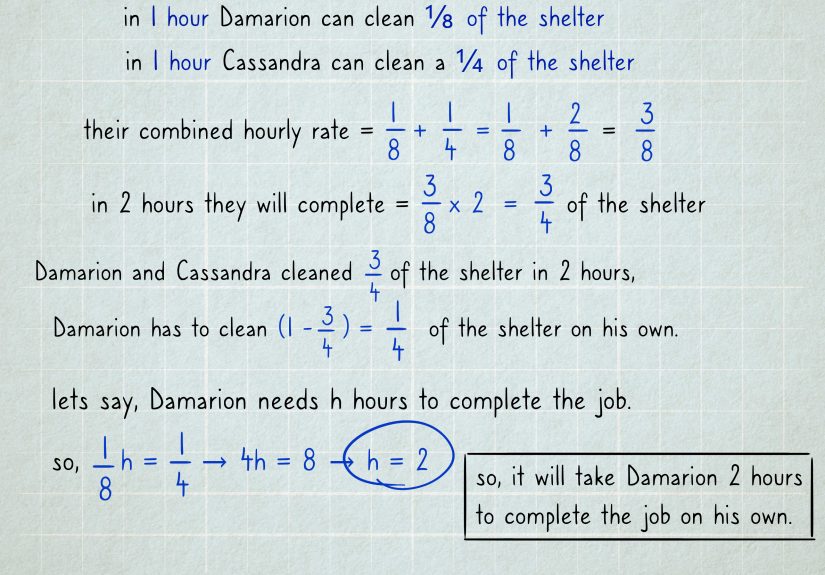
1⁄5 + 1⁄10 = 2⁄10 + 1⁄10 = 3⁄10 of the wall.
Step 2: Scale from one unit of time to a full job
If 3⁄10 of the job is done in one hour, how long to do 1 full job?
Time = 1 ÷ (3⁄10) = 10⁄3 hours ≈ 3.33 hours.
This is the same result you’d get with the equation 1⁄5 + 1⁄10 = 1⁄t, just seen through
a “per hour” lens.
Step 3: Extend to more complex situations
The unitary approach is especially helpful when:
- Workers join or leave partway through a job (you can track how much is completed each hour).
- There is negative work, such as a draining pipe or a worker undoing someone else’s work (yes, it happens).
- You want to verify your algebra by checking with a per-hour perspective.
For example, if a tank is filled by one pipe and emptied by another, you can calculate
“net work per hour” by subtracting the emptying rate from the filling rate, then scale
to a full tank.
Common Mistakes in Combined Labor Problems (and How to Avoid Them)
Even strong students slip on combined work problems, often for the same reasons.
Being aware of these traps can save you easy points on quizzes and exams.
Mistake 1: Averaging times instead of adding rates
A very common error is taking the average of the individual times. If A takes 4 hours and B takes 6,
some people guess (4 + 6)⁄2 = 5 hours. That’s wrong because the combined time must be less
than the faster worker’s time. Two people together should never be slower than the fastest
person working alone.
Mistake 2: Mixing up which quantity to invert
Students also sometimes invert the wrong numbers. Remember:
- Time given ⇒ rate is 1 ÷ time.
- Combined rate found ⇒ time is 1 ÷ rate.
Whenever you compute a combined rate, pause and ask, “Is this a rate (job per hour) or a time (hours per job)?”
Then invert only if you’re moving from one to the other.
Mistake 3: Forgetting units
Units matter. If one time is in minutes and another in hours, convert everything to a single unit
before you start adding. The math only works cleanly when all times and rates speak the same “language.”
Mistake 4: Ignoring negative work
In problems with filling and draining, construction and demolition, or people undoing work,
negative rates are your friend. A worker who undoes 1⁄8 of a job per hour has rate −1⁄8 job per hour.
Add positive and negative rates to get the net rate, then proceed as usual.
Where Combined Labor Problems Show Up in Real Life
These problems aren’t just math teacher hobbies. Understanding combined work and time is useful in:
-
Scheduling teams. Managers estimate how long a task will take with different numbers
of staff on a project. -
Production and operations. Factories track machine throughput and how adding or removing
machines affects output. -
Home improvement and chores. Families divide cleaning, yard work, and renovations and want
realistic timelines. -
Test prep. Combined work problems are fixtures on many standardized math tests, so mastering
them is a valuable skill on its own.
The more you practice with different numbers and setups, the more you’ll see that every combined labor problem
is just a remix of the same core idea: add rates, then convert back to time.
Practical Experience: What Solving Combined Labor Problems Teaches You
Beyond getting the right answer, working through combined labor problems actually builds
some surprisingly useful habits for school, work, and everyday life.
1. You learn to value clear assumptions
In most combined work problems, you quietly assume things like:
- Everyone works at a constant rate.
- No one needs a lunch break, coffee, or a TikTok scroll.
- The job is clearly defined as “one complete task.”
Once you notice these assumptions, you start transferring that mindset to real projects:
“What exactly counts as done? Does everyone actually work at the same pace? What could slow us down?”
It’s a surprisingly good warm-up for project management.
2. You get better at dividing work fairly
Combined work problems implicitly raise questions of fairness.
If one worker is twice as fast, should they do twice as much? Should they also be paid more?
In team projects, you start seeing who is the “fast worker” and who’s the “slow worker,” and you
become more intentional about balancing responsibilities so nobody burns out or coasts.
For example, imagine two students on a group project. One writes at double speed but hates formatting;
the other is slower but meticulous. A combined labor mindset suggests a simple solution:
let the faster writer draft more content while the careful partner handles editing, visuals, and final checks.
The total “job” gets done faster and with less stress.
3. You develop a sense for realistic timelines
After working enough time and work examples, you get a feel for what is realistic:
if one person takes 10 hours and another 20 hours, seeing a total time of 2 hours should instantly
ring alarm bells. That’s not just useful on a math test; it’s useful whenever you hear wild promises
at the office like, “Yes, two of us can rebuild the entire website by Friday.”
You begin to mentally estimate: “One person would need about three full days for this.
Two of us might manage in a day and a half, if nothing goes wrong.” Suddenly you’re the person in the room
with the grounded, reasonable timeline – which bosses and clients tend to appreciate.
4. You appreciate how coordination affects performance
Combined work problems usually assume that workers can perfectly coordinate their efforts.
In real life, coordination has a cost: people miscommunicate, wait on one another, or redo tasks.
So while the math might say two workers can finish in 3 hours, real-world experience teaches you
that you may need extra time for planning, handoffs, and quality checks.
This awareness makes you better at planning group work: you add a buffer, schedule check-ins,
and clarify who does what. Those tiny adjustments take the clean math model of “sum of rates”
and turn it into a practical plan that actually works.
5. You become more comfortable with fractions and proportional thinking
Finally, there’s a pure math benefit: combined labor problems force you to add fractions, work with ratios,
and move comfortably between “per hour” and “total hours.” That kind of proportional thinking shows up
everywhere – from adjusting recipes to interpreting data dashboards at work.
If you stick with it, solving combined work problems stops feeling like an abstract chore and starts
looking like mental training for how tasks and teams behave in the real world. You’re not just learning
how long it takes to paint a fence together; you’re learning how to think about shared work, productivity,
and time in a clear, quantitative way.
Wrapping Up
Combined labor problems don’t have to be intimidating. Once you see that they’re all built on the same
foundation – adding rates and then converting back to time – the puzzle pieces start to fall into place.
Whether you prefer the algebraic work–rate equation, the
fraction-of-the-job perspective, or the unitary per-hour approach,
pick one method as your default and use the others for checking your work or handling tricky variations.
With a bit of practice, you’ll be able to look at a combined work problem, smile, and think,
“Okay, who’s doing how much per hour?” – and then calmly solve what once looked like a mess of words and numbers.







 Close
Close